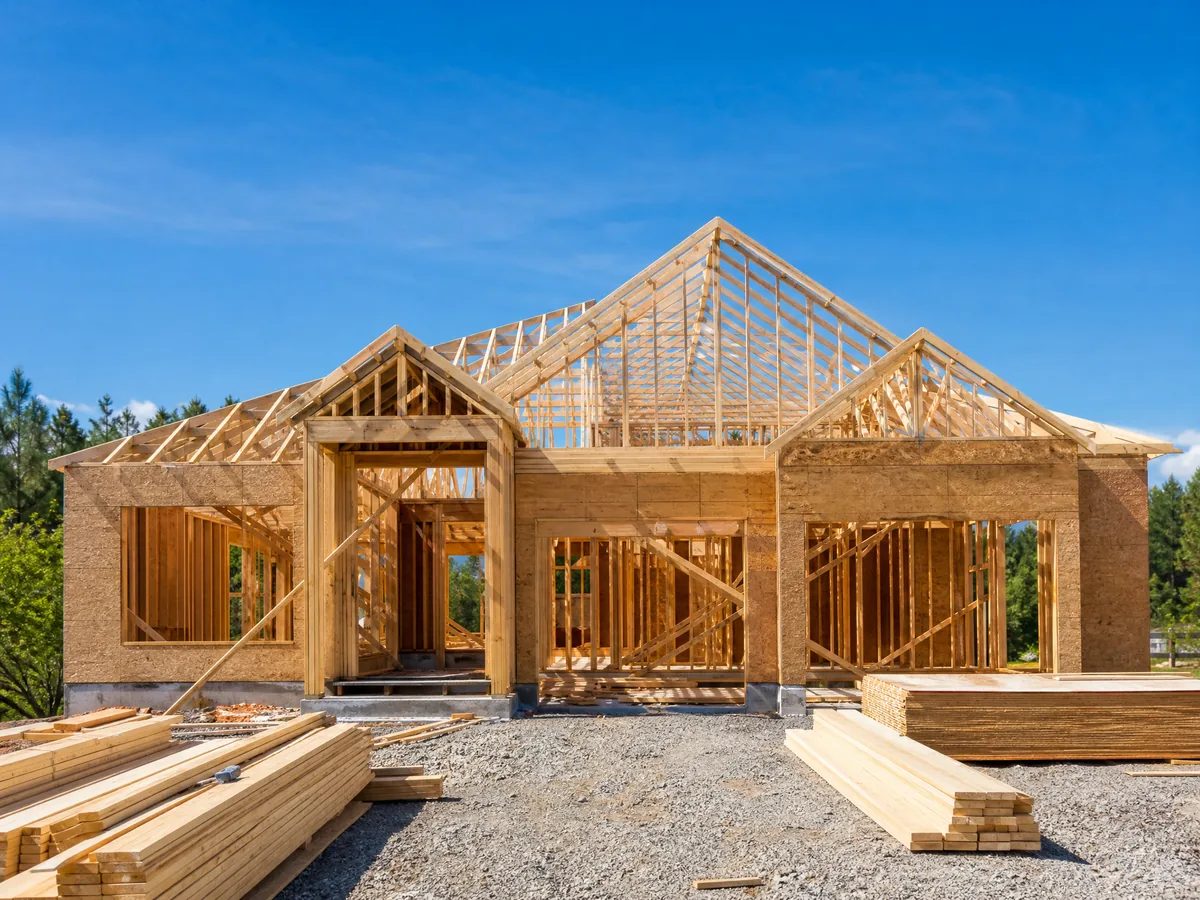
Ground up construction loans that fund Fort Collins new builds.
Built for spec home builders and developers. We fund the land and the vertical build up to 70% LTV and 85% of cost, with draws that keep pace with the job. In Larimer County the water tap fee often outweighs the building permit, and it depends on which of three water providers serves your lot. Business-purpose only, and every structure is set in underwriting.
Typical figures, subject to underwriting and market conditions. Not a commitment to lend.
How it works
We finance both the land and the vertical construction, with a draw schedule built around your timeline. Experienced builders can access higher leverage on cost.
What does the water tap fee cost on a Fort Collins area building lot, and why does it matter more than the permit fee?
On a Fort Collins-Loveland Water District lot, budget $55,685 to $113,285 for the water tap alone, well ahead of the building permit line. FCLWD's 2026 schedule prices raw water at $120,000 per firm acre-foot plus a $37,175 base plant investment fee, and the required acre-feet scale with the lot's irrigable size, from a 0.15 acre-foot conservation tap up to 0.63 acre-feet on lots over 11,000 square feet. Choosing the conservation tap, which trades a recorded deed restriction against outdoor potable watering for a smaller required allocation, can save tens of thousands of dollars on the same lot. Size the water tap into your construction budget before you size the permit.
My lot has a Fort Collins mailing address. Does that mean Fort Collins Utilities sets my water tap cost?
Not necessarily, and the difference is real money. A single Fort Collins area address can sit inside any of three separate water providers: City of Fort Collins Utilities, East Larimer County Water District (ELCO), or Fort Collins-Loveland Water District (FCLWD), each with its own fee schedule. The city's own 2025 Water Supply Requirement cash-in-lieu rate ran $63,800 per acre-foot against FCLWD's $120,000 per acre-foot, a large gap on the same size lot. Confirm which provider actually serves the parcel before you set a construction budget line, not after.
I'm holding a vacant Larimer County lot before I break ground. What property tax rate applies while it sits empty?
An unimproved residential lot is taxed at the 27% non-residential assessment rate, not the lower residential rate. That is a real carry line most out-of-state builders miss. Colorado's residential rate splits into 7.05% against school mills and 6.25% against every other local mill, but a vacant lot held for a future build gets none of that: it assesses at the same 27% rate as commercial property. On a Fort Collins parcel carrying the certified core mill stack of roughly 96 mills, that difference shows up every year the lot sits unimproved, before the first foundation is poured.
I'm building inside a Larimer County metro district. How much can that add to my carrying costs versus building inside Fort Collins city limits?
A lot inside a metro district can carry a tax bill double what the same value pays under the plain city and county stack. The ring towns around Fort Collins are full of them. Larimer County's metro districts certified $50.9 million in property tax revenue in tax year 2024, nearly as much as every city and town in the county combined. Individual district levies run from single digits up past 100 mills, so a 60-mill district adds roughly $1,875 a year to a $500,000 property's carrying cost, and a district near 100 mills adds more than $3,200. Pull the parcel's actual tax area from the county assessor before you size the deal; a listing sheet will not show it.
Fort Collins used to cap unrelated roommates at three. Does that change what I should build near CSU?
That cap is gone, and the change is recent enough that a lot of comp sets still assume it applies. A 2024 state law preempted local occupancy limits based on familial relationship, and Fort Collins repealed its own three-unrelated-adult rule the same year. The binding constraints on a new build now are building and fire code, bedroom egress, and off-street parking, not a headcount cap, which opens up legitimate by-the-bedroom build-to-rent product near a campus that hit an all-time enrollment high in fall 2025. That kind of build can pair with a DSCR rental loan once construction wraps.
If my lot gets reassessed while I'm building, when do I find out and what can I do about it?
Later than you'd expect: Larimer County runs its own protest calendar and mails determinations in mid-August, six weeks after most Colorado counties. Larimer uses the state's alternate protest procedure, so its 2025 appeal window ran from May 1 to June 9 but Notices of Determination did not go out until August 15. From there the next stop is the County Board of Equalization, and an owner who disagrees with that decision has 30 days to escalate to the State Board of Assessment Appeals, binding arbitration, or district court. An investor holding a construction lot gets no owner-occupant exemption to fall back on, so the appeal window is the only lever if a reassessment lands hard.
How much of a Fort Collins build do I have to fund myself?
Budget roughly 15% of total cost, and check it against the value test too. We fund up to 85% of cost and up to 70% LTV, whichever binds first. On a $1,000,000 all-in Fort Collins project that is up to $850,000 from us and $150,000 from you (1,000,000 x 85% = 850,000). The line most out-of-state builders leave out of that cost number is the water tap, which on a Fort Collins-Loveland Water District lot runs from about $55,685 to $113,285 depending on lot size. Put the tap fee in the budget before you set your equity. Subject to underwriting.
Does my building track record change leverage on a Fort Collins ground up loan?
Yes. Experienced builders can access higher leverage. A first build is not a decline, it just sits closer to the conservative end of the range, and the ceilings are the same either way: up to 70% LTV, up to 85% of cost, up to $5 million, on a 12 to 24 month term with draws released against the build schedule. Bring your completed projects, your builder, and the schedule to the first call. Subject to underwriting.
Is there a minimum credit score to build in Fort Collins?
No, there is no minimum score on this program. A construction loan qualifies off the land, the build cost and the finished value, so credit carries far less weight than it would at a bank. Where it is weak, we normally answer with lower leverage rather than a decline, which on a Fort Collins build means more of the cost stack, tap fee included, comes from you. There is no hard credit pull to start. Subject to underwriting.
More Ground-Up Construction questions, answered on the program page
Local rules move. Every tax rate, fee, ordinance and market figure here comes from a primary source and carries the date we read it, and we correct them as the rules change. Where a number is mid-change or we could not verify it, we say so rather than guess. Before you commit a budget, confirm anything that drives it with the city or county, and talk to your attorney or CPA on questions of law or tax.
Published by USA Mortgage Funding, LLC, NMLS #152588. Researched from primary sources by our team, drafted with AI assistance, and every figure checked against its source before publishing. Where an answer rests on a public record, that record is linked under it. Figures read on 2026-08-15.
Funding Fort Collins deals fast.
Get real terms, usually same day. No obligation, no hard credit pull to start.