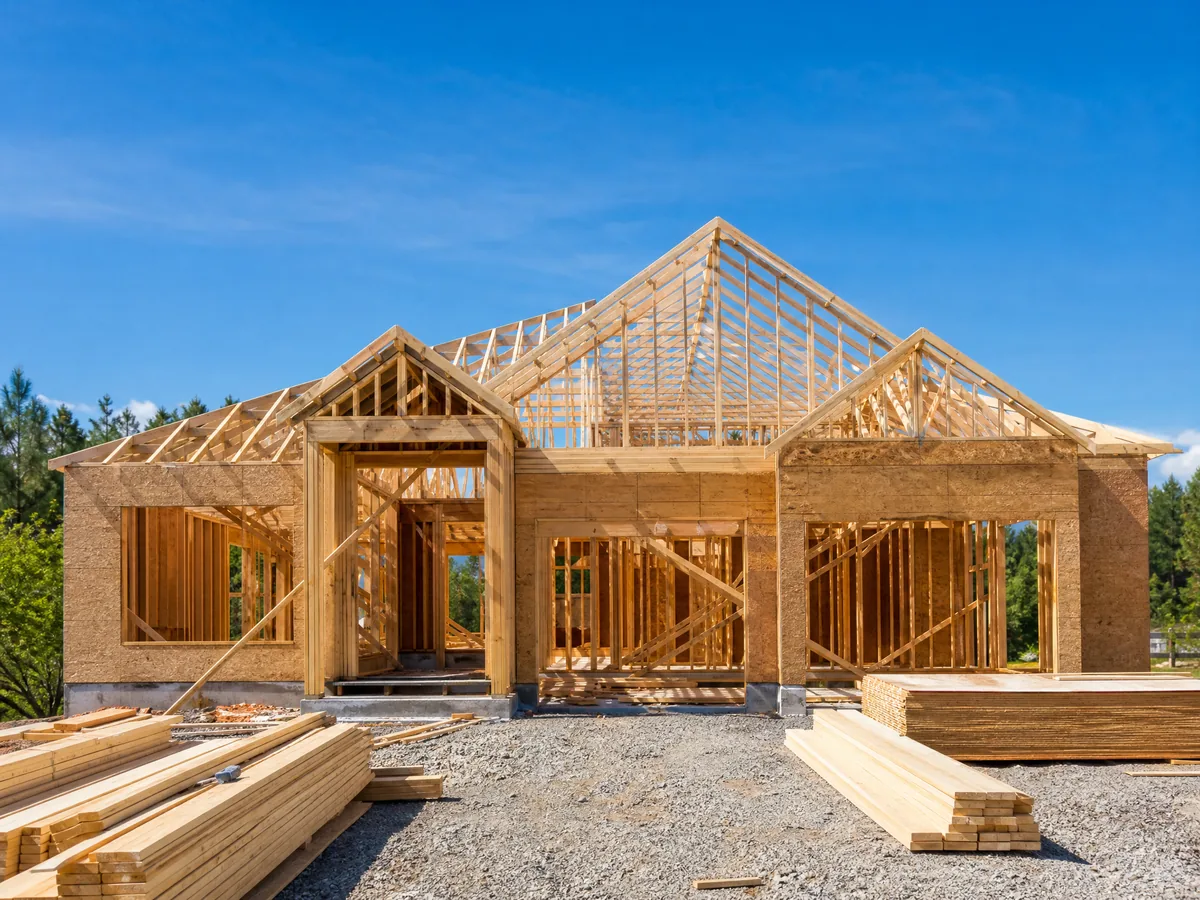
Ground up construction loans built for Oklahoma City job sites.
Built for spec home builders and developers. We fund the land and the vertical build up to 70% LTV and 85% of cost, with draws that keep pace with the job. Oklahoma City codifies its permit fee, and impact fees turn on which of four assessment areas the lot falls in. Business-purpose only, and every structure is set in underwriting.
Typical figures, subject to underwriting and market conditions. Not a commitment to lend.
How it works
We finance both the land and the vertical construction, with a draw schedule built around your timeline. Experienced builders can access higher leverage on cost.
Ground-Up Construction in Oklahoma City, answered.
What does Oklahoma City charge for a building permit on a new build?
$0.16 per square foot on a new residential building, $0.28 on commercial or office, $0.19 on a warehouse, with a $75.00 minimum permit fee. Those are not expediter estimates. They are set in Chapter 60 of the Oklahoma City Municipal Code, the city's General Schedule of Fees, so you can check them against the code yourself. A 2,000 square foot house is 2,000 x $0.16 = $320; a 20,000 square foot commercial building is 20,000 x $0.28 = $5,600. Trade permits are separate and priced line by line: residential new construction electrical runs a $175.00 base for 240-volt single phase service up to 200 amps, plus $50.00 for each additional 100 amps and $50.00 each for the rough and the final inspection, and residential plumbing starts at $83.00 with $28.50 for each bathroom past the first. Annual contractor registration is $100.00 per trade, and the city adds a 2.7% service fee to nearly every one of these charges if you pay by card.
Do I pay a plan review fee on a single-family build, and what else gates the permit?
No plan review fee on a house. The code says those fees do not apply to one- and two-family or city-owned buildings. On everything else, review of plans submitted with the application is 50% of the total building permit fee, capped at $2,750.00; it is not refundable, but it credits against the permit fee with the balance due at issuance. Review of plans before you file is $150.00 as of 2026-07-01, and a pre-construction meeting with the general contractor is $500.00. The $2,750.00 cap only begins to bind once the permit fee itself passes $5,500.00, which at the $0.28 commercial rate is about 19,600 square feet. The real gate on a residential permit is insurance: Municipal Code section 12-199 requires the applicant to file a certificate of insurance showing general liability at the level required of Construction Industries Board trade contractors plus workers compensation cover or a verified exemption, and each such contractor to register annually with the Supervisor of Licenses. Line that up before you plan a permit date. Oklahoma City does not publish a review turnaround, so do not put a day count from a blog into your carry.
How do Oklahoma City's development impact fees work on a new build?
Two fees, both charged on new square footage on top of the permit fee, and both escalated every July 1. Oklahoma City charges a streets development fee that varies by land use category and by which of four assessment areas the parcel sits in, Core, Infill, New Growth or Rural, plus a parks development fee that applies to residential development only. The same house pays a lower streets rate in the Core than in New Growth or Rural. The code fixes a base rate for each, then multiplies it every July 1 by the Engineering News Record Twenty City Average Construction Cost Index against a 2015 base, so the base rates written into the code are not what you will be billed, and we are not going to print a current dollar figure we cannot stand behind. Run the parcel through the city's impact fee calculator, or have your closer pull it, before you size the budget. Two mechanics worth knowing: the fee is due at building permit issuance, and if payment is deferred to certificate of occupancy it is calculated at the rate prevailing then, which is a live carry risk on a long build. Removing an existing permitted building can generate a demolition credit computed on the prior legal conforming use, with no refund where the credit exceeds the new fee. The assessment area maps are on file with the City Clerk and they control, so the parcel has to be looked up rather than guessed.
How much new construction is the metro absorbing, and where is it going?
The Oklahoma City metro authorized 8,218 housing units by building permit in calendar 2025, up 19.2% from 6,896 in 2024. 6,387 of those were single-family, up 8.6% year over year, and 1,241 were in buildings of five units or more. The figure a builder should sit with: the average declared construction value on a metro single-family permit in 2025 was $298,233, which is $1.90 billion of declared value across 6,387 permits. That is a permit-declared construction cost, not a sale price and not an appraised value, and in a non-disclosure state where sale prices never hit the public record it is one of the few construction cost datapoints that is genuinely public. Treat it as a sanity check on a budget, not a substitute for your own bids. On where the units land, Canadian County (Yukon, Mustang, Piedmont) grew 7.8% from 2020 to 2024 and took 3,056 net domestic movers in 2024 on a base of 155,833, more than double Oklahoma County's rate, and Mustang and Yukon carry two of the highest observed rents in the metro's city-level data as of June 2026. If the exit is a build-to-rent hold, our DSCR rental loan is the natural refinance once the certificate of occupancy is in hand.
Does building in a floodplain overlay slow down an Oklahoma City permit?
Yes, it routes the job into a longer plan review, and there's now a real fee attached to it. Oklahoma City's permitting process runs a separate review track for any site inside a FEMA floodplain overlay zone, on top of the standard building permit review. The code sets a dedicated floodplain activity permit fee of $100.00, on top of the building permit and any trade permits. Check whether the parcel sits in an overlay zone before you set a start date, since the city doesn't publish a standard review turnaround and a floodplain site adds a step the schedule has to absorb. This is separate from the streets and parks impact fees above, and it applies regardless of whether the lot is residential or commercial.
How should I structure the construction mortgage to avoid an Oklahoma tax trap?
State a maximum loan amount on the instrument. Under Oklahoma's mortgage registration tax statute, if the principal secured isn't determinable from the mortgage itself, the county treasurer taxes the mortgage on the full value of the property instead, unless the owner files a sworn statement of the maximum amount secured. An open-ended construction line or draw facility with no stated ceiling is a real, avoidable tax hazard here, not a technicality. The upside: Oklahoma's mortgage tax is scaled to loan term, so a mortgage under two years is taxed at a fraction of what a 30-year mortgage pays, which works in favor of a 12 to 24 month construction loan once the maximum is properly stated.
How much of an Oklahoma City build do I have to fund myself?
Roughly 15% of total project cost, and the land is part of that math. We fund up to 70% LTV and up to 85% of cost, with draws released against the build schedule rather than paid up front. On a $500,000 Oklahoma City project, lot plus vertical, that is up to $425,000 from us and $75,000 from you (500,000 x 85% = 425,000), and the lower of the two tests governs. Put the soft costs in your number before you size the equity: the permit runs $0.16 per square foot on a new residential building with a $75.00 minimum, trade permits are priced separately, and the streets and parks development fees are billed on new square footage at issuance. Subject to underwriting.
What credit score do I need for a ground up construction loan in Oklahoma City?
There is no minimum score on this program. We run credit, but a construction loan is asset-based, so it carries far less weight than it would at a bank. What moves the file is the lot, the budget, the schedule, and your track record: experienced builders can access higher leverage, up to 70% LTV and 85% of cost. A thinner credit file is usually offset with lower leverage rather than a decline, and there is no hard pull to start the conversation. Subject to underwriting.
How large can an Oklahoma City construction loan get, and how long is the term?
Up to $5 million, on a 12 to 24 month term. That covers most of what actually gets built here. The average declared construction value on a metro single-family permit in 2025 was $298,233 across 6,387 permits, so a typical Oklahoma City spec house sits well inside the program and the ceiling is the constraint only on a multi-lot or larger commercial build. Draws follow the build schedule, and the loan is written for spec or build-to-rent. If the exit is a hold, our DSCR rental loan is the refinance once the certificate of occupancy is in hand. Subject to underwriting.
Local rules move. Every tax rate, fee, ordinance and market figure here comes from a primary source and carries the date we read it, and we correct them as the rules change. Where a number is mid-change or we could not verify it, we say so rather than guess. Before you commit a budget, confirm anything that drives it with the city or county, and talk to your attorney or CPA on questions of law or tax.
Published by USA Mortgage Funding, LLC, NMLS #152588. Researched from primary sources by our team, drafted with AI assistance, and every figure checked against its source before publishing. Where an answer rests on a public record, that record is linked under it. Figures read on 2026-08-13.
Funding Oklahoma City deals fast.
Get real terms, usually same day. No obligation, no hard credit pull to start.