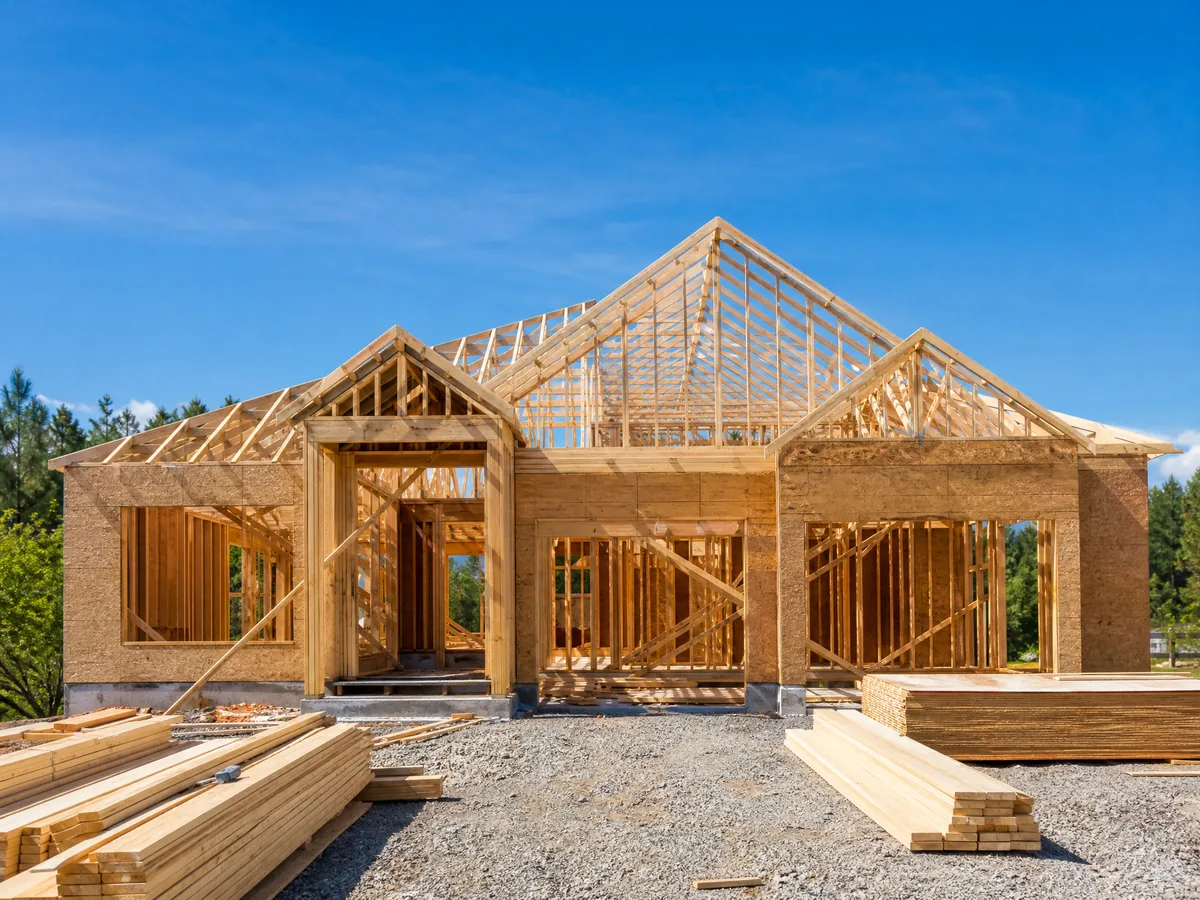
Ground up construction loans for Texas builders, dirt to finish.
Built for spec home builders and developers. We fund the land and the vertical build up to 70% LTV and 85% of cost, with draws that keep pace with the job. Across Texas the entitlement volume is there, and the constraint on a spec build is absorption rather than approvals. Business-purpose only, and every structure is set in underwriting.
Typical figures, subject to underwriting and market conditions. Not a commitment to lend.
How it works
We finance both the land and the vertical construction, with a draw schedule built around your timeline. Experienced builders can access higher leverage on cost.
Texas leads the country in permits. What does that actually tell me?
It tells you the state builds at scale, not that 2025 was a good year. Texas issued 140,002 single-family permits in 2025, the most of any state and roughly 15.4% of the 909,280 issued nationwide. That count was down 11.7% year over year, and the pullback was regional rather than a Texas problem: Florida, second by volume, fell 10.3%, and North Carolina, third, fell 6.9%. Builder appetite is not the bottleneck here. Absorption and rate are. If you want the count for your own county or metro rather than the state, the Texas Real Estate Research Center at Texas A&M republishes the Census Building Permits Survey monthly, on the 17th workday, and that is the number we will look at when we size your term.
Is the population growth story still holding up behind a Texas spec build?
Yes on headcount, but the growth is slowing and the mix has changed. Texas added 391,243 residents in 2025, the largest numeric gain of any state, reaching roughly 31.7 million. The rate of growth, 1.2%, was the slowest since 2021, and Texas ranked 4th by percentage growth even while ranking 1st by headcount. Underneath that: natural increase of 157,111, domestic in-migration of 67,299, and international migration of 167,475, which was down 48% from 319,569 the year before. So the demand is real and it is still the biggest absolute pool of new households in the country, but a pro forma that assumes last decade's pace is optimistic. Underwrite the absorption you can defend in your submarket.
How should I underwrite the resale exit on a Texas spec home?
Plan for a slow, flat market and comp to your submarket, not to the state. As of Q2 2026 the statewide median sale price was $340,000, unchanged year over year, on 99,688 closed sales, up 4.5%. Inventory was 5.4 months and homes averaged 65 days on market, 3 days longer than a year earlier. The state number is flat because prices rose in 14 Texas metros and fell in 11, with one flat, and the four largest metros each fell by less than 1.5% while the biggest gains came from smaller markets like Texarkana and Abilene. That means the statewide median is close to useless as a proxy for your deal. Our construction terms run 12 to 24 months, and on a Texas spec we would rather set the term long enough to sell into a 65-day market than have you buy an extension.
What do Texas property taxes do to carry while the house is going up?
Texas trades income tax for property tax, and a build in progress gets none of the homeowner relief. There is no state individual income tax, and the effective property tax rate on housing value runs about 1.2% to 1.4% depending on the county. That is a fixed, non-discretionary line on every month of your carry, and it is set locally rather than at the state level. The 2025 relief package does not reach you: SB 4 raised the mandatory school district homestead exemption from $100,000 to $140,000, approved by voters as Proposition 13 in November 2025 for the 2026 tax year, and SB 23 raised the additional exemption for owners 65 and older or disabled, but homestead exemptions apply to owner-occupants. A spec house is not a homestead, so it gets no exemption and no 10% homestead appraisal cap. With 254 counties and 254 appraisal districts, pull the actual rate for the parcel before you set the budget, and take the tax planning to your CPA.
How much should I budget for insurance during construction in Texas?
More than you did a few years ago. Texas insurance is a real carry line, not a rounding error. Average Texas homeowners premiums rose more than 55% between 2019 and 2024, and the average rate changes filed with the Texas Department of Insurance were 11% in 2022, 21% in 2023, 19% in 2024 and 4.3% in 2025. Builder's risk and vacant-dwelling coverage price off the same market. Get a real quote for the specific parcel before you lock your budget rather than carrying a placeholder from an older deal, because we will underwrite the carry you can actually document.
Anything unusual about closing a construction loan in Texas?
Two things: your title premium is set by the state, and your completed-value appraisal carries more weight than it would elsewhere. The Texas Insurance Commissioner is required by statute to fix and promulgate title insurance premium rates, and Order No. 2025-9697 cut basic premium rates 6.2% effective March 1, 2026. The premium on a given policy amount is identical at every title company in Texas, so there is nothing to shop there. Competition is on escrow service, endorsements, and closing-fee items. Separately, Texas is a non-disclosure state: no statute compels reporting a sale price to the county appraisal district, and prices are not recorded on deeds. Off-market and non-MLS comps are genuinely harder to source here, which puts more load on the appraisal supporting your completed value. Bring us a plan set and a budget that an appraiser can actually work from.
How much of a Texas ground up build do I have to fund myself?
About 15% of cost, and the land counts toward it. We fund up to 85% of total cost and up to 70% of completed value, whichever binds first. On a Texas build with land and vertical costs of $600,000, that is up to $510,000 from us and $90,000 from you (600,000 x 85% = 510,000), with the vertical money drawn on the build schedule instead of advanced at closing. Loans run up to $5,000,000 on a 12 to 24 month term. Subject to underwriting.
Do you check credit on a Texas construction loan?
We run it, but there is no minimum score on this program. Construction is asset-based, so the plan set, the budget, the completed value, and your equity carry the file. Weak credit is normally answered with lower leverage rather than a decline, and there is no hard pull to start. You will not be asked for W-2s or pay stubs either. Texas is a non-disclosure state, so expect the completed-value appraisal to carry far more weight than the credit report. Subject to underwriting.
Do I have to be an experienced builder to borrow on a Texas spec?
No, but experience buys leverage. Experienced builders can access higher leverage inside the 70% LTV and 85% LTC caps. A first build gets underwritten harder on the plan set, the budget, and the general contractor, and it usually prices at a lower advance. Texas issues more single-family permits than any other state, so the trade competition on your job is real and the schedule you hand us has to be one an appraiser can work from. Subject to underwriting.
Local rules move. Every tax rate, fee, ordinance and market figure here comes from a primary source and carries the date we read it, and we correct them as the rules change. Where a number is mid-change or we could not verify it, we say so rather than guess. Before you commit a budget, confirm anything that drives it with the city or county, and talk to your attorney or CPA on questions of law or tax.
Published by USA Mortgage Funding, LLC, NMLS #152588. Researched from primary sources by our team, drafted with AI assistance, and every figure checked against its source before publishing. Where an answer rests on a public record, that record is linked under it. Figures read on 2026-08-12.
Funding Texas deals fast.
Get real terms, usually same day. No obligation, no hard credit pull to start.