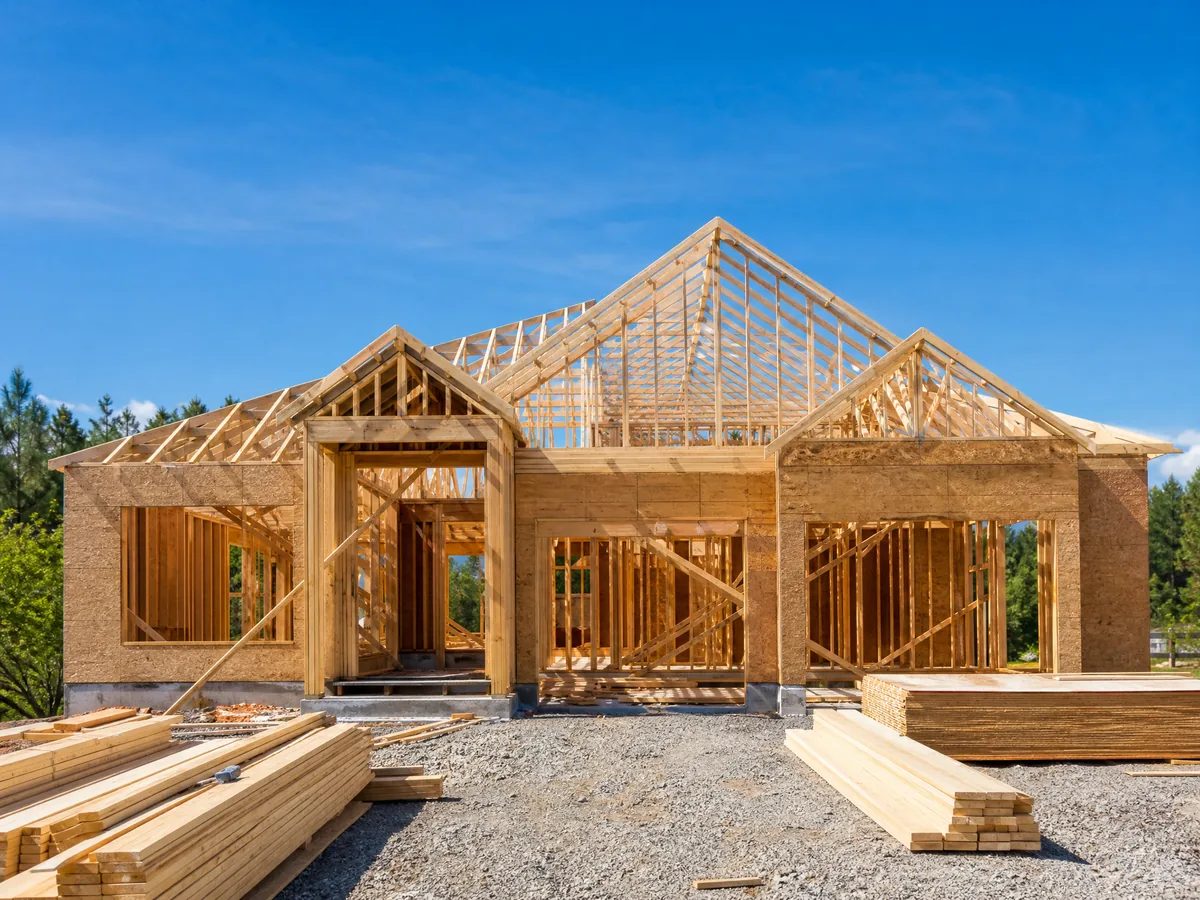
Ground up construction loans built for Yakima County lot buyers.
Ground-up construction financing for Yakima County spec builders and developers, up to 70% LTV and up to 85% of cost, with draws sized to your build schedule. Yakima County authorized 713 new privately-owned housing units in 2025, a thin pipeline against a quarter-million residents, so a well-priced lot doesn't sit long. Washington charges retail sales tax on the full construction contract, not just materials, and we underwrite that cost into your draw schedule from the start. Business-purpose only, and terms are set in underwriting.
Typical figures, subject to underwriting and market conditions. Not a commitment to lend.
How it works
We finance both the land and the vertical construction, with a draw schedule built around your timeline. Experienced builders can access higher leverage on cost.
What will a building permit actually cost on a Yakima County spec build?
Plan on roughly $4,600 all-in for a $350,000-valuation house in unincorporated Yakima County, and somewhat less inside the city. Yakima County's fee table runs $1,162.75 plus $6.50 per additional $1,000 above $100,000, which works out to $2,787.75 on a $350,000 valuation, plus plan review at 65% of that fee ($1,812.04), for $4,599.79 before mechanical, plumbing, or any grading and floodplain fees. The City of Yakima's own 2026 schedule, in force since June 1, 2026, prices the same valuation at $2,227.38 in permit fee, $1,447.80 in plan review, and a 4% technology fee of $147.01, for $3,822.19, about 17% less than the county on the identical valuation. The city sets valuation from ICC per-square-foot tables by occupancy and construction type, not from your actual budget, so confirm the number with Code Administration before you lock a line item.
Does Washington sales tax hit my construction contract, or just the materials?
The whole contract, labor included, and the rate depends on where the lot sits. Washington's Department of Revenue is explicit: a speculative builder is "the consumer of all material incorporated into the real estate," and any contractor working for that builder "must charge sales tax on the total contract price." The combined rate runs 8.60% inside the City of Yakima and 8.20% in unincorporated Yakima County, Grandview, Moxee, Zillah, and Wapato, as of the fourth quarter of 2026. On a $350,000 build that's roughly $28,700 to $30,100 in sales tax depending on jurisdiction, a $1,400 spread on the same contract. Sales tax rates move quarterly, so re-check the current rate before you finalize a construction budget.
I'm buying farmland in the valley to build on. Do I owe back taxes for taking it out of production?
Likely yes, if the parcel carries the county's current-use classification, and it's worth checking before you close. Yakima County Assessor's own 2026 booklet describes RCW 84.34 current-use farm classification, under which land is valued at its in-use value rather than market value, and states plainly that "if there is a change in use or a new owner does not wish to assume the liability an additional tax will be assessed" on the gap between the current-use tax paid and full market-value tax. Nearly 7,700 parcels in the county carry this classification, so it's a live cost on real deals here, not a theoretical one. Confirm the parcel's current-use status and any recapture exposure with the Assessor's office before you close on a build lot cut from ag ground.
Does it matter which part of Yakima County I buy my lot in?
It moves both your carrying cost and your building code, and the two don't move together. The county's 2026 tax stacks range from 0.54% to 1.00% of assessed value depending on tax code area: Union Gap runs 7.51897 per $1,000 while unincorporated land in the Naches school area runs 10.01312, a real gap on a build you'll carry for a year or more. Separately, Yakima County has adopted the International Wildland-Urban Interface Code, which the county's own page says exists to "safeguard life and property" and requires owners to maintain defensible space, and that code applies to the timbered and rangeland fringe around Naches, Tieton, Cowiche, and Ahtanum, not the irrigated valley floor around Yakima, Union Gap, Sunnyside, Toppenish, and Grandview. The county's own page on that code names no edition, no adopting ordinance, and no construction requirements, so confirm both the tax code area and the wildfire code status with the county before you commit to a lot.
Do I need to worry about water rights if I'm building on an irrigated lot?
Yes, and in this basin the answer is actually on paper. The Yakima River Basin is the only watershed in Washington with a completed general stream adjudication: the Yakima County Superior Court entered a final decree on May 9, 2019, after a case that ran 42 years, determining roughly 2,300 water rights that the state confirms are "appurtenant to the land." That makes a water right an appraisable, priority-dated piece of collateral on irrigated ground, and its absence or a junior priority date is a value problem a comparable city lot won't share. Even senior rights weren't immune: the Sunnyside Valley Irrigation District reports Washington curtailed senior diverters starting October 6, 2025, the earliest cutoff in over 30 years. Confirm the adjudicated certificate in title before you buy any irrigated acreage to build on. The same adjudicated water right is a collateral question on an irrigated commercial parcel too, which is what our Yakima CRE bridge loans underwrite.
How much of a Yakima build do I have to fund myself?
At least 15% of cost, and often more once the land is priced in. We go up to 85% of cost and up to 70% LTV, whichever binds first. On a $1,000,000 total project cost that is up to $850,000 from us and $150,000 from you (1,000,000 x 85% = 850,000), released in draws against your build schedule rather than in one advance. Washington charges sales tax on the full construction contract, labor included, so a cost figure quoted net of tax understates both the budget and every draw against it. Subject to underwriting.
I have only built one spec house in Yakima. Does that cap my leverage, and does credit decide it?
Experience moves leverage. Credit mostly does not.Experienced builders can access higher leverage inside the same 70% LTV and 85% of cost ceilings, so a lighter track record usually means a smaller advance rather than a decline. On an asset-based construction loan there is no minimum credit score. We run credit, but it carries far less weight than at a bank, and there is no hard credit pull to start. The lot, the budget and the finished value carry the file. Subject to underwriting.
How long is the term on a Yakima construction loan, and what if permitting runs long?
12 to 24 months, with draws sized to the build schedule. Pick the term against a realistic permit timeline rather than an optimistic one. Neither the City of Yakima nor Yakima County publishes a plan review turnaround time, so the permit line belongs in your schedule as an unknown, not a fixed number of days. Build that slack into the term you ask for at the front end instead of asking for it late. Subject to underwriting.
More Ground-Up Construction questions, answered on the program page
Local rules move. Every tax rate, fee, ordinance and market figure here comes from a primary source and carries the date we read it, and we correct them as the rules change. Where a number is mid-change or we could not verify it, we say so rather than guess. Before you commit a budget, confirm anything that drives it with the city or county, and talk to your attorney or CPA on questions of law or tax.
Published by USA Mortgage Funding, LLC, NMLS #152588. Researched from primary sources by our team, drafted with AI assistance, and every figure checked against its source before publishing. Where an answer rests on a public record, that record is linked under it. Figures read on 2026-08-21.
Funding Yakima deals fast.
Get real terms, usually same day. No obligation, no hard credit pull to start.