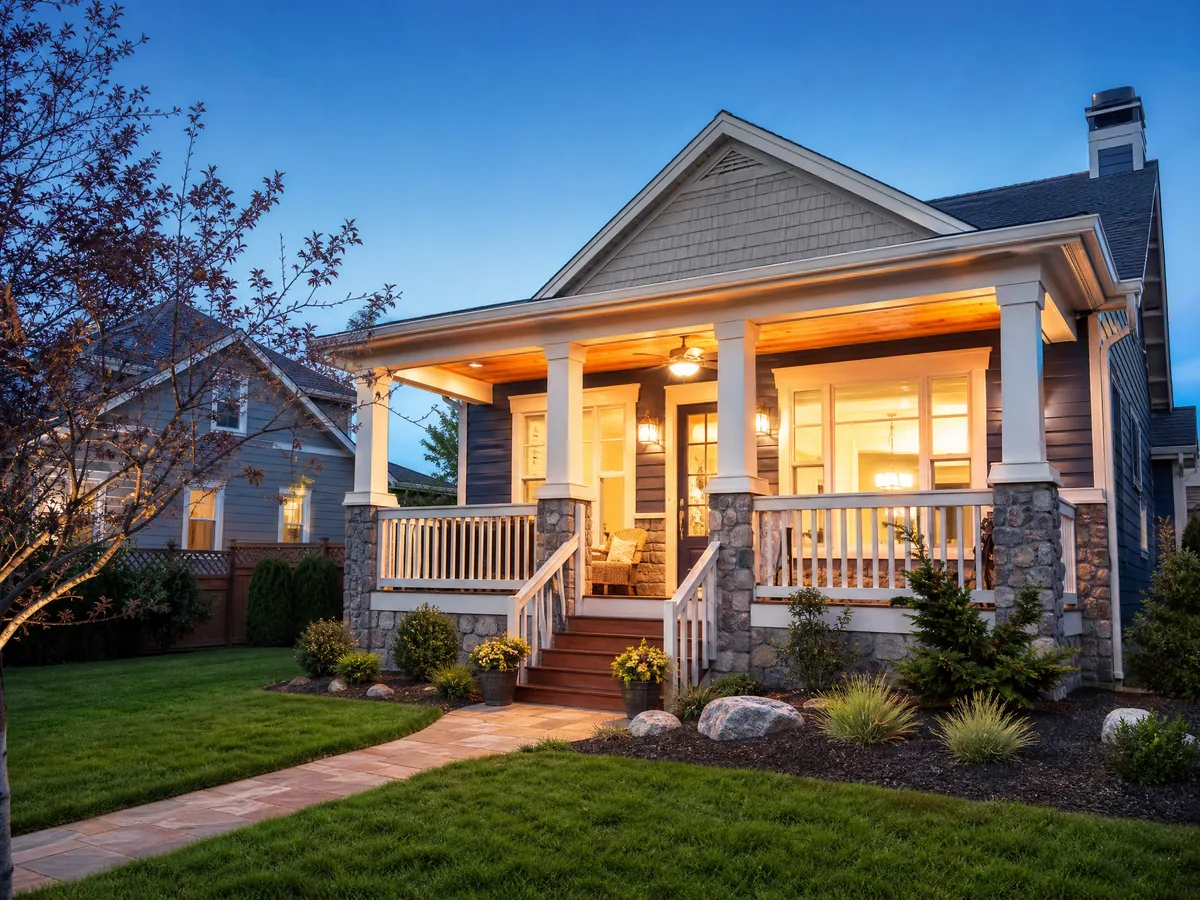
Charlotte landlords finance rentals with DSCR loans on cash flow.
Hold your rentals with financing that underwrites the asset, not just you. DSCR as low as 0.75, rates from 5.5% interest-only, and 30-year fixed options for single properties or whole portfolios. Charlotte's job base is broad and still growing, with banking as one strong anchor among several, and Mecklenburg resets every assessed value on January 1, 2027. Business-purpose only, and rates and structure are set in underwriting.
Typical figures, subject to underwriting and market conditions. Not a commitment to lend.
How it works
No tax returns or personal income docs in most cases. We qualify on the property's cash flow, so you can scale your portfolio without the paperwork drag of conventional lending.
Charlotte gets called a banking town. Is the rental demand really that concentrated?
No, and that is the good news for a DSCR hold. Financial activities employment in the metro reached 127,890 jobs in June 2026, up 1.2% year over year and up 24.8% from 102,448 in June 2019, so it is a genuine, growing anchor. But it is one of several: trade and transport plus professional and business services together employ roughly four times what financial activities does, and total nonfarm employment sits at 1,401,400 jobs with unemployment at 3.7%. The rental base you are underwriting is a broad, diversified labor market that happens to have a strong finance sector, not a single-employer town.
Why does Mecklenburg County's property tax revaluation cycle matter for a DSCR hold?
Because your tax line does not drift, it steps. Mecklenburg reappraises every four years, not annually: the last revaluation was 2023 and the next is 2027, with values set as of January 1. Between revaluations the county carries the prior value forward and only changes it for specific reasons under state law, one of which is a permitted remodel on your own property. Today's combined rate inside the City of Charlotte is 0.7857 per $100 of assessed value (county 0.4927 plus city 0.2930), so a $400,000 assessment pays about $3,142.80 a year before fees. Underwrite a multi-year hold expecting a single January reset, not a gradual increase.
Charlotte's construction pipeline gets a lot of attention. Does new rental supply threaten rent growth?
Less than the headlines suggest, because the pipeline is contracting. Charlotte permitted 21,135 housing units in 2025, down 18% from 25,837 in 2024 and down 29% from the 2023 peak of 29,695. The pullback is steeper on the detached side: single-family permits fell 24.8% in the first half of 2026 versus the first half of 2025. Against that thinning supply, single-family rent (Zillow Observed Rent Index) grew 2.4% year over year through June 2026 while the all-property-type rent index grew only 0.5%, the pattern you would expect when detached-rental stock is tight relative to multifamily delivery. A borrower financing new construction into that gap can size the deal with a ground-up construction loan and convert to a DSCR hold once it leases.
Can I underwrite short-term rental income on a Charlotte DSCR property?
You can operate one, but do not underwrite a permit fee or a registration line that does not exist. Charlotte has no short-term rental permit, license or registry: the adopted Unified Development Ordinance's use table contains no short-term rental use, and state law (NCGS 160D-1207(c)) bars a North Carolina city from requiring one, a reading affirmed in Schroeder v. City of Wilmington (2022). Zoning, building, noise and nuisance codes still apply, along with state and local occupancy and sales taxes. Ignore host-blog references to a 400-foot separation rule or a local-manager requirement; that was draft language floated in 2021 and never adopted into the ordinance that took effect.
How predictable is insurance carry on a Charlotte rental compared to a coastal metro?
More predictable, structurally. North Carolina is a rate-bureau state: the NC Rate Bureau files homeowners rates for every carrier and the Commissioner of Insurance approves or negotiates them, rather than each insurer filing its own rate whenever it wants. The settled 2025 round capped increases at 7.5% on 2025-06-01 and another 7.5% on 2026-06-01, with a 35% cap in any territory and no new Bureau filing before 2027-06-01. Charlotte and Mecklenburg County are roughly 200 miles inland and are not on the eligible-county list for the state's coastal wind pool, so there is no residual-market assessment risk to price the way there is on the coast. Carry math here moves in scheduled, negotiated increments rather than filed-rate churn.
Does Charlotte have rent control or a rental registration requirement I need to underwrite around?
No, and North Carolina bars local governments from adopting either one. NCGS 160D-1207(c) prohibits any city or county from requiring a landlord to obtain a permit or register a rental property, outside a narrow set of violation-based exceptions, and NCGS 42-14.1 separately bars local rent-control ordinances and, since a 2024 amendment, bars a city from compelling a landlord to accept a tenant's federal housing assistance as a condition of renting. An investor coming out of a rental-registration city, Minneapolis, Philadelphia, or much of New Jersey, has no equivalent filing to run here. Note the honest exception: if the property carries city funding or an incentive, a narrow carve-out in the statute may still reach it, so check that before you assume a blanket exemption.
How much do I need to put down on a Charlotte rental with a DSCR loan?
Twenty percent at the top of the range. Max leverage is up to 80% LTV, so on a $400,000 Charlotte purchase that is up to $320,000 from us and $80,000 from you (400,000 x 80% = 320,000). Where a specific file lands inside that range is set in underwriting. Size the cash you need with the tax line in view: inside the City of Charlotte the combined county and city rate is 0.7857 per $100 of assessed value, so a $400,000 assessment carries about $3,142.80 a year before fees, and every Mecklenburg value resets on January 1, 2027. Subject to underwriting.
Does a Charlotte rental have to break even to qualify for a DSCR loan?
No. We go down to a 0.75 DSCR. A 1.0 ratio means the rent covers the payment, taxes and insurance exactly. At 0.75 the property can come up short and still qualify, which matters in Mecklenburg County, where the tax line steps on a fixed date rather than drifting and the next reset lands January 1, 2027. If your hold crosses that date, test your coverage against the post-reset tax number, not today's. Subject to underwriting.
What is the smallest DSCR loan you will write in Charlotte?
$100,000, and the ceiling is $3,000,000. Credit starts at 640 on this program, terms run 30-year fixed or a 5, 7 or 10-year ARM, and prepayment structures are flexible. Most Charlotte-area rentals clear the floor comfortably, since even the metro's cheapest entry points ran just over $280,000 in June 2026, Gastonia at $280,853 and Kannapolis at $284,683. Tell us your expected hold and we will size the term to it. Subject to underwriting.
Local rules move. Every tax rate, fee, ordinance and market figure here comes from a primary source and carries the date we read it, and we correct them as the rules change. Where a number is mid-change or we could not verify it, we say so rather than guess. Before you commit a budget, confirm anything that drives it with the city or county, and talk to your attorney or CPA on questions of law or tax.
Published by USA Mortgage Funding, LLC, NMLS #152588. Researched from primary sources by our team, drafted with AI assistance, and every figure checked against its source before publishing. Where an answer rests on a public record, that record is linked under it. Figures read on 2026-08-13.
Funding Charlotte deals fast.
Get real terms, usually same day. No obligation, no hard credit pull to start.