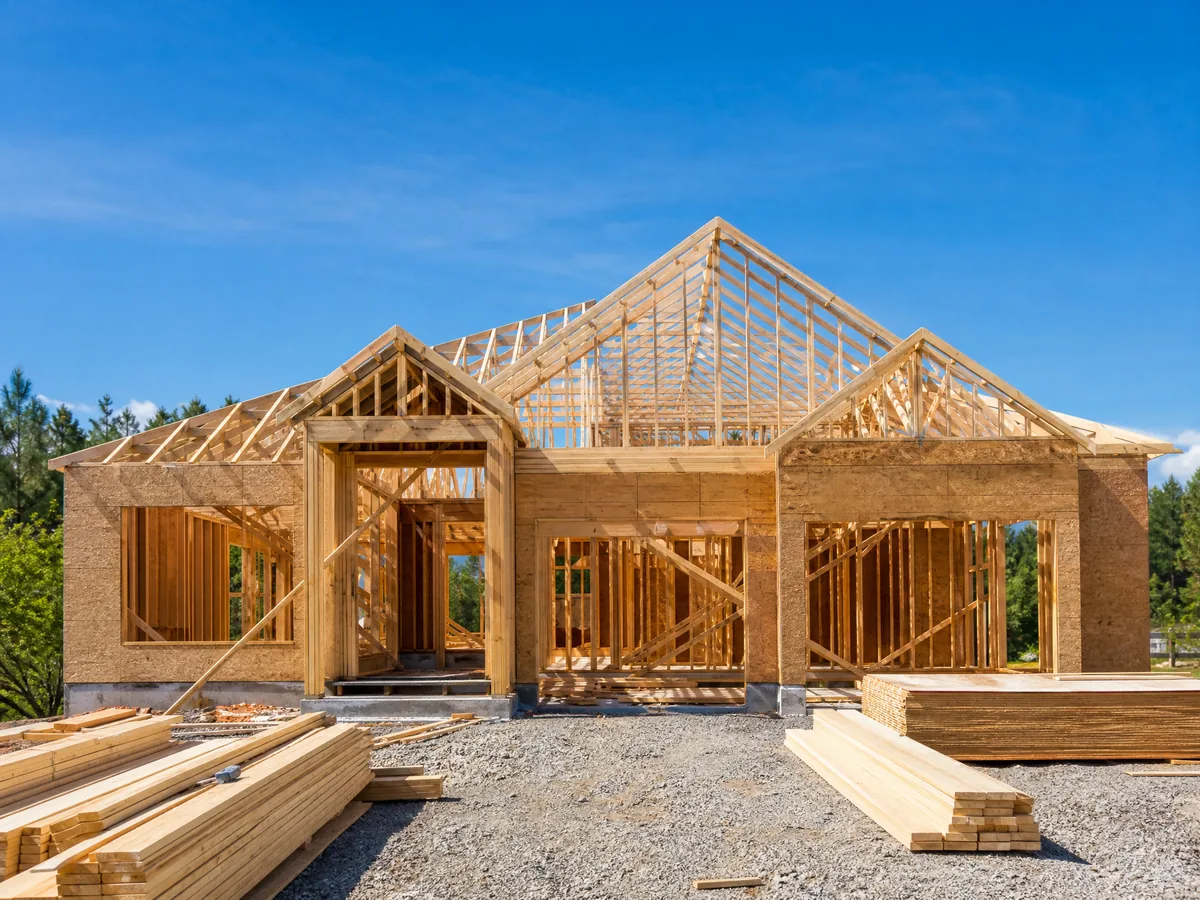
Charlotte builders start from the dirt, ground up construction loans.
Built for spec home builders and developers. We fund the land and the vertical build up to 70% LTV and 85% of cost, with draws that keep pace with the job. Mecklenburg County runs one building department for Charlotte and all six towns, so scattered sites clear one desk. Business-purpose only, and every structure is set in underwriting.
Typical figures, subject to underwriting and market conditions. Not a commitment to lend.
How it works
We finance both the land and the vertical construction, with a draw schedule built around your timeline. Experienced builders can access higher leverage on cost.
What does a Mecklenburg County building permit actually cost for a new house?
On a $300,000 construction permit value, plan on roughly $1,900 in county permit fees plus a separate zoning permit. Mecklenburg's fee ordinance prices a permit in that value band at $1,662.37 plus $5.05 per $1,000 over $250,000, plus a flat technology charge on every permit. That is the county's construction permit only, and a zoning permit is billed on its own schedule; in practice zoning approval comes first and plan review follows. The county uses whichever is higher, your stated construction value or its own valuation data, so you cannot lowball the number to shrink the fee. Run your own numbers through the county's permit fee estimator before you lock a budget, since the county revises the fee schedule and the last revision took effect July 1, 2026.
How fast does plan review actually move in Mecklenburg County?
The county's published goal is an average of 7 days for one and two-family residential review, 12 days for townhouse projects. That is a stated performance goal, not a guarantee, and the county says it varies with submittal volume. Plan review is required for all new one and two-family homes, all townhouse projects, and any renovation that exceeds $175,000 and includes structural modifications, so a heavy rehab or scrape-and-rebuild does not get to skip the queue just because it is not a full new build. Build the review window into your draw schedule rather than assuming the fastest published number.
Will my new build get reassessed before Mecklenburg's next revaluation in 2027?
Yes. Mecklenburg freezes assessed values between revaluations, but state law lets the county update a frozen value mid-cycle for a physical change to the property, and new construction is the clearest example. Practically, that means your finished house gets valued close to what you built, not carried at the vacant lot's 2023 assessment until the next countywide reset. Underwrite the tax line on the completed value, not the pre-construction one, especially if you are holding through 2027, when every other property in the county resets at once.
Does Charlotte zoning support a build-to-rent duplex or triplex, or is that a rezoning fight?
Charlotte's adopted zoning code lists duplexes, triplexes, and quadraplexes as permitted with prescribed conditions across every N1 neighborhood district, plus N2 and several other districts. That makes small-multifamily infill a standard, by-right-with-conditions use across most of the city's residential fabric rather than an exception you have to fight a rezoning case to get. The specific conditions (setbacks, lot size, parking) sit in the ordinance itself, so confirm them for your parcel before you finalize unit count. If your plan is to build and hold as a rental, our DSCR rental loan can take over once the construction loan pays off.
Is Charlotte's new-construction market still running hot?
No, it is pulling back, which is exactly when a builder needs construction debt rather than a bank line. The metro permitted 21,135 housing units in 2025, down 18% from 2024 and down 29% from the 2023 peak of 29,695. The pullback is steeper on detached product: single-family permits fell 24.8% in the first half of 2026 versus the same period in 2025, while total permits (including multifamily) fell only about 10%. At the same time, the metro's single-family rent index rose 2.4% year over year through June 2026 versus 0.5% for all rental types, the kind of gap that favors a build-to-rent exit over a for-sale spec flip right now.
Are county permit fees the only fees I need to budget for a new Charlotte build?
No. Water and sewer connection is billed separately by Charlotte Water and it is the bigger number. Tap and system development fees for domestic water and sewer service on a new house run into five figures on top of whatever the county charges for the building permit, and that bill comes from Charlotte Water, not Mecklenburg County Code Enforcement. Pull the current fee schedule before you finalize a construction budget rather than sizing the utility line off a prior fiscal year's numbers.
How much cash does a Charlotte ground-up build take?
Fifteen percent of cost at the top of the range. We fund up to 85% of cost and up to 70% of LTV, whichever binds first, with draws released against the build schedule. On a $1,000,000 Charlotte project cost that is up to $850,000 from us and $150,000 from you (1,000,000 x 85% = 850,000). Budget the lines that are not the building itself: Mecklenburg permit fees, and Charlotte Water tap and system development fees, which are billed separately by the utility and run into five figures on a new house. Subject to underwriting.
I have only built one or two houses in Charlotte. Does that change my leverage?
It can. The program tops out at up to 70% LTV and 85% LTC, and experienced builders can access higher leverage inside that range. A lighter track record usually means starting lower in the range rather than a decline. Bring plans, budget, subs and schedule to the first call: Mecklenburg's published goal is an average of seven days for one and two-family plan review and twelve for townhouse projects, so a complete submittal is a real part of your draw timeline. Subject to underwriting.
What is the largest Charlotte construction loan you will write?
Up to $5,000,000, on a 12 to 24-month term, for spec or build-to-rent. That covers most single-house and small-scale subdivision work in this metro. Tell us the exit early, because it shapes the file. Charlotte's pipeline is contracting, with single-family permits down 24.8% in the first half of 2026 against the same period in 2025, so a builder starting now delivers into thinner new supply than the 2023 peak. Subject to underwriting.
More Ground-Up Construction questions, answered on the program page
Local rules move. Every tax rate, fee, ordinance and market figure here comes from a primary source and carries the date we read it, and we correct them as the rules change. Where a number is mid-change or we could not verify it, we say so rather than guess. Before you commit a budget, confirm anything that drives it with the city or county, and talk to your attorney or CPA on questions of law or tax.
Published by USA Mortgage Funding, LLC, NMLS #152588. Researched from primary sources by our team, drafted with AI assistance, and every figure checked against its source before publishing. Where an answer rests on a public record, that record is linked under it. Figures read on 2026-08-13.
Funding Charlotte deals fast.
Get real terms, usually same day. No obligation, no hard credit pull to start.