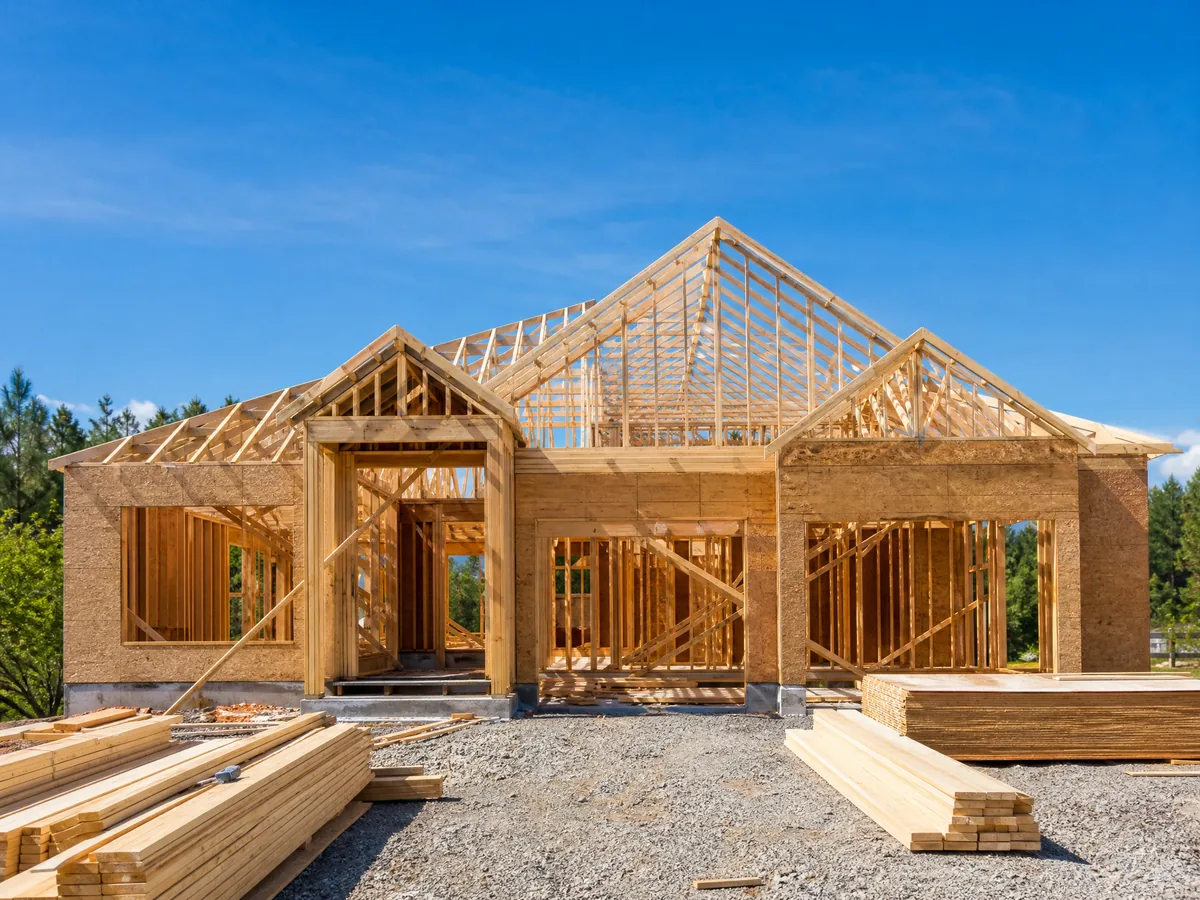
Raleigh ground up construction loans, from the first shovel.
Built for spec home builders and developers. We fund the land and the vertical build up to 70% LTV and 85% of cost, with draws that keep pace with the job. Raleigh publishes its full development fee schedule and caps any line's annual change at 10 percent. Business-purpose only, and every structure is set in underwriting.
Typical figures, subject to underwriting and market conditions. Not a commitment to lend.
How it works
We finance both the land and the vertical construction, with a draw schedule built around your timeline. Experienced builders can access higher leverage on cost.
What do Raleigh's city fees add to a ground-up construction budget?
Budget about $18,834 in city water, sewer, and thoroughfare fees before the building permit itself, on a standard single-family start with a 3/4-inch meter. That's $5,506 in combined water and sewer capital facility fees, $5,756 for the water tap, $5,155 for the sewer tap, and a $2,417 thoroughfare fee for a 2,000 to 2,999 square foot house (the thoroughfare fee scales with heated square footage, from $1,833 under 1,000 square feet to $2,937 at 5,000-plus). Raleigh publishes its Development Fee Guide every year and caps any single fee's change at 10% annually, so you can price these costs before you buy the lot. Confirm your specific meter size and square footage tier against the current guide.
How is Raleigh's building permit fee calculated for a new house?
It's a percentage of your construction value, not a flat fee: 0.38% for the building permit itself, and roughly 1.01% once you add electrical, mechanical, plumbing, and plan review on top. Electrical runs 49% of the building permit fee, mechanical 28%, plumbing 34%, and plan review 57%. Because the fee scales with the build, a larger or higher-spec house carries a proportionally larger permit line, which is worth modeling into your draw schedule rather than treating as a fixed number.
Does Raleigh charge impact fees the way Texas or Florida cities do?
No, and the difference traces back to a state supreme court ruling. In Quality Built Homes Inc. v. Town of Carthage, the North Carolina Supreme Court held that towns had no authority to charge general water and sewer impact fees, and the legislature responded with a narrower 2017 statute creating a defined system development fee at the utility level, not a broad road, school, or park impact fee. Raleigh's own thoroughfare fee is a separately authorized road-capacity charge, not a general impact fee. Talk to your attorney or CPA about how this affects your specific project's fee exposure.
Is there enough housing demand in Wake County to support new construction right now?
Yes, on the county's own numbers: Wake's 2021 comprehensive plan projects a need for 125,000 to 175,000 more housing units over 10 to 15 years, and the county is adding about 66 people a day. Wake County's population grew 11.2% between 2020 and 2025, to 1,257,235, and the county issued 8,113 permits in 2025, the year Raleigh issued more residential permits than any other municipality in the county at 1,416. If your plan is to build and hold rather than build and sell, our DSCR rental loan can take over once the certificate of occupancy is in hand.
Does building inland in Wake County change how I insure a new construction project?
Yes: no coastal wind pool, no wind-pool surcharge. Raleigh sits roughly 120 miles from the Atlantic, and Wake County isn't among the counties eligible for the NCIUA Beach Plan's wind and hail coverage. North Carolina also sets homeowners rates through the NC Rate Bureau in negotiated statewide steps rather than open filed-rate competition, so builder's risk and the permanent policy price more predictably here than on the coast. Get a quote for the specific site rather than assuming a coastal figure applies.
Should I sell a new Raleigh build or hold it as a rental?
The numbers point east and south of Raleigh for a hold, and toward the spring listing window for a sale. Rent-to-value runs as high as 0.58% in Zebulon and 0.52% in Wendell against 0.36% in Raleigh proper and 0.28% in Cary, so a build-to-rent hold pencils better outside the core. If you'd rather sell, median days on market in the Raleigh-Cary MSA runs 44 in April versus 74 in January, so timing your completion to a spring listing matters. Either way, values across the Triangle are down 1% to 5% year over year, so underwrite a flat ARV rather than appreciation. Our fix and flip loan covers a build-to-sell exit if you decide to flip instead of hold.
What credit score do I need for a ground-up construction loan in Raleigh?
There is no minimum score. Construction is asset-based, so we underwrite the land, the budget, the draw schedule, and the exit. We do run credit, but it carries far less weight than it would at a bank, and weaker credit is usually answered with lower leverage rather than a decline. There is no hard credit pull to start a conversation. Subject to underwriting.
How much of a Raleigh build do I have to fund myself?
Plan on about 15% of cost. We fund up to 85% of cost and up to 70% of value, whichever binds first. On a $500,000 total project cost that is up to $425,000 from us and $75,000 from you (500,000 x 85% = 425,000), released in draws against the build schedule rather than in one advance. Remember that Raleigh's own water, sewer and thoroughfare fees, about $18,834 on a standard single-family start before the building permit itself, sit inside the cost number that 85% is measured against. Subject to underwriting.
Do I need a track record to build in Raleigh, or will you fund a first project?
Experience shows up in leverage, not in a yes or no.Experienced builders can access higher leverage inside the same range, which runs up to 70% LTV and 85% of cost on a 12 to 24 month term. A first-time builder is not shut out; the file just needs a tighter budget and a contractor who has finished comparable work. Raleigh helps on that front, since the city publishes its Development Fee Guide every year and caps any single fee's change at 10% annually, so a first-timer can price the soft costs before buying the lot. Subject to underwriting.
Local rules move. Every tax rate, fee, ordinance and market figure here comes from a primary source and carries the date we read it, and we correct them as the rules change. Where a number is mid-change or we could not verify it, we say so rather than guess. Before you commit a budget, confirm anything that drives it with the city or county, and talk to your attorney or CPA on questions of law or tax.
Published by USA Mortgage Funding, LLC, NMLS #152588. Researched from primary sources by our team, drafted with AI assistance, and every figure checked against its source before publishing. Where an answer rests on a public record, that record is linked under it. Figures read on 2026-08-13.
Funding Raleigh deals fast.
Get real terms, usually same day. No obligation, no hard credit pull to start.