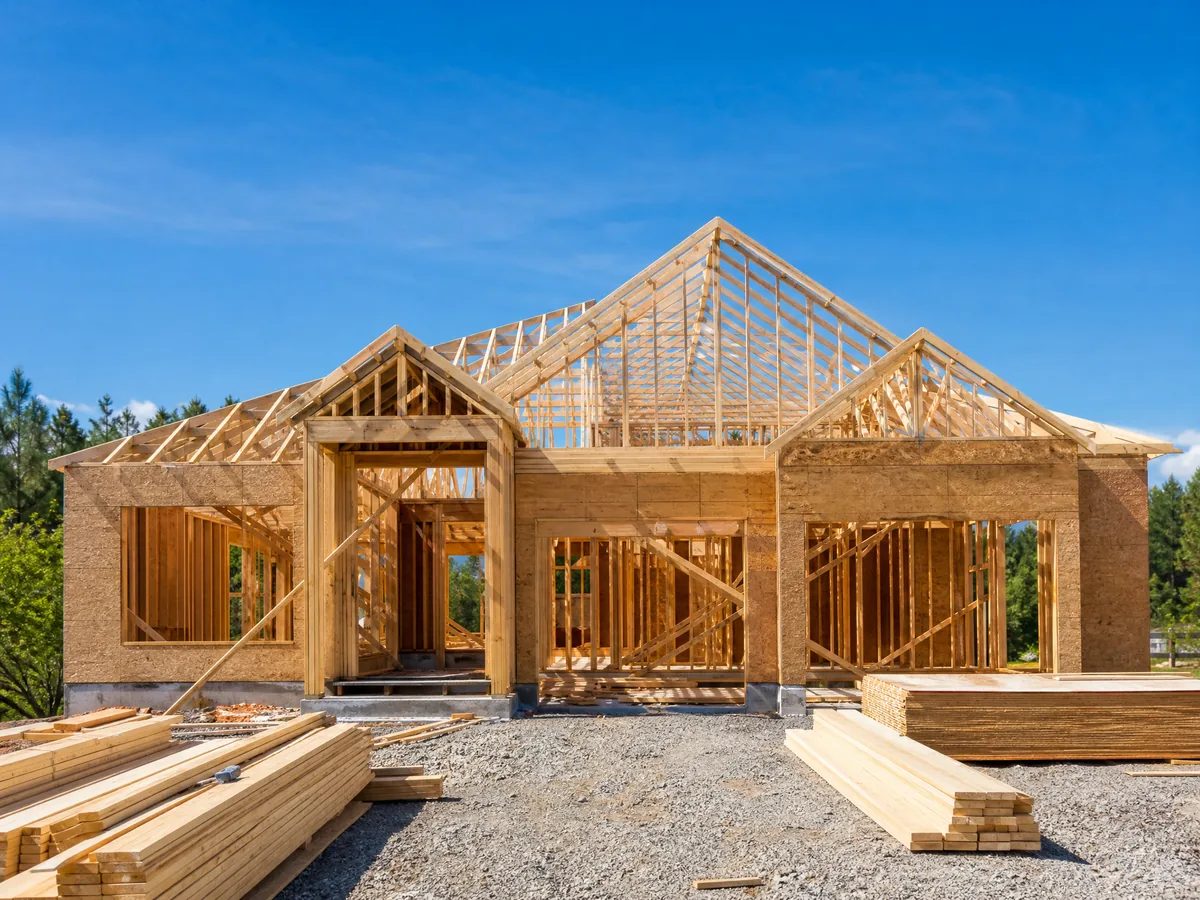
San Diego ground up construction loans for infill ADU builds.
Built for spec home builders and developers. We finance both the land and the vertical construction, up to 70% LTV and 85% of cost, with draws that keep pace with your build. San Diego's new-build demand runs to ADUs and small infill projects rather than detached subdivision tract, and coastal-zone parcels carry an added layer of state review. Business-purpose only, and every structure is set in underwriting.
Typical figures, subject to underwriting and market conditions. Not a commitment to lend.
How it works
We finance both the land and the vertical construction, with a draw schedule built around your timeline. Experienced builders can access higher leverage on cost.
How real is the demand for ADU financing in San Diego, versus detached spec construction?
ADU is the growth product, and detached spec construction has been shrinking for a decade. County-wide ADU permits rose from 1,150 in 2020 to 3,991 in 2024, up 247%, and completions rose from 342 to 1,984, up 480%. In 2024 the City of San Diego alone permitted 2,281 ADUs and completed 848, though only 4% (58) of the city's 2024 permitted ADU projects carried three or more units. Over the same stretch, City of San Diego single-family permits fell from 864 in 2016 to 132 in 2024. Size a construction pipeline around ADU and small infill product, not a detached subdivision play.
What does the City of San Diego charge in development impact fees on a new single-family build?
The published citywide fee stack alone runs from about $31,000 to $35,500 on a detached single-family unit, before any utility or transportation charge. For fiscal year 2026, a 2,001 to 2,050 square foot single-family home carries $20,607 Park DIF, $1,259 Fire DIF, $3,197 Library DIF, and $6,176 Mobility DIF, summing to about $31,239. A unit of 2,501 square feet or larger carries about $35,522. Multi-family and ADU-scale product is lighter: fees run from about $17,342 a door on units 500 square feet and under to about $27,583 a door on units 1,301 square feet and over. Water and sewer capacity charges and the Regional Transportation Congestion Improvement Program fee were not published where we could source them, so budget those separately and confirm current figures with the city before setting your construction line.
Did San Diego's ADU rules change in 2025, and does that affect a project already underwritten?
Yes: the bonus ADU program that let single-family lots add units without a hard ceiling was capped in 2025, and it is worth re-checking your unit count if your project predates the change. The City Council adopted a reform package on 2025-06-18, effective 2025-08-22 outside the Coastal Zone, capping bonus ADUs at 4 units per lot up to 8,000 square feet, 5 on lots of 8,001 to 10,000 square feet, and 6 on larger lots, and eliminating the bonus program entirely in eight low-density single-family zones except in High and Highest Resource Areas. Coastal Zone implementation still requires California Coastal Commission certification, so a coastal-adjacent parcel is not yet running under the new rules. The standard state ADU package, one detached ADU, one conversion ADU, and one JADU on a single-family lot, is untouched and still ministerial statewide.
Do San Diego construction sites carry a wildfire building requirement beyond insurance?
Yes, on Very High Fire Hazard Severity Zone parcels: the City adopted its own defensible-space rule ahead of the state. San Diego Municipal Code section 512.0604, effective 2026-02-28 for new structures in a Very High Fire Hazard Severity Zone, requires ember-resistant defensible space in the first five feet around a structure, a rule California's own statewide version was still a draft as of mid-2026. The 2025 bonus-ADU reform also added setback and two-evacuation-route requirements for fire-zone parcels. The hazard map itself grew about 26% in 2025, from 646,838 to 871,212 very-high acres countywide, so a lot that was outside the zone in 2024 may not be today. Get the fire-zone status of your parcel confirmed before you finalize the construction budget.
Will Mello-Roos or CFD charges add to my carrying cost while I build in San Diego County?
In eastern Chula Vista and the newer master-planned north county, yes, and they stack on top of the property tax bill rather than inside it. Community Facilities District special taxes are fixed charges outside Proposition 13's 1% ad valorem ceiling entirely; districts like Otay Ranch Village 2 and Village 3 in Chula Vista carry average per-parcel levies of roughly $1,700 to $2,200 a year, and a single parcel can carry several CFDs plus school district and open space charges on the same bill. Pull the parcel's actual fixed-charge lines from the county tax bill before you underwrite carry, since these do not show up in the ad valorem tax rate.
Where in San Diego County does ground-up infill construction financing make the most sense?
Detached spec construction has largely moved to infill and ADU product inside the City of San Diego. Single-family permits fell from 864 to 132 between 2016 and 2024 while ADU permits rose from zero to 2,107. South bay (Chula Vista, National City) carries a lower entry basis with newer master-planned, CFD-heavy parcels; north county coastal and the Camp Pendleton corridor (Oceanside, Vista) and inland east county (Escondido, El Cajon) round out the set with older stock and lower rents. A build sized for a rental exit rather than a spec sale can move into a DSCR rental loan once construction wraps.
How much of a San Diego build do I have to fund myself?
Plan on about 15% of total project cost. We finance land and vertical construction up to 70% LTV and up to 85% of cost, with draws released against your build schedule. On a $2,000,000 total cost that is up to $1,700,000 from us and $300,000 from you (2,000,000 x 85% = 1,700,000), and the 70% LTV test applies alongside it, so the lower of the two governs. Budget the City's development impact fees inside that cost figure rather than beside it, since the published citywide stack on a detached single-family unit alone runs about $31,239 on a 2,001 to 2,050 square foot house and about $35,522 at 2,501 square feet and above. Subject to underwriting.
Do you check credit on a San Diego construction loan?
We run credit, but there is no minimum score on this program. Construction is asset-based lending: the land, the budget, the schedule and the finished value carry the file, and credit matters far less than it would at a bank. Weaker credit is normally offset with lower leverage rather than a decline, so a file might land under the 85% of cost ceiling instead of at it. There is no hard credit pull to start a conversation. Subject to underwriting.
Do I need a building track record to get a San Diego construction loan?
Experience is not a gate, but it moves your leverage. Experienced builders can access higher leverage inside the 70% LTV and 85% of cost ceilings; a first project usually prices and sizes more conservatively. Terms run 12 to 24 months with draws per the build schedule, up to $5,000,000. A smaller ADU or infill project is a reasonable place to build that record in this county, since ADU is where San Diego's new-build volume has actually gone while single-family permits fell from 864 in 2016 to 132 in 2024. Subject to underwriting.
More Ground-Up Construction questions, answered on the program page
Local rules move. Every tax rate, fee, ordinance and market figure here comes from a primary source and carries the date we read it, and we correct them as the rules change. Where a number is mid-change or we could not verify it, we say so rather than guess. Before you commit a budget, confirm anything that drives it with the city or county, and talk to your attorney or CPA on questions of law or tax.
Published by USA Mortgage Funding, LLC, NMLS #152588. Researched from primary sources by our team, drafted with AI assistance, and every figure checked against its source before publishing. Where an answer rests on a public record, that record is linked under it. Figures read on 2026-08-15.
Funding San Diego deals fast.
Get real terms, usually same day. No obligation, no hard credit pull to start.