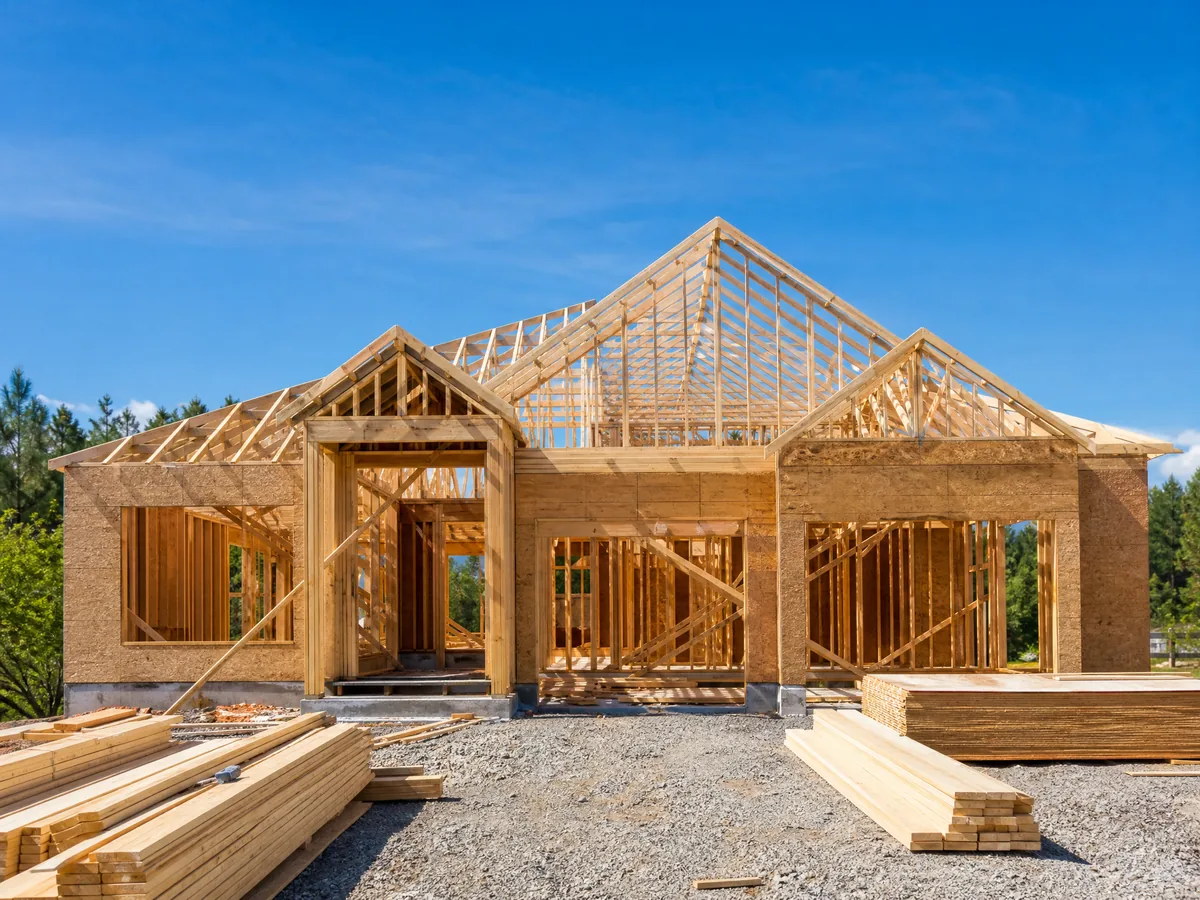
Ground up construction loans for Tampa spec home builders.
Florida statute puts a clock on a Tampa Bay permit review, and every late day cuts the permit fee. Built for spec home builders and developers, we fund the land and the vertical build up to 70% LTV and 85% of cost, with draws that keep pace with the job. Business-purpose only, and every structure is set in underwriting.
Typical figures, subject to underwriting and market conditions. Not a commitment to lend.
How it works
We finance both the land and the vertical construction, with a draw schedule built around your timeline. Experienced builders can access higher leverage on cost.
How long does Florida give a county to approve my building permit?
30 business days for a single-family home under 7,500 square feet. Bigger houses, multifamily up to 50 units, commercial under 25,000 square feet, and site plans get 60 business days. That is Florida Statutes section 553.792, and it applies once your application is complete and sufficient. The jurisdiction also has to tell you in writing what is missing within 5 business days of receiving the application, and a master building permit runs on a 12-business-day clock. Two things to keep straight. The clock starts on a complete application, so a thin submittal buys you nothing, and these are statutory backstops rather than a published estimate of what Hillsborough, Pinellas or Pasco actually take on a given week. Ask your jurisdiction for its current turn time, then hold it to the statute. We would rather set a 12 to 24 month term against your real permit path than watch you buy an extension.
What happens if the jurisdiction misses the permit deadline?
The permit fee drops by 10% for every business day of delay, and by 20% per business day after a resubmitted revision. Section 553.792 puts that reduction in the statute, so a blown deadline costs the jurisdiction money as well as costing you time. There is a matching rule on the inspection side: under section 553.79, if an inspection fails and the local enforcement agency does not state the reason within 5 business days, it has to refund 10% of the permit and inspection fees. Track your submittal and inspection dates in writing from day one, because you cannot claim a reduction you cannot document. Whether to press a specific claim is a conversation for your attorney, not for us.
What should I budget for impact fees and CDD assessments?
Ask the jurisdiction, because we will not quote you a number we cannot source. What is true generally is that Florida new construction carries impact or mobility fees on top of the permit fee itself, and that CDD assessments are common in the newer subdivisions of Pasco and eastern Hillsborough. Both matter to a build budget and to the exit: an impact or mobility fee is a one-time hit at permit, while a CDD assessment rides the tax bill every year and shows up in a buyer's or a renter's math long after you are out. We do not have a current, citable Hillsborough or Pasco fee schedule, and a made-up figure is worse than no figure. Pull the schedule from the county for your specific parcel and use case, put the real number in the budget we lend against, and take the assessment questions to your CPA.
What do insurance and property taxes do to the carry on a Tampa Bay build?
Insurance is a first-order underwriting variable here, and which side of the bay you build on can move it more than the note rate does. Using the Florida Office of Insurance Regulation's own county table, average homeowners premiums including wind as of March 2026 ran $4,063 in Pinellas, $3,525 in Hillsborough and $2,756 in Pasco. That Pinellas-to-Pasco gap is about $1,300 a year on an otherwise similar house, before flood, which is a separate policy a lender will require inside a Special Flood Hazard Area. The direction is finally friendly: FLOIR reported average premiums falling in 51 of 67 counties between its January and July 2026 reports, with 21 new carriers approved to write residential property since the 2022-23 reforms. On taxes, investor property gets Florida's 10% annual assessment cap rather than the 3% homestead cap, and the cap resets on a change of ownership, so a completed build is assessed on its finished market value with no carryover from the dirt. Underwrite to that, not to the lot's old tax bill.
What are the Florida closing taxes on a lot purchase and a construction loan?
Documentary stamp tax: 70 cents per $100 of consideration on the deed, and 35 cents per $100 on the note. Deed consideration expressly includes the amount of any mortgage or other encumbrance, whether or not the underlying debt is assumed, and the statute puts payment on the purchaser even though most Florida counties settle deed stamps to the seller by contract. Contract allocation, not the statute, controls at your closing table. On the financing side, the Department of Revenue describes a cap on the tax for promissory notes and no cap on the mortgage or lien tax, and Florida also imposes a nonrecurring intangible tax on mortgages. We are a lender, not your closing counsel, so confirm the exact figures on your file with the closing attorney or title agent before you commit them to the budget. The reason to care early is simple: on a build, these hit at the land closing and again on the construction note, and they belong in the sources and uses from the first draft.
Where in the metro does new construction pencil, and does build-to-rent still work?
The build-driven corridors show up in the data as Wesley Chapel and Riverview, and single-family rent is the part of the market still growing. As of June 2026, Wesley Chapel in Pasco carried the highest mid-tier home value of the eight submarkets we track at $402,222 and the highest rent at $2,262, with Riverview in Hillsborough next on rent at $2,159 against a $366,239 value. That is consistent with newer stock and active building, though the values themselves are the sourced part and the construction read is an inference. For a build-to-rent hold, the split worth knowing is that Tampa metro single-family rent was up 1.1% year over year in June 2026 while the all-property-types index was down 0.7%. The apartment delivery wave is pressuring multifamily, not the detached house you are building. On the resale exit, plan for a patient market: metro median days on market was 72 in July 2026, roughly flat against a year earlier. Price the carry for a full marketing period rather than a best case.
How much equity does a $1,000,000 Tampa build take, with the permit path budgeted in?
Roughly 15% of cost, and the value test can push it higher. We go up to 85% of cost and up to 70% LTV, and both caps apply, on loans up to $5M. On a $1,000,000 Tampa build that is up to $850,000 from us and $150,000 from you (1,000,000 x 85% = 850,000), with draws released against the build schedule rather than funded up front. Leave room for the permit path when you size the equity: the clock in Florida Statutes section 553.792 is a statutory backstop, not a promised turn time, and the carry across a 12 to 24 month term is yours. Subject to underwriting.
Does my contractor's Hillsborough or Pinellas submittal history matter as much as my build history?
Both help, and experienced builders can access higher leverage. This is asset-based lending, so we run credit but it carries far less weight than at a bank, and there is no minimum score on a construction file. There are also no W-2s and no tax returns, because the loan qualifies off the property and your equity. A thinner track record usually means lower leverage rather than a decline. Bring the plans, the budget, and your contractor's real submittal history in Hillsborough, Pinellas or Pasco, since the statutory review clock is a backstop rather than an observed average. Spec or build-to-rent both work. Subject to underwriting.
Local rules move. Every tax rate, fee, ordinance and market figure here comes from a primary source and carries the date we read it, and we correct them as the rules change. Where a number is mid-change or we could not verify it, we say so rather than guess. Before you commit a budget, confirm anything that drives it with the city or county, and talk to your attorney or CPA on questions of law or tax.
Published by USA Mortgage Funding, LLC, NMLS #152588. Researched from primary sources by our team, drafted with AI assistance, and every figure checked against its source before publishing. Where an answer rests on a public record, that record is linked under it. Figures read on 2026-08-12.
Funding Tampa deals fast.
Get real terms, usually same day. No obligation, no hard credit pull to start.