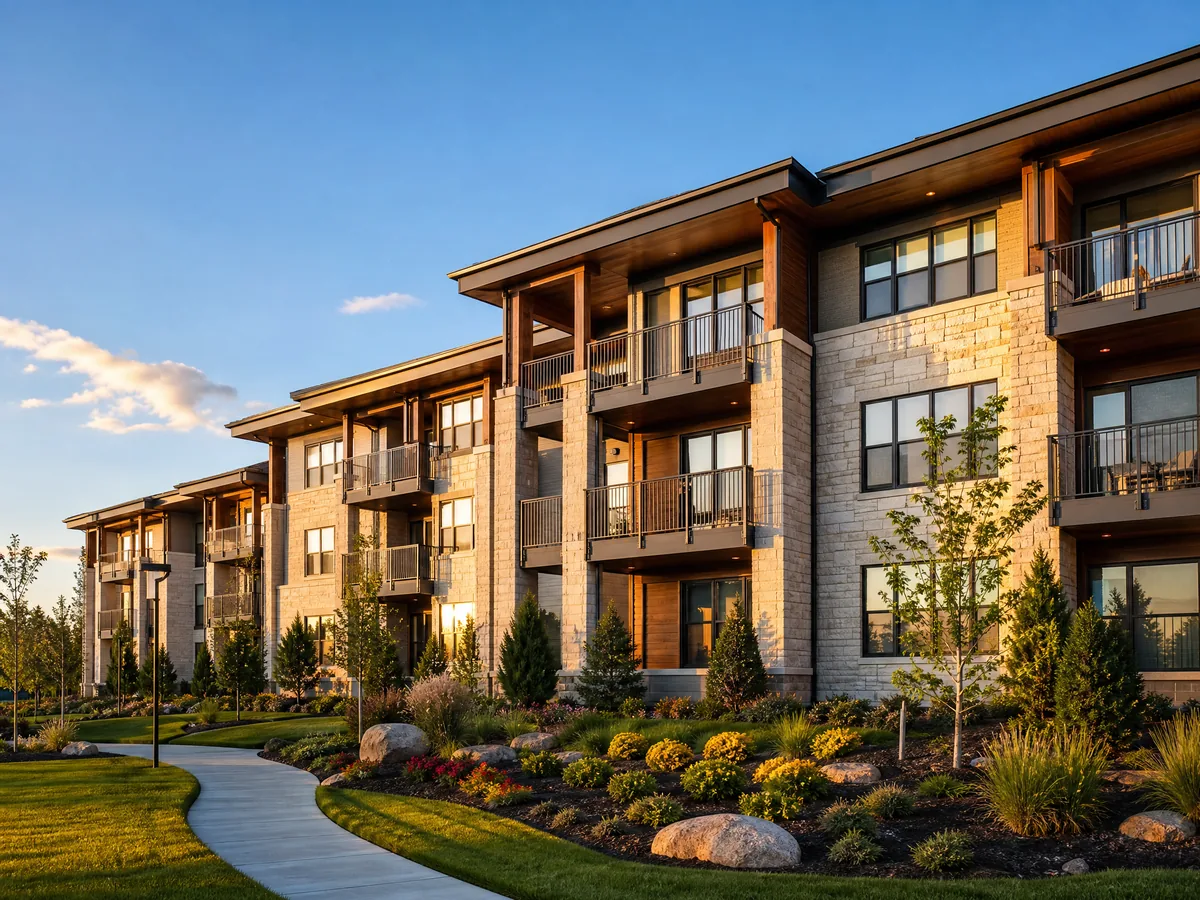
Permanent commercial mortgage financing on stabilized Atlanta property.
Long-term, permanent financing for stabilized commercial real estate. We place it in house through agency multifamily channels (Fannie Mae and Freddie Mac), insurance funds, and other wholesale sources. In Georgia, a long-term note carries intangible recording tax a bridge note skips. Business-purpose only, and every structure is set in underwriting.
Typical figures, subject to underwriting and market conditions. Not a commitment to lend.
How it works
For a stabilized asset ready for permanent debt, we shop your file across agency multifamily programs, insurance companies, and wholesale lenders, then place the structure that fits your hold. When a deal needs to stabilize first, we can bridge it and refinance into permanent debt later.
Does Georgia charge a tax on the loan itself, and does it apply to permanent debt?
Yes, and permanent debt is exactly where it lands. Georgia's intangible recording tax runs $1.50 per $500 of the face amount of the note, or about 0.30% of the loan, capped at $25,000 per note, which you hit around an $8.33M loan. It is due within 90 days of execution. Legally the holder of the note owes it; in practice the borrower pays it at closing. Short-term notes are exempt, and the short-term threshold is reported to have moved from 36 months to 62 months effective July 1, 2025, so a 12 to 24 month bridge note may owe none of it while a long-term permanent note does. On a $5M permanent loan that is roughly $15,000 of cash to close that a bridge quote would not show. Confirm the current treatment of your specific note with the Georgia closing attorney before you size the deal. One more reason not to skip it: unpaid intangible recording tax bars collection by any action, foreclosure, or exercise of the power of sale until the tax, interest and a 50% penalty are paid.
Who actually closes a commercial loan in Georgia, and how is the lien documented?
A licensed Georgia attorney closes it, and the lien is a security deed, not a mortgage. The Supreme Court of Georgia treats preparing or facilitating execution of a deed as the practice of law (In re UPL Advisory Opinion 2003-2). The attorney has to be physically present, telephonic supervision of a non-lawyer closer does not satisfy it, and closing or disbursing in violation is a misdemeanor plus civil liability. There is no path where a title company runs escrow instead. The attorney holds and disburses. On the collateral side, a Georgia security deed conveys legal title to the lender rather than creating a mortgage lien, and remedies run non-judicially: sales happen on the first Tuesday of the month between 10:00 a.m. and 4:00 p.m. at the county courthouse, after 30 days' notice to the debtor and four weekly advertisements in the county legal organ with at least 21 days between the first ad and the sale. Roughly a 37-day practical minimum from first publication. Same first-Tuesday cadence Texas investors already know, which is one reason a Texas-based shop reads Georgia files quickly.
Will my property tax line reset after I buy in Fulton or DeKalb?
Plan on it, and do not underwrite the seller's bill. Georgia assesses property at 40% of fair market value statewide, so your effective rate is the combined millage times 0.40, with county, school and municipal levies stacked. Georgia HB 581 created a statewide floating homestead exemption capping annual taxable-value growth at CPI effective January 1, 2025, but it never applied to investment property in the first place because that property is not homesteaded, and Fulton, Gwinnett, Cobb, DeKalb, their school districts and the City of Atlanta all opted out anyway. The result is that your asset gets reassessed to market with no inflation cap, and a permanent loan sized on a pre-sale tax figure will show a DSCR you cannot hold. Model the post-purchase reassessment, and have your CPA or tax attorney sign off on the number before you lock a long-term rate.
How does the Atlanta multifamily supply wave change agency underwriting on my rent roll?
Underwrite flat rent, not trend rent. Metro Atlanta multifamily ran 6.4% vacancy in the first quarter of 2026 with $1,600 average asking rent and 0.4% rent growth, on 3.2K units delivered against 3.4K absorbed and 17.1K units still under construction. Absorption is keeping pace, but the pipeline is not done landing, and that is what holds rent growth near flat. An agency underwriter reading a pro forma with meaningful rent bumps in year one is going to trim them. Bring trailing collections and the concession schedule rather than asking rents. For context on where pricing sat as of the first quarter of 2026, the metro traded at a 5.3% cap rate and about $194,000 per unit on $7.5B of trailing volume. Single-family rents were slightly negative over the same stretch, down 0.2% year over year through the first half of 2026, so the softness is not confined to apartments.
Can I get permanent debt on an Atlanta office building right now?
It depends on the rent roll, and the market data cuts both ways. As of the first quarter of 2026, Atlanta office vacancy was 26.5%, down 50 basis points year over year, with asking rent at $33.09 per square foot, up 4.6%, net absorption of 487,222 square feet, the largest quarterly total since the third quarter of 2022, and 2.6M square feet leased, the strongest in five quarters. At the same time 13 office properties totaling $115.9M traded at an average $84.55 per square foot, down 9.3% year over year, with the deal count up 30.6%. More trades at a lower price per foot is a repricing, and it is the window some recapitalizations get done in. The construction pipeline is nearly exhausted, with 332,000 square feet under way in the first quarter, all speculative and all delivering in 2026. What we will not do is put a number on distress we cannot source: we have no verified figures on Atlanta CMBS special servicing or specific defaulted towers, so we are not going to imply them. A stabilized, leased asset can be placed; a half-empty one usually needs a bridge and a business plan first.
What does the industrial market look like for a long-term hold here?
Tight fundamentals with supply still arriving. Atlanta industrial ran 9.0% vacancy in the second quarter of 2026, stable, with availability at 12.0% and falling, asking rent at $7.43 per square foot and rising, 9.17M square feet of net absorption year to date including 4.4M in the quarter, and leasing volume up 19% year over year. Against that, 4.8M square feet delivered in the quarter and 12.3M square feet is under construction at 32.7% preleased. Big-box space over 500,000 square feet is tighter than the headline at roughly 7.0% vacancy, with I-85 North functionally tight while the airport and south Atlanta submarkets work through large-block vacancy. For permanent debt that means the credit and the term of your lease matter more than the metro average. Bring the lease abstracts and the rent roll on the first call and an advisor can tell you quickly which channel fits.
Local rules move. Every tax rate, fee, ordinance and market figure here comes from a primary source and carries the date we read it, and we correct them as the rules change. Where a number is mid-change or we could not verify it, we say so rather than guess. Before you commit a budget, confirm anything that drives it with the city or county, and talk to your attorney or CPA on questions of law or tax.
Published by USA Mortgage Funding, LLC, NMLS #152588. Researched from primary sources by our team, drafted with AI assistance, and every figure checked against its source before publishing. Where an answer rests on a public record, that record is linked under it. Figures read on 2026-08-12.
Funding Atlanta deals fast.
Get real terms, usually same day. No obligation, no hard credit pull to start.