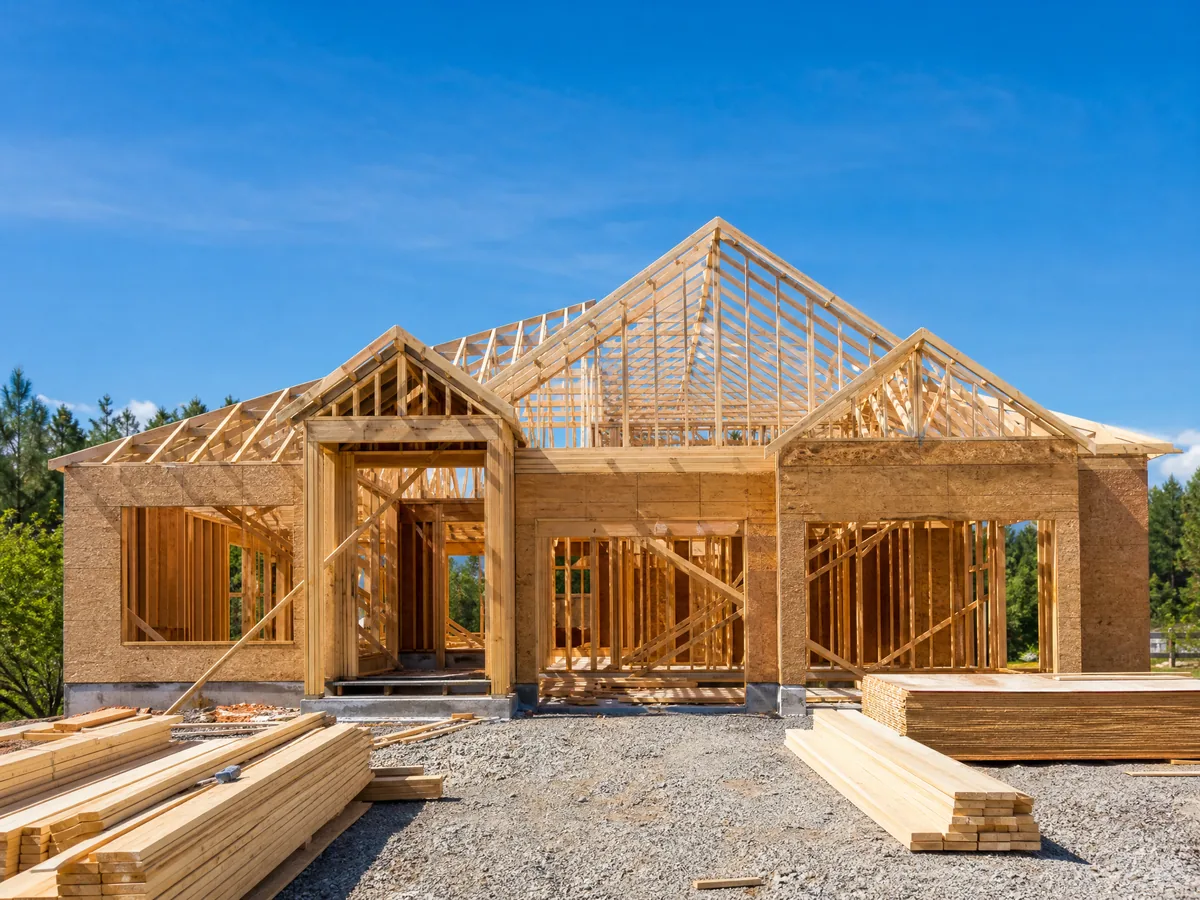
Ground up construction loans that back Greensboro new builds.
Built for spec home builders and developers. We fund the land and the vertical build up to 70% LTV and 85% of cost, with draws that keep pace with the job. State law froze Guilford County's 2026 reappraisal for a year, so a lot bought today carries the old value. Business-purpose only, and every structure is set in underwriting.
Typical figures, subject to underwriting and market conditions. Not a commitment to lend.
How it works
We finance both the land and the vertical construction, with a draw schedule built around your timeline. Experienced builders can access higher leverage on cost.
What does a new-build permit cost in Greensboro, and can I use Winston-Salem's fee schedule as a stand-in?
No, and the City of Greensboro's own permit fee schedule was not retrievable to quote here. Greensboro's website returned an access error on every attempt to pull its building permit fees and system development fees, so we cannot publish a Greensboro dollar figure. Winston-Salem and Forsyth County, a different city in a different county, publish theirs plainly: new single-family construction runs $0.15 per square foot for building plus $0.09 each for electrical, plumbing, and mechanical, a $0.42 per square foot trade stack that prices a 2,000 square foot house at roughly $840, plus the $10 state Homeowners Recovery Fund fee. Do not carry that Winston-Salem number into a Greensboro pro forma; confirm Greensboro's current fee schedule with the city before you set a construction budget line.
Guilford County just froze reappraisals. What does that mean for carrying a new build through 2026 and into 2027?
Your 2026 tax bill is based on the old, pre-reappraisal value, and it reprices on the 2027 bill. North Carolina Senate Bill 889 froze Guilford County's 2026 reappraisal for one year, so a Greensboro lot or spec build bought in 2026 is taxed on the county's last completed value, not the new one, until the 2027 bill lands. Guilford's own numbers show the gap: an estimated 58.54 cents per $100 revenue-neutral rate on the 2026 values against an adopted 78.95 cents rate, roughly 35% above revenue-neutral. Underwrite your holding costs assuming the 2027 bill moves, and know the appeal window on the 2026 reappraisal runs through May 17, 2027.
Building in High Point? What does the water and sewer system development fee add to my lot cost?
Budget about $3,978 per standard lot as of July 1, 2026, and it's climbing. High Point's system development fee for a standard residential 5/8 inch by 3/4 inch meter runs $1,988 water plus $1,990 sewer, effective 2026-07-01, up 11.2% from the prior year's $3,575.84. Larger meters scale sharply: a 2 inch meter runs $21,215, a 6 inch meter $132,595. That fee sits on top of your building, electrical, plumbing and mechanical permit costs, so build it into your lot-acquisition math before you underwrite a High Point spec build. Greensboro's and Winston-Salem's system development fee amounts were not available to confirm here, so don't carry the High Point number into either of those cities.
New-construction permits fell across Guilford County last year. Does that change how a spec build should be sized?
Fewer builders pulled permits in 2025, and resale inventory loosened at the same time, which favors a build priced to move, not held for appreciation. Guilford County authorized 2,876 new privately owned housing units in 2025, down 25.2% from 3,843 in 2024. Over the same period the Greensboro-High Point resale market saw active listings climb roughly a fifth year over year with days on market ticking up, a buyer-leaning market as of mid-2026. Underwrite your exit at that pace, not at a seller's-market clip.
Greensboro's housing stock is supposed to be old mill-town inventory. Does that change whether I should build new or rehab?
Not on age alone: Greensboro's housing stock is actually newer than the national average. Only 29.3% of Greensboro city housing units were built before 1980, against 34.4% nationally, and the median year built is 1987. The rehab opportunity in this metro is a price-point story, homes priced well below Charlotte or Raleigh, not an age story. That should shape whether a ground-up build competes on new construction alone or needs to beat an already-reasonably-modern resale stock on price and finish.
Greensboro is a majority-renter city. Does that make a build-to-rent new construction strategy pencil better than a spec sale?
The renter base supports it, and the rent trend is moving the right direction for a hold. Just over half of occupied units in Greensboro city are renter-occupied, and across the metro rents are rising faster than home values, a favorable spread for a build-to-rent exit into a DSCR rental loan once construction wraps. Greensboro's mid-tier home value ran $266,364 in June 2026 against a $1,415 Greensboro rent index, a gross-yield figure that ignores taxes, insurance, and vacancy but points the right way for a build-to-hold plan.
How much of a Greensboro build do I have to fund myself?
Roughly 15% of total cost, plus your soft costs. We fund up to 85% of cost and up to 70% LTV, whichever binds first. On a $400,000 Greensboro project cost, land plus vertical, that is up to $340,000 from us and $60,000 from you (400,000 x 85% = 340,000), with the build drawn against the schedule rather than advanced up front. Permit and system development fees sit outside that math, so confirm the city's current schedule before you set the budget line. Subject to underwriting.
Do you require a minimum credit score for a Greensboro construction loan?
No. There is no minimum score on this program. We run credit, but on an asset-based construction file it carries far less weight than at a bank, and there is no hard pull to start. The file qualifies off the land, the budget, and the finished value rather than W-2s or pay stubs. A weaker credit file usually means lower leverage rather than a decline, which on a build means more of the cost sits with you. Subject to underwriting.
Do I need a build track record to get a Greensboro construction loan?
No, but experience moves the leverage. Experienced builders can access higher leverage inside the 70% LTV and 85% LTC ceilings, and a first build generally prices in more of your own cost. The program runs to $5M on terms of 12 to 24 months, spec or build-to-rent, so a first Greensboro project should be sized to finish inside that window rather than stretched to the ceiling. Permits ran thinner across Guilford County in 2025, so build the schedule you can actually hold. Subject to underwriting.
More Ground-Up Construction questions, answered on the program page
Local rules move. Every tax rate, fee, ordinance and market figure here comes from a primary source and carries the date we read it, and we correct them as the rules change. Where a number is mid-change or we could not verify it, we say so rather than guess. Before you commit a budget, confirm anything that drives it with the city or county, and talk to your attorney or CPA on questions of law or tax.
Published by USA Mortgage Funding, LLC, NMLS #152588. Researched from primary sources by our team, drafted with AI assistance, and every figure checked against its source before publishing. Where an answer rests on a public record, that record is linked under it. Figures read on 2026-08-13.
Funding Greensboro deals fast.
Get real terms, usually same day. No obligation, no hard credit pull to start.