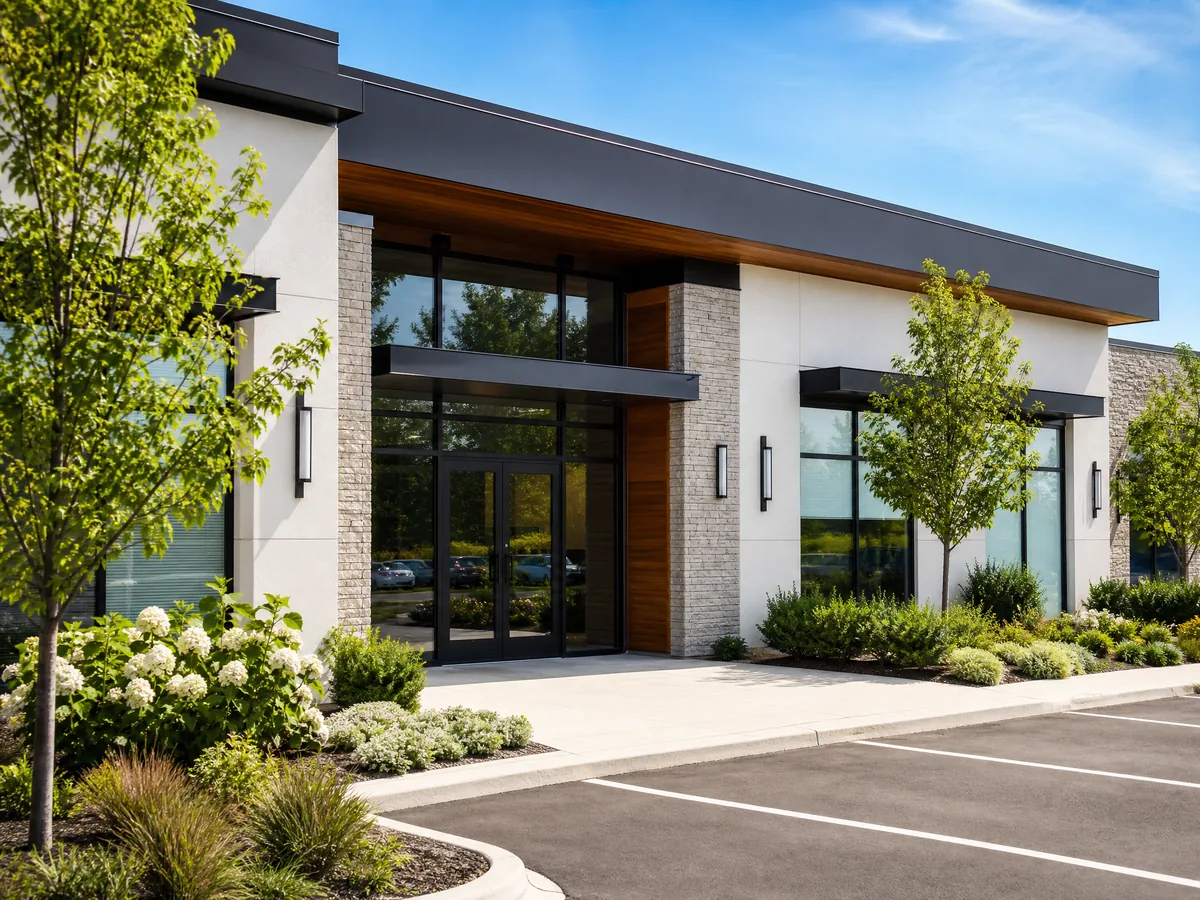
Buying a building in Nashville, backed by SBA loans.
When a deal calls for long-term, government-backed financing, we place SBA 7(a) and 504 loans through relationships with more than 20 SBA lenders. We match your scenario to the right program and the terms that fit. In Nashville the local work is property-side: assessment ratio, recording taxes, and Metro permits. Business-purpose only, and every structure is set in underwriting.
Typical figures, subject to underwriting and market conditions. Not a commitment to lend.
How it works
SBA loans offer low down payments and long amortizations for owner-occupied property and business acquisition. USA Mortgage arranges and places SBA financing through our network of partner lenders; we are not ourselves an SBA lender. We shop your file across that network so you get the strongest approval.
Who actually funds an SBA loan on a Nashville property?
A partner lender does, not us. USA Mortgage arranges and places SBA 7(a) and 504 financing through a network of more than 20 SBA lenders. We are not ourselves an SBA lender, so the credit decision and the rate come from the bank, and on a 504 from the CDC alongside it. On the agency side, the SBA Tennessee District Office is here in Nashville at 51 Century Blvd., Suite 250. Our job is to match the file to the lender most likely to approve it and keep it moving. Because the file opens at the bank rather than with us, there is no online SBA application here. See the SBA program page for terms, or tell us about the deal and an advisor makes the lender match.
What will property taxes run on an owner-occupied building in Davidson County?
Budget roughly 1.1% of appraised value, not the 0.7% a house at the same price would pay. Tennessee assesses residential and farm property at 25% of appraised value and commercial and industrial at 40%. Davidson County's 2025 rates are $2.814 per $100 of assessed value in the Urban Services District and $2.782 in the General Services District. Run it on a $500,000 building in the GSD: 40% of $500,000 is $200,000 assessed, and $200,000 divided by 100 times $2.782 is $5,564 a year, about 1.11% of value. The same $500,000 as residential would be assessed at $125,000 and billed $3,477.50, about 0.70%. Commercial carry is roughly 1.6 times residential carry on identical value, which matters most when you are converting a use rather than buying a building that is already commercial. Davidson reappraises on a four-year cycle, so confirm the current appraised value with the Assessor before you build a 25-year expense stack on it.
Tennessee has no income tax. Does my entity owe anything at the state level?
Probably yes, and this is the one out-of-state buyers get wrong. Tennessee does not tax wage or salary income, and the Hall income tax on interest and dividends was fully repealed for tax years beginning on or after January 1, 2021, so on the personal side "no income tax" is now literally true. It is not true of your entities. Franchise and excise tax applies to LLCs, LPs and corporations doing business in Tennessee: 6.5% of Tennessee net earnings for excise, 0.25% of net worth for franchise, and a $100 minimum that an entity registered with the Secretary of State owes whether or not it is active. That reaches both the operating company and the real estate holding entity. The family-owned non-corporate entity exemption exists, but it requires at least 66.67% of receipts to be passive investment income, and rent from commercial property is not passive investment income, so it rarely helps an owner-occupied building. Get it answered by a Tennessee CPA before you pick the entity that will hold the building for the next 25 years. On the sales tax side, Davidson County's local rate rose by 0.5% effective February 1, 2025 under the transit referendum, which is worth knowing if your business sells at retail here rather than in a collar county.
What do Tennessee's recording taxes add to closing?
Two separate taxes: one on the deed, one on the note. The realty transfer tax is $0.37 per $100, measured on the greater of consideration or property value, and the grantee, meaning the buyer, pays it by statute. The indebtedness tax on recorded mortgage debt is 11.5 cents per $100, with the first $2,000 exempt; the debtor owes it and the note holder collects and remits. Every recorded debt instrument has to carry the legend stating the maximum principal indebtedness for Tennessee recording tax purposes. On a $1,000,000 purchase with $800,000 of recorded debt, that is $3,700 on the deed and about $918 on the note, before recording fees. Revolving lines are taxed once on the stated maximum, and re-draws are not taxed again; an increase beyond the stated maximum is taxed on the increase with no $2,000 exclusion. Because the tax follows what actually gets recorded, ask your closer to price it off the final instruments rather than the purchase price.
My business is hospitality. How does Nashville's visitor base factor in?
The lodging base is real, but Metro's short-term rental rules decide whether a small lodging plan is even permittable. Davidson County has 42,156 hotel rooms and the wider Nashville MSA 60,933, per Visit Music City's statistics page. If your plan involves short-term lodging in a house, duplex or small residential building rather than a hotel, read Metro Code section 6.28 first. New not-owner-occupied short-term rental permits are not issued in AR2A, R, RS or RM zoning, which is the entire conventional residential stack, and issue only as a use permitted with conditions in mixed-use, office, commercial, downtown DTC and shopping-center districts. Permits also do not survive a sale: the ordinance says a permit "shall not be transferred or assigned to another individual, person, entity, or address," and Tennessee's own preemption statute ends grandfathered status on sale or transfer. So a seller's trailing short-term rental revenue is not income you inherit. Underwrite to the zoning, and have your attorney confirm the permit path before you go hard.
I'm renovating the building after I buy it. What should I budget for Metro permits and review time?
Fees are formulaic, timing is not. Metro's commercial building permit fee is $2,326.84 plus $2.79 per additional $1,000 of valuation above $500,000, on top of a $25 zoning examination fee and a Codes Tech Fee equal to 10% of the valuation fee. The plans examination fee runs $1,338.54 plus $0.18 per thousand in the $275,000 to $5,000,000 band, and it is never refunded even if no permit ever issues. Metro Codes publishes no turnaround standard, though it does run concurrent electronic plan review across Water and Sewer, Stormwater, Health, Fire Marshal, Planning, NDOT and Historic. One more item to check early: Metro Code section 17.20.120 conditions the building permit on sidewalk compliance for nonresidential development and redevelopment in designated areas. Where an in-lieu payment is available it is capped at 3% of total construction value, but there is no option to pay when the lot is on a side of the street that already has sidewalks, or when a sidewalk would extend the network from an abutting development. Covered owners dedicate right-of-way or a pedestrian easement either way. From January 1, 2027, Tennessee Public Chapter 1044 puts a clock on the review itself: written staff comments within 30 business days, approval or advancement to the decision-making body within 60, and missing either deadline approves the application as submitted. It caps local governments at two deficiency notices, and it governs plan review rather than the inspection cycle, so it shortens entitlement risk without guaranteeing an approval.
Is my Nashville building too small for an SBA loan?
SBA financing here starts at $350,000 and runs to $5,000,000 and up. Below that floor a conventional commercial loan usually closes faster and costs less than the SBA process is worth. Remember the file opens at a partner bank rather than with us, so the size question gets answered alongside the lender match. 7(a) and 504 both sit inside that range and suit different deals. Subject to underwriting.
Do I have to occupy the Nashville building myself?
Yes. SBA financing is for owner-occupied commercial real estate. This is the one program on the site that is not an investor loan: your business operates from the building. If the plan is to buy a Nashville property and lease it to unrelated tenants, that is a conventional commercial or bridge file instead, and we will point you there rather than start an SBA package that cannot clear occupancy. Subject to underwriting.
How long can I amortize an SBA loan on a Nashville property?
Up to 25 years, at market SBA rates. That long amortization is the reason owner-users tolerate the paperwork, because it keeps the monthly payment well under what a 10-year commercial note on the same Nashville building would cost. Financing runs up to 90%, so on a $2,000,000 building that is up to $1,800,000 financed and $200,000 from you (2,000,000 x 90% = 1,800,000). Budget the Davidson County carry at the 40% commercial assessment ratio, not the 25% residential one. Subject to underwriting.
Local rules move. Every tax rate, fee, ordinance and market figure here comes from a primary source and carries the date we read it, and we correct them as the rules change. Where a number is mid-change or we could not verify it, we say so rather than guess. Before you commit a budget, confirm anything that drives it with the city or county, and talk to your attorney or CPA on questions of law or tax.
Published by USA Mortgage Funding, LLC, NMLS #152588. Researched from primary sources by our team, drafted with AI assistance, and every figure checked against its source before publishing. Where an answer rests on a public record, that record is linked under it. Figures read on 2026-08-12.
Funding Nashville deals fast.
Get real terms, usually same day. No obligation, no hard credit pull to start.