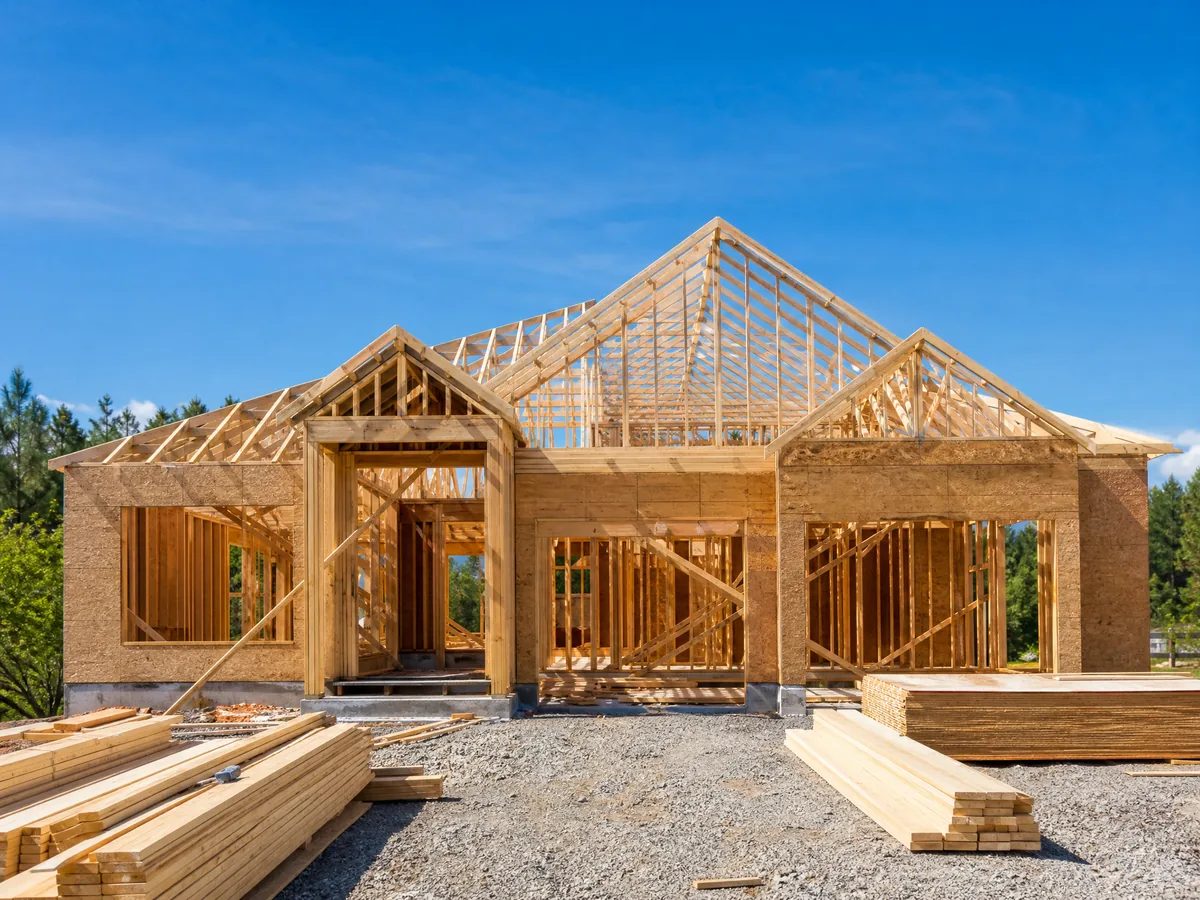
Construction money for Tennessee builders, drawn to the schedule.
Ground-up financing to $5,000,000, up to 70% of value and 85% of cost, on a 12 to 24 month term with draws released against the build schedule. In Tennessee the two lines that catch builders out are the recording tax on the note and the fact that a partly built house has no public insurance backstop. Business-purpose only, and every structure is set in underwriting.
Typical figures, subject to underwriting and market conditions. Not a commitment to lend.
How it works
We finance both the land and the vertical construction, with a draw schedule built around your timeline. Experienced builders can access higher leverage on cost.
How does Tennessee's recording tax hit a construction loan?
It is charged on the debt you record, not on the money you have drawn. Tennessee's indebtedness tax is $0.115 per $100 of debt, with the first $2,000 exempt, the mortgagor pays it, and the note holder collects and remits. Every recorded debt instrument carries a legend stating the maximum principal indebtedness for Tennessee recording tax purposes. On a $1,200,000 construction facility that is $1,377.70 at recording (1,198,000 / 100 x 0.115 = 1,377.70), payable up front even though the draws release over 12 to 24 months. There is a structural break worth knowing: where the instrument is a revolving line, the tax is charged once on the stated maximum and re-draws are not taxed again, while an increase beyond that stated maximum is taxed on the increase with no second $2,000 exclusion. Set the stated maximum with that in mind rather than raising it later.
How do I insure a Tennessee house that is half built?
Builder's risk through surplus lines, arranged before the first draw. Tennessee has no state FAIR plan and no property insurer of last resort, one of a minority of states without one, so a vacant or under-construction property has no public backstop and hard-to-place risk goes to the surplus-lines market from day one. The perils that drive Tennessee losses are tornado, straight-line wind and hail, and Middle Tennessee has documented major outbreaks in March 2020 and December 2023. On a framed but unfinished structure that is not a theoretical exposure. We do not publish Tennessee vacant or builder's-risk pricing because we have no sourced figure for it. Get a written quote for the specific site and the specific build window, and factor the wind and hail deductible, commonly a percentage of coverage rather than a flat dollar amount, into your contingency.
What happens to the tax bill when I finish a Tennessee spec house?
The improvement gets picked up, but the county reappraisal cycle governs the timing. Tennessee counties revalue on a continuous six-year cycle, or a four-year cycle with State Board of Equalization approval, or a five-year cycle where the assessor agrees and the county legislative body votes it, and values are otherwise frozen between reappraisals. Residential is assessed at 25 percent of value and commercial and industrial at 40 percent. After a countywide reappraisal the county must compute a certified tax rate that raises the same revenue as the prior year on the new values, and going above it requires published notice and a public hearing. So a reappraisal year is a rate-cut year by default, and what you actually absorb is whatever the county votes above certified plus how your parcel moved against the county average. Confirm your county's cycle and its current-year appeal dates rather than reusing last year's.
Who closes a Tennessee construction loan, and can I choose them?
A title or escrow company, and since July 1, 2025 the borrower chooses. Tennessee is a title and escrow state. No attorney is required to close, and closings are customarily run by title companies and escrow agents staffed by non-attorneys, though drafting a deed for another person is the practice of law under TCA 23-3-103 and stays with a licensed attorney. Legislation effective July 1, 2025 gives the buyer or borrower the right to pick the settlement agent, subject only to lender approval, and that right cannot be waived by agreement. On a construction file with staged draws and a lot purchase, being able to keep one settlement agent across both closings is worth using. Whether that statute reaches purely commercial transactions is not settled in our sourcing, so confirm with your closer.
Does Tennessee cap what I can be charged on a construction loan?
Yes, and there is no business-purpose exemption to route around it. TCA 47-14-103 sets the maximum effective rate by the form of the transaction rather than by the borrower or the purpose, so a loan to your building LLC sits under the same ceiling as a loan to an individual. For a written contract that ceiling is the formula rate at TCA 47-14-102: four points above the published average prime loan rate, or 24 percent per year, whichever is less. TCA 47-14-113 then polices the fee side, limiting loan charges to fair and reasonable compensation for an expense actually incurred or a service actually rendered. That is the legal frame, and it is the reason a Tennessee construction quote should itemise its charges. We state the ceiling and stop; your pricing comes out of underwriting on your file.
How much do I put down on a Tennessee ground up build?
Enough to hold 30 percent of value or 15 percent of cost, whichever binds first. We lend up to 70% of value and up to 85% of cost, and the tighter of the two governs. On a project appraising at $1,000,000 the value test caps us at $700,000 (1,000,000 x 70% = 700,000); if the all-in cost is $800,000 the cost test caps us at $680,000 (800,000 x 85% = 680,000), so $680,000 is the loan and $120,000 comes from you, plus the recording tax and closing costs. The facility runs to $5,000,000 on a 12 to 24 month term with draws released per the build schedule. Subject to underwriting.
What credit score do I need for a Tennessee construction loan?
There is no minimum score on this program. Construction is asset-based, so we run credit but it carries far less weight than it would at a bank. The file turns on the site, the budget, the plans and the exit. Weaker credit is usually answered with lower leverage rather than a decline, and there is no hard credit pull to start. What moves leverage most on a Tennessee build is the strength of the builder and the realism of the schedule, not the score. Subject to underwriting.
Do I need a track record to build in Tennessee with your money?
Experienced builders can access higher leverage, and a first project is still a conversation. The term card runs to 70% of value and 85% of cost, and where a borrower sits inside that range is largely a function of completed projects, the general contractor, and how well the budget survives a line-item review. A thinner record generally shows up as lower leverage rather than a decline. Bring the plans, the permit status, the signed contractor agreement and a builder's risk quote. Subject to underwriting.
More Ground-Up Construction questions, answered on the program page
Local rules move. Every tax rate, fee, ordinance and market figure here comes from a primary source and carries the date we read it, and we correct them as the rules change. Where a number is mid-change or we could not verify it, we say so rather than guess. Before you commit a budget, confirm anything that drives it with the city or county, and talk to your attorney or CPA on questions of law or tax.
Published by USA Mortgage Funding, LLC, NMLS #152588. Researched from primary sources by our team, drafted with AI assistance, and every figure checked against its source before publishing. Where an answer rests on a public record, that record is linked under it. Figures read on 2026-08-23.
Funding Tennessee deals fast.
Get real terms, usually same day. No obligation, no hard credit pull to start.