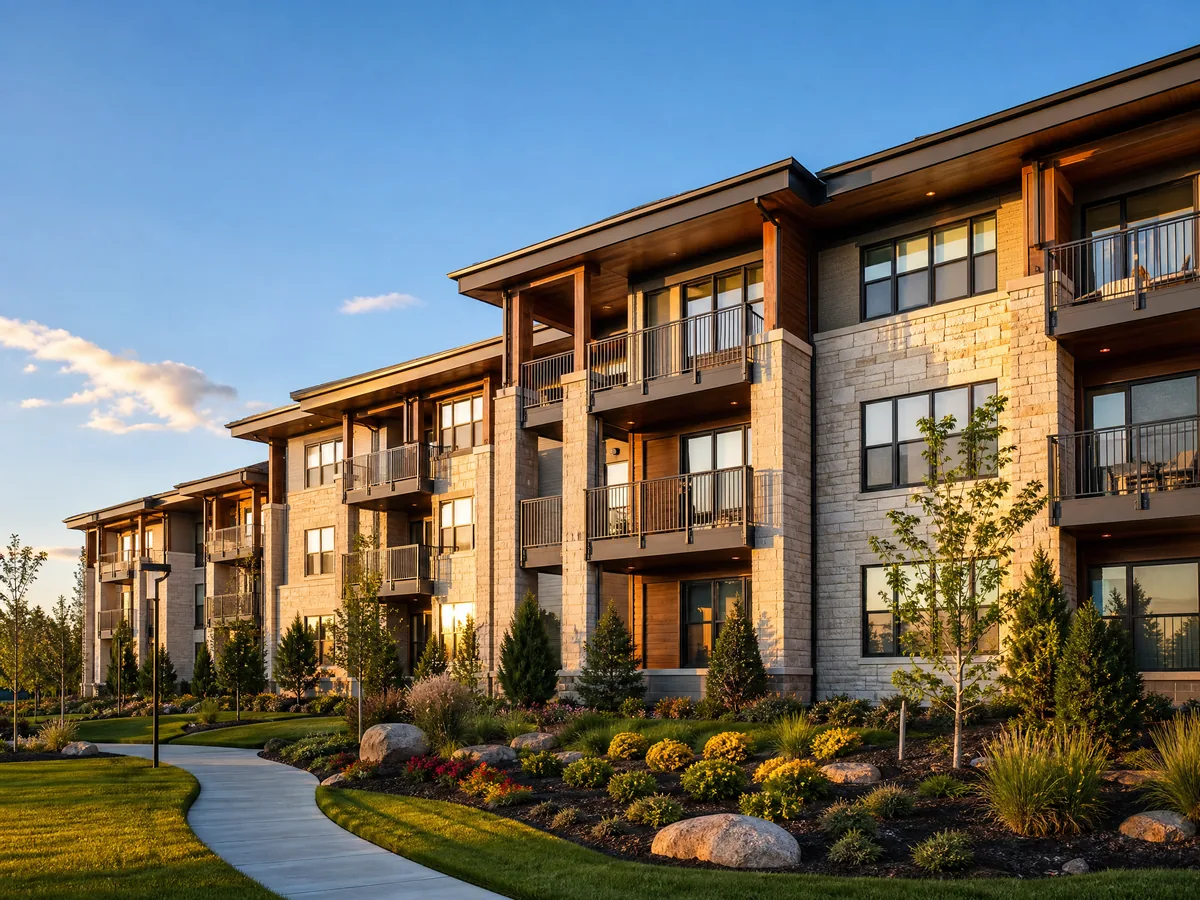
Permanent debt on stabilized Tennessee commercial property.
Long-term financing for stabilized commercial and multifamily assets, placed in house through agency channels, insurance funds and other wholesale sources. On a long hold the Tennessee variables are the 40 percent commercial assessment ratio, the certified tax rate reset at reappraisal, and franchise and excise tax on the owning entity. Business-purpose only, and every structure is set in underwriting.
Typical figures, subject to underwriting and market conditions. Not a commitment to lend.
How it works
For a stabilized asset ready for permanent debt, we shop your file across agency multifamily programs, insurance companies, and wholesale lenders, then place the structure that fits your hold. When a deal needs to stabilize first, we can bridge it and refinance into permanent debt later.
How does Tennessee assess commercial property, and what does it do to NOI?
At 40 percent of value, which is the single biggest structural difference from a residential asset. TCA 67-5-801 assesses residential and farm property at 25 percent of value and industrial and commercial property at 40 percent, so the same building at the same market value carries a 60 percent higher assessed base as a commercial parcel at the same local rate. On a permanent loan that line is fixed, non-discretionary and locally set for the whole term, and it goes straight through net operating income into the coverage test that sizes the loan. There is no state property tax; the levy is county and municipal, and inside a city a parcel pays both. Underwrite the specific parcel rather than a state average, and read the metro page for local rates, for example Nashville.
What happens to my tax line at the next Tennessee reappraisal?
The rate is supposed to fall, and the county has to hold a hearing to keep it up. Counties revalue on a continuous six-year cycle, or a four-year cycle with State Board of Equalization approval, or a five-year cycle where the assessor agrees and the county legislative body votes it, and values are frozen in between. After a countywide reappraisal the assessor and chief executive compute a certified tax rate that raises the same total revenue as the prior year on the new values, reviewed by the State Board of Equalization. To adopt a rate above it, the governing body must publish notice, hold a public hearing, and file an affidavit of publication and a certified copy of the rate ordinance with the State Board. So a large jump in assessed value does not mechanically produce a proportionate bill. What you absorb is whatever the county votes above certified plus how your parcel moved relative to the county average. On a ten-year hold, plan for one or two of these.
Does my Tennessee ownership entity owe state tax on a stabilized asset?
Almost certainly yes, whatever you have read about no income tax. Tennessee repealed the Hall income tax for tax years beginning on or after January 1, 2021, so there is no individual income tax. But franchise and excise tax reaches corporations, LLCs, LPs and business trusts chartered, qualified or registered in Tennessee or doing business here: excise at 6.5 percent of Tennessee net earnings and franchise at 0.25 percent of net worth, with a $100 minimum payable even by an inactive registered entity. Public Chapter 950 of 2024 repealed the alternative property measure, so franchise tax is net-worth-only for years ending on or after January 1, 2024. The family-owned exemption does not help here: commercial rents do not qualify as passive investment income. Tennessee does follow federal section 1031 and opportunity-zone deferral for excise purposes. Confirm with your Tennessee CPA.
What does Tennessee charge to record a large permanent loan?
Eleven and a half cents per $100 of debt, and it scales all the way up. The indebtedness tax is $0.115 per $100 with the first $2,000 exempt, paid by the mortgagor and collected and remitted by the note holder, and every recorded debt instrument carries a legend stating the maximum principal indebtedness for Tennessee recording tax purposes. On a $10,000,000 permanent loan that is $11,497.70 (9,998,000 / 100 x 0.115 = 11,497.70). If the placement accompanies a purchase, add the realty transfer tax at $0.37 per $100 of the greater of consideration or value, paid by the grantee by statute. On an assumption there is no indebtedness tax where the seller stays liable, while a new contract cancelling the seller's obligation is new debt and is taxed. Those are budget lines, not rounding.
Who closes a permanent commercial loan in Tennessee?
A title or escrow company, with an attorney where the documents require one. Tennessee is a title and escrow state: no attorney is required to close, and title companies and escrow agents customarily handle closings, staffed by non-attorneys. Drafting a deed for another party is the practice of law under TCA 23-3-103 and stays with a licensed attorney. Legislation effective July 1, 2025 gives the buyer or borrower the right to choose the settlement agent subject to lender approval, though the commentary on it is residential throughout and whether it reaches commercial transactions is not settled in our sourcing. We also decline to tell you who customarily pays for the owner's policy in Tennessee, or to compare Tennessee title costs to another state's, because neither has a source we would publish from. Get a written closing estimate early.
How should I insure a Tennessee commercial asset on a long hold?
Through the standard market while you can, and with the deductible modelled. Tennessee's dominant perils are tornado, straight-line wind and hail rather than coastal storm, and Middle Tennessee has documented major outbreaks in March 2020 and December 2023. The state has no FAIR plan and no property insurer of last resort, so any asset that becomes hard to place, including one that goes substantially vacant, goes to surplus lines with no public backstop. Percentage wind and hail deductibles are common in this market, which changes the shape of a loss on a large roof area. We publish no Tennessee average premium; the secondary figures conflict badly. The Department of Commerce and Insurance publishes filing-level rate changes, and that is the place to look for a real trend rather than an agency blog.
More CRE Permanent questions, answered on the program page
Local rules move. Every tax rate, fee, ordinance and market figure here comes from a primary source and carries the date we read it, and we correct them as the rules change. Where a number is mid-change or we could not verify it, we say so rather than guess. Before you commit a budget, confirm anything that drives it with the city or county, and talk to your attorney or CPA on questions of law or tax.
Published by USA Mortgage Funding, LLC, NMLS #152588. Researched from primary sources by our team, drafted with AI assistance, and every figure checked against its source before publishing. Where an answer rests on a public record, that record is linked under it. Figures read on 2026-08-23.
Funding Tennessee deals fast.
Get real terms, usually same day. No obligation, no hard credit pull to start.