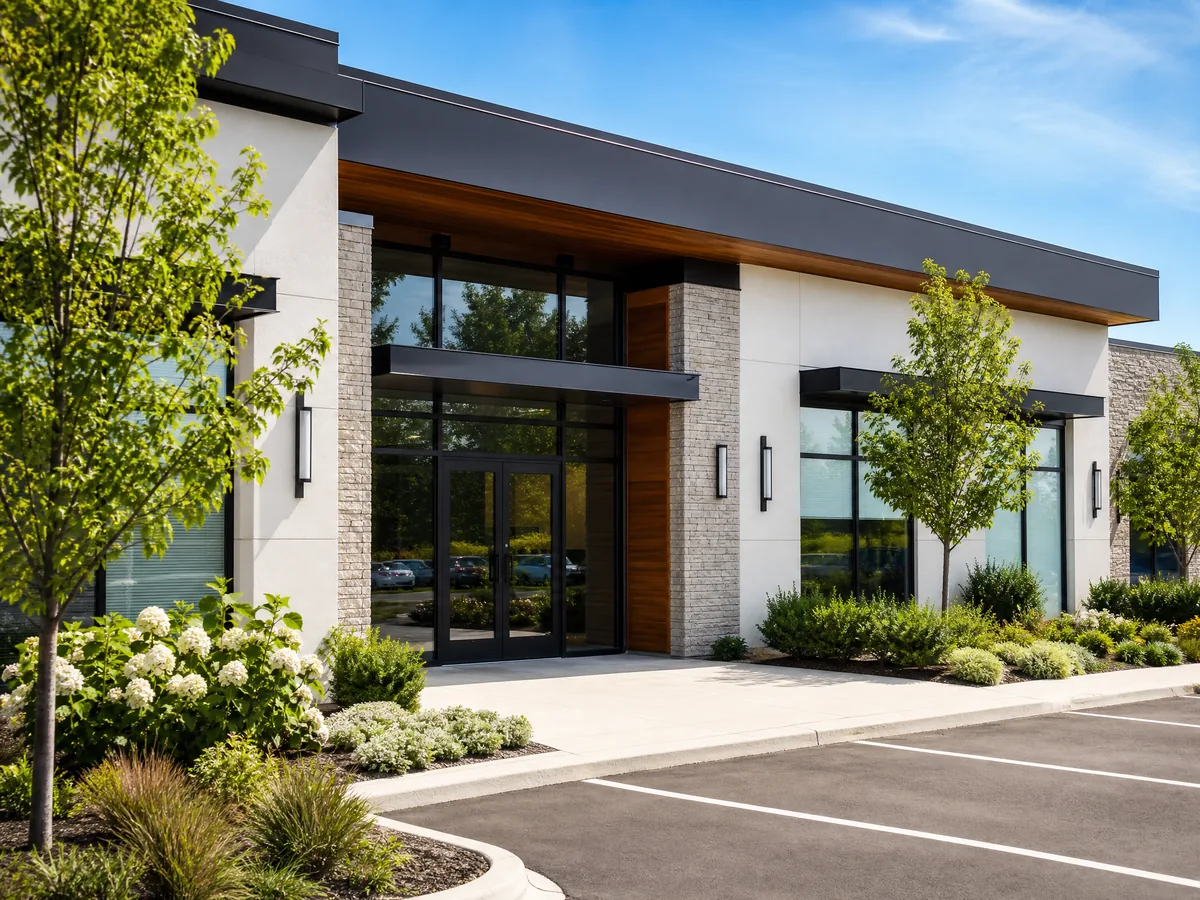
SBA financing for Tennessee owner-occupied commercial property.
SBA 7(a) and 504 financing from $350,000 to $5,000,000 and up, financing up to 90% and amortising as long as 25 years, for owner-occupied commercial real estate. Expect 30 to 90 days rather than a hard-money timeline. Tennessee's own layer is the 40 percent commercial assessment ratio, the two closing taxes, and franchise and excise tax on the operating entity. Business-purpose only, and every structure is set in underwriting.
Typical figures, subject to underwriting and market conditions. Not a commitment to lend.
How it works
SBA loans offer low down payments and long amortizations for owner-occupied property and business acquisition. USA Mortgage arranges and places SBA financing through our network of partner lenders; we are not ourselves an SBA lender. We shop your file across that network so you get the strongest approval.
How is my Tennessee building assessed once my business occupies it?
As commercial, at 40 percent of value. TCA 67-5-801 sets the assessment ratio at 25 percent for residential and farm property and 40 percent for industrial and commercial, so an owner-occupied building carries a 60 percent higher assessed base than a house of the same market value at the same local rate. On a 25-year amortisation that is a long-lived operating expense, and it is a county and municipal levy with no state property tax, so inside a city you pay both. Values are frozen between countywide reappraisals and there is no acquisition-value reset when you buy, which makes the first several years fairly predictable. For local rate context, read the metro page, for example Nashville SBA loans.
What does Tennessee add to the closing costs on an SBA purchase?
A tax on the deed and a tax on the note. The realty transfer tax is $0.37 per $100 of the greater of consideration or value, and by statute the grantee, meaning your business as buyer, pays it. The indebtedness tax is $0.115 per $100 of debt, first $2,000 exempt, paid by the mortgagor. On a $1,500,000 owner-occupied purchase with a $1,350,000 loan that is $5,550 on the deed (1,500,000 / 100 x 0.37 = 5,550) plus $1,550.20 on the note (1,348,000 / 100 x 0.115 = 1,550.20). A 504 structure records more than one instrument, so ask your closer to itemise the recording tax and county fees across all of them rather than quoting one number. County recording fee schedules are not published uniformly, so confirm locally.
Does my Tennessee operating company owe state tax if there is no income tax?
Yes, through franchise and excise tax. The Hall income tax was repealed for tax years beginning on or after January 1, 2021, so Tennessee has no individual income tax. But corporations, LLCs, LPs and business trusts chartered, qualified or registered here, or doing business here, owe excise at 6.5 percent of Tennessee net earnings and franchise at 0.25 percent of net worth, with a $100 minimum, payable even by an inactive registered entity. Sole proprietors and general partnerships are not subject. Public Chapter 950 of 2024 repealed the alternative property measure, so franchise tax is net-worth-only for years ending on or after January 1, 2024. That is a real line in the debt service coverage an SBA lender underwrites on an operating business. Run it with your Tennessee CPA before you sign a purchase contract.
Who closes an SBA loan in Tennessee, and does a lawyer have to be involved?
A title or escrow company can close it, and no attorney is required by state law. Tennessee is a title and escrow state, the opposite of an attorney-closing state, and closings are customarily handled by title companies and escrow agents staffed by non-attorneys. One task stays with a lawyer: drafting a deed for another party is the practice of law under TCA 23-3-103. Since July 1, 2025 the buyer or borrower chooses the settlement agent, subject to lender approval, and a seller may not require a particular one, though whether that statute reaches commercial transactions is not settled in our sourcing. On an SBA file the lender's own document set and the CDC's requirements usually decide who can handle the closing in practice, so agree that early.
How long does an SBA loan take in Tennessee?
30 to 90 days, and the state layer is not what slows it down. SBA underwriting, the appraisal, environmental review and the agency's own process set the clock, and that is true in every state. What Tennessee adds is administrative rather than slow: two closing taxes to compute, a title or escrow closing rather than an attorney one, and county recording practices that vary. If the timeline does not fit the seller's deadline, a Tennessee commercial bridge loan can take the purchase and the SBA loan can refinance it once the process completes. Talk to us before you sign a contract with a short closing date. Subject to underwriting.
What size SBA loan can I get in Tennessee, and how much do I put in?
From $350,000 to $5,000,000 and up, with financing up to 90 percent. On a $2,000,000 owner-occupied Tennessee building financed at 90 percent that is $1,800,000 from the loan and $200,000 from you (2,000,000 x 90% = 1,800,000), before closing costs, and Tennessee's transfer and indebtedness taxes sit on top of that. Terms run up to 25 years, across 7(a) and 504 structures. The property must be owner-occupied commercial real estate, which is the line that separates this from our investment programs. Subject to underwriting.
Can a first-time commercial buyer use an SBA loan in Tennessee?
Yes, and that is much of what the program exists for. There is no prior-property requirement. What matters is the operating business: its cash flow, its time in business, and whether it will occupy the property, since SBA financing here is for owner-occupied commercial real estate. Financing runs up to 90 percent, which is far more leverage than a conventional commercial purchase, and terms out to 25 years keep the payment manageable. Budget the Tennessee closing taxes and the 40 percent commercial assessment into your first-year cash. Subject to underwriting.
More SBA Financing questions, answered on the program page
Local rules move. Every tax rate, fee, ordinance and market figure here comes from a primary source and carries the date we read it, and we correct them as the rules change. Where a number is mid-change or we could not verify it, we say so rather than guess. Before you commit a budget, confirm anything that drives it with the city or county, and talk to your attorney or CPA on questions of law or tax.
Published by USA Mortgage Funding, LLC, NMLS #152588. Researched from primary sources by our team, drafted with AI assistance, and every figure checked against its source before publishing. Where an answer rests on a public record, that record is linked under it. Figures read on 2026-08-23.
Funding Tennessee deals fast.
Get real terms, usually same day. No obligation, no hard credit pull to start.