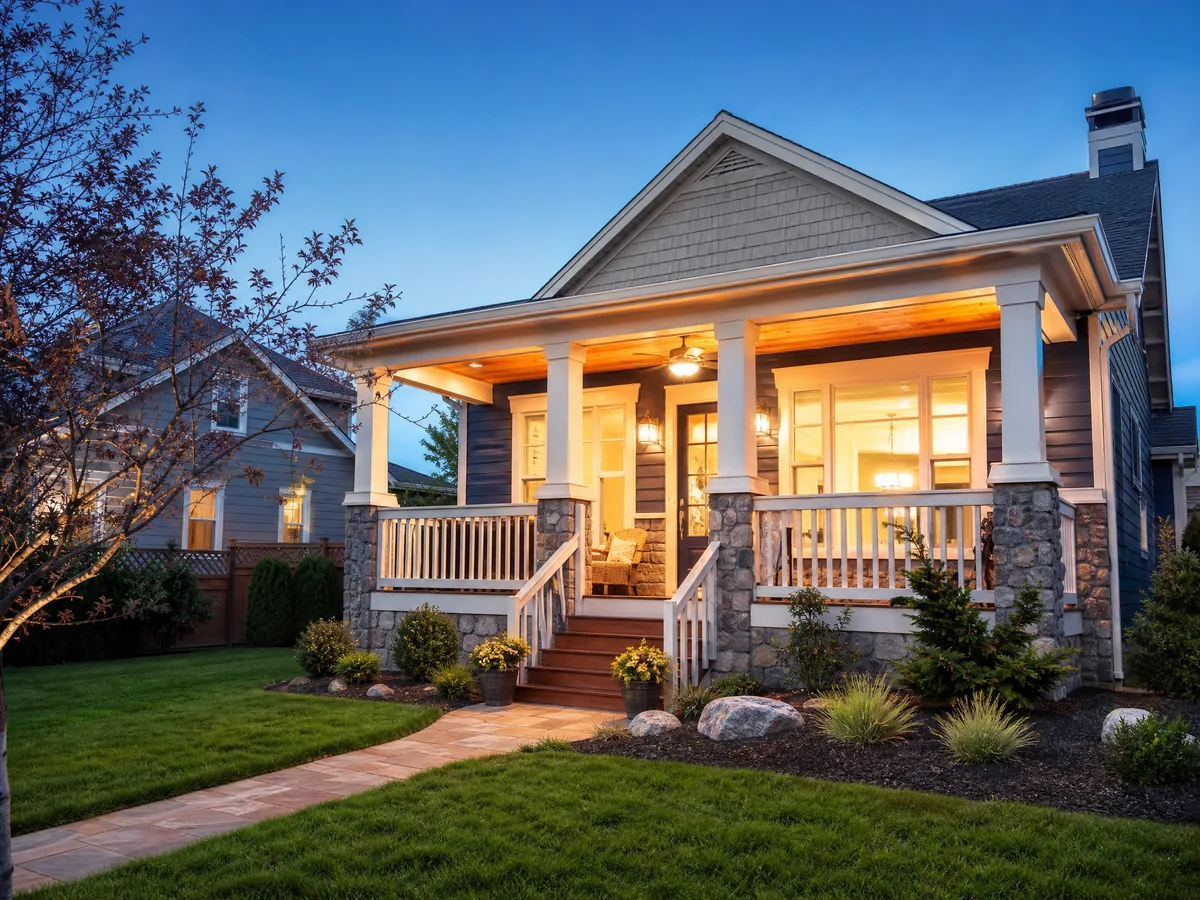
DSCR loans for Washington rentals, qualified on the property.
Hold your rentals with financing that underwrites the asset, not just you. DSCR as low as 0.75, 30-year fixed and 5, 7 and 10 year ARM options, for single properties or whole portfolios. Washington caps annual rent increases statewide, so the rent growth line in your model is a legal question here before it is a market one. Business-purpose only, and every structure is set in underwriting.
Typical figures, subject to underwriting and market conditions. Not a commitment to lend.
How it works
No tax returns or personal income docs in most cases. We qualify on the property's cash flow, so you can scale your portfolio without the paperwork drag of conventional lending.
Yes, since May 7, 2025, and any page that tells you otherwise is out of date. HB 1217, chapter 209, Laws of 2025, added RCW 59.18.700, which bars a landlord from raising rent during the first 12 months of a tenancy and, in any 12-month period after that, by more than 7% plus CPI or 10%, whichever is less. The Department of Commerce publishes the number each year: 9.683% for calendar 2026 and 10% for calendar 2027. The index is the Seattle-area June-over-June CPI-U for all urban consumers, all items, and it governs the whole state, so a rental in Spokane or Vancouver WA is capped by a Seattle number. Cities are still preempted from setting their own rent caps under RCW 35.21.830. The state does it now instead. The section expires July 1, 2040 unless amended.
Is a single-family rental exempt from the Washington rent cap?
No, and this is the most common mistake on a Washington rental model. RCW 59.18.710(1) opens by saying a landlord may exceed the cap only as authorized by the exemptions described in this section, and detached single-family rentals appear on that list in one place only: subsection (f), which requires an owner-occupied residence. A non-owner-occupied rental house, the classic DSCR asset, is covered once it is more than 12 years past its first certificate of occupancy. Neither property type nor portfolio size changes the answer, and the cap applies regardless of whether the tenancy is month-to-month or for a fixed term, so you cannot structure around it with month-to-month leases. There is also a lease-type parity rule: you may not charge more than a 5% difference for a given unit based on lease type. Subject to underwriting on our side, and worth a conversation with your Washington attorney on yours.
Which exemptions does a Washington investor actually get?
Two: the 12-year new construction window, and vacancy decontrol. RCW 59.18.710(1)(a) exempts a unit whose first certificate of occupancy issued 12 or fewer years before the date of the rent-increase notice. Read that precisely. It runs from the first CO to the date of the notice, not the date of the increase, not your purchase date, and not a renovation date, and it follows the building rather than the owner, so a building rolls out of the exemption on the twelfth anniversary of its first CO. We have found no guidance saying a gut rehab or a conversion restarts that clock, so do not assume it does. The second one is the release valve: RCW 59.18.700(1)(b) says the cap does not stop you adjusting rent by any amount after a tenant vacates. There is no limit on what a new tenant is charged. The owner-occupancy exemptions in (e) through (g) are switched off under RCW 59.18.710(2) where the owner is a REIT, a corporation, or an LLC with at least one corporate member, which is directly relevant to how you title.
How much notice does a Washington rent increase need?
90 days statewide, and more in some cities. This is the one place the state genuinely splits by region. RCW 59.18.140 requires a minimum of 90 days prior written notice of a rent increase, and the increase cannot take effect before the term of the rental agreement completes. Income-based subsidized tenancies run on 30 days. On top of that, Seattle requires 180 days under SMC 22.206.180 and attaches an Economic Displacement Relocation Assistance obligation to any increase of 10% or more in a 12-month period, and Tacoma also requires at least 180 days plus relocation assistance. We have not located comparable ordinances in Spokane or Vancouver WA, so do not assume the 90-day floor is the whole answer there either. Verify the city. The notice itself has to follow the statutory form in RCW 59.18.720, stating the effective date, the percentage, the dollar increase and the new total, and an exemption claim has to be checked on the form with supporting facts.
What happens if I get the rent increase wrong?
Mandatory damages and one-way fee shifting, and the Attorney General can come at it directly. Under RCW 59.18.700(5)(a), on a finding of violation the court shall award the tenant damages equal to any excess rent, fees or costs paid, damages of up to three months of the unlawful rent, fees or costs charged, and reasonable attorneys' fees and costs. RCW 59.18.700(5)(b) lets the Attorney General act whether or not the tenant gave you a chance to cure, recover civil penalties of up to $7,500 per violation, and issue civil investigative demands. A tenant who gives written demand to cure may then terminate before the increase takes effect on 20 days notice without fees. And you may not report a tenant to a screening service for not paying the unlawfully increased portion. None of this changes how we size a loan, but it should change how you build a management process before you close.
Do Washington taxes help or hurt the DSCR calculation?
Helpful on the income line, unforgiving on the tax line. There is no income tax on the money you earn today, no corporate income tax, and no capital gains excise tax on real estate transferred by deed. RCW 82.04.390 and WAC 458-20-118 keep rents outside the business and occupation tax, though a mere license to use property without exclusive possession is taxable service income, which is where short-stay arrangements can land. Against that, property tax runs on 100% of true and fair value with no assessment cap under RCW 84.40.030(1), and it sits inside the DSCR ratio along with insurance, so it is often the line that decides the approval. Note also that SB 6346, signed in 2026, creates a 9.9% tax on Washington income above $1,000,000 including rental and pass-through income for tax years beginning in 2028, and it is being challenged in court. Run the deal on the DSCR calculator and take entity questions to a Washington CPA.
How much do I need to put down on a Washington DSCR rental?
Plan on 20% at maximum leverage. We go up to 80% LTV, so on a $500,000 purchase that is up to $400,000 from us and $100,000 from you (500,000 x 80% = 400,000), before closing costs and reserves. The DSCR floor is 0.75, and taxes and insurance sit inside that ratio. In Washington that means a full-value property tax assessment with no cap, plus an earthquake add-on if you carry one, can be the thing that pushes you to a larger down payment. Subject to underwriting.
I am sitting right at 640. Does that change my terms on a Washington DSCR loan?
640 is where this program starts, not where maximum leverage starts. We do run credit here, unlike our asset-based programs, because a 30-year rental loan prices off it. At the floor, expect lower leverage rather than a decline, and there is no hard pull to open a file. If your score will not clear it, the asset-based side of the shop has no minimum at all. Subject to underwriting.
Is there a minimum loan size on a Washington DSCR rental loan?
Yes. $100,000 to $3,000,000. That range covers most single-family and small multifamily in Washington. Above the top end, or holding five or more doors, a portfolio structure usually fits better. Terms run 30-year fixed or 5, 7 and 10 year ARM, and prepay comes in flexible structures set with the rest of the terms, so tell us up front if you expect to sell or refinance early. Subject to underwriting.
More Rental / DSCR questions, answered on the program page
Local rules move. Every tax rate, fee, ordinance and market figure here comes from a primary source and carries the date we read it, and we correct them as the rules change. Where a number is mid-change or we could not verify it, we say so rather than guess. Before you commit a budget, confirm anything that drives it with the city or county, and talk to your attorney or CPA on questions of law or tax.
Published by USA Mortgage Funding, LLC, NMLS #152588. Researched from primary sources by our team, drafted with AI assistance, and every figure checked against its source before publishing. Where an answer rests on a public record, that record is linked under it. Figures read on 2026-08-12.
Funding Washington deals fast.
Get real terms, usually same day. No obligation, no hard credit pull to start.