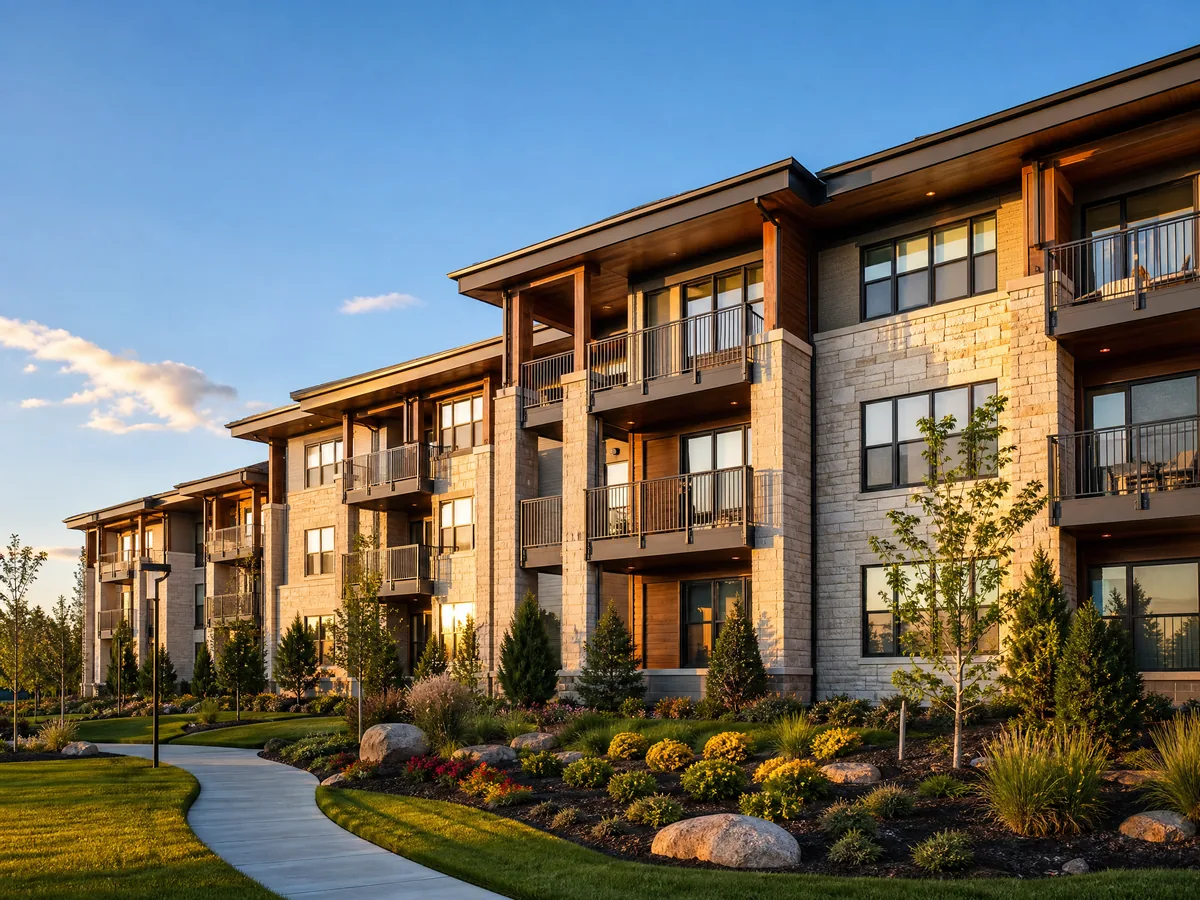
Permanent commercial mortgage debt on stabilized Washington property.
Long-term, permanent financing for stabilized commercial real estate. We place it in house through agency multifamily channels (Fannie Mae and Freddie Mac), insurance funds, and other wholesale sources. On a Washington multifamily asset the statewide rent cap is now part of how a long-term lender reads your rent roll. Business-purpose only, and every structure is set in underwriting.
Typical figures, subject to underwriting and market conditions. Not a commitment to lend.
How it works
For a stabilized asset ready for permanent debt, we shop your file across agency multifamily programs, insurance companies, and wholesale lenders, then place the structure that fits your hold. When a deal needs to stabilize first, we can bridge it and refinance into permanent debt later.
How does the statewide rent cap change what a permanent lender underwrites?
It puts a legal ceiling on the rent growth line, which is new since May 7, 2025. RCW 59.18.700 bars any increase in the first 12 months of a tenancy and caps later increases at 7% plus CPI or 10%, whichever is less, measured per rolling 12-month period of that tenancy rather than per calendar year. The Department of Commerce publishes the maximum annually: 9.683% for 2026 and 10% for 2027, calculated on Seattle-area June-over-June CPI for all urban consumers, and the same number governs the whole state. A long-term lender sizing to debt service coverage now has an upper bound on organic growth for every covered unit in the rent roll. Bring the certificate of occupancy date for the building and the in-place rent schedule to the first call. Subject to underwriting. The section expires July 1, 2040 unless amended.
Which Washington multifamily assets are exempt from the cap?
New buildings, for 12 years, and units that turn over. RCW 59.18.710(1)(a) exempts a tenancy in a unit whose first certificate of occupancy issued 12 or fewer years before the date of the rent-increase notice. The clock runs from the first CO to the notice date, it follows the building rather than the owner, and the building rolls out of the exemption on the twelfth anniversary. The other exemptions reach public housing authorities, public development authorities, nonprofits with regulated rents, and LIHTC developments with an enforceable Washington State Housing Finance Commission regulatory agreement in place. Separately, RCW 59.18.700(1)(b) is explicit that nothing stops you adjusting rent by any amount after a tenant vacates. There is no published guidance saying a substantial rehab or a conversion earns a new first certificate of occupancy, so a repositioning plan should not assume the 12-year clock restarts.
Do manufactured housing communities run on the same rules in Washington?
No, they run on a tighter track, and it matters to how the asset underwrites. RCW 59.20.370(1) bars a lot rent increase in the first 12 months of a tenancy and caps later increases at a flat 5% in any 12-month period. There is no CPI component, no annual Commerce publication, and no 12-year new-construction exemption: RCW 59.20.380 exempts only lots owned by public housing authorities, public development authorities and nonprofits, qualified low-income developments they own, plus a post-qualified-sale provision and a one-time increase when a rental agreement transfers on the sale of a home. The section was amended in 2026 by HB 2452, principally to change how the increase notice is served, and the 5% figure survived. Park economics in Washington are materially tighter than apartment economics for this reason, and a permanent lender will price to that.
What does the excise tax cost on a large Washington commercial transfer?
Up to 3% of the top slice, before local add-ons. The graduated state REET rates are 1.10% up to $525,000, 1.28% to $1,525,000, 2.75% to $3,025,000, and 3.00% above $3,025,000, plus a $5 state technology fee per transfer. Cities and counties may add 0.25%, and jurisdictions planning under the Growth Management Act may add another 0.25%, so a 0.50% local stack is common in Puget Sound. That structure means the blended rate on a large asset sits far above what a flat-rate state charges, and it should be modelled in the hold period rather than discovered at closing. Agricultural land and timberland are a flat 1.28% at any price. The thresholds readjust every fourth year and 2026 is an adjustment year, so verify DOR before relying on them into 2027, and confirm your city's local rate on DOR's tables. We have not verified who bears REET by custom, so treat the allocation as a contract question.
How do Washington property taxes hit the NOI a permanent lender underwrites?
At full value, with nothing capping the reassessment. RCW 84.40.030(1) requires all property to be valued at 100% of its true and fair value and assessed on the same basis, and Washington has no assessment-increase cap. On a long-term hold that means the tax line tracks value rather than your purchase price, and the familiar 1% figure is a levy limit on taxing districts, not a ceiling on a bill, under RCW 84.55.010 and the limit factor in RCW 84.55.005(2). Underwrite the tax line at reassessed value rather than the seller's current bill. Appeals go to the county board of equalization by July 1 of the assessment year, or within 30 days of the value-change notice, or within a county-set window of up to 60 days, whichever is later, and counties set their own windows. Submarket detail belongs on the metro page, for example Seattle CRE permanent or Everett.
Does Washington tax rental income at the entity level?
Not through the business and occupation tax on straightforward rents, and not through an income tax today. RCW 82.04.390 says the B&O chapter does not apply to gross proceeds derived from the sale of real estate, and WAC 458-20-118 says amounts derived from the sale and rental of real estate are exempt. The line to watch is that a mere license to use property, without exclusive possession, is taxable service income, as are property management fees and lending interest, at DOR service rates of 1.5%, 1.75% or 2.1% depending on prior-year income. Washington also has no income tax on income earned today and no corporate income tax, though SB 6346, signed in 2026 and now in litigation, imposes 9.9% on Washington income above $1,000,000 including rental and pass-through income for tax years beginning in 2028. Pair every one of these with your Washington CPA before you model it.
More CRE Permanent questions, answered on the program page
Local rules move. Every tax rate, fee, ordinance and market figure here comes from a primary source and carries the date we read it, and we correct them as the rules change. Where a number is mid-change or we could not verify it, we say so rather than guess. Before you commit a budget, confirm anything that drives it with the city or county, and talk to your attorney or CPA on questions of law or tax.
Published by USA Mortgage Funding, LLC, NMLS #152588. Researched from primary sources by our team, drafted with AI assistance, and every figure checked against its source before publishing. Where an answer rests on a public record, that record is linked under it. Figures read on 2026-08-12.
Funding Washington deals fast.
Get real terms, usually same day. No obligation, no hard credit pull to start.