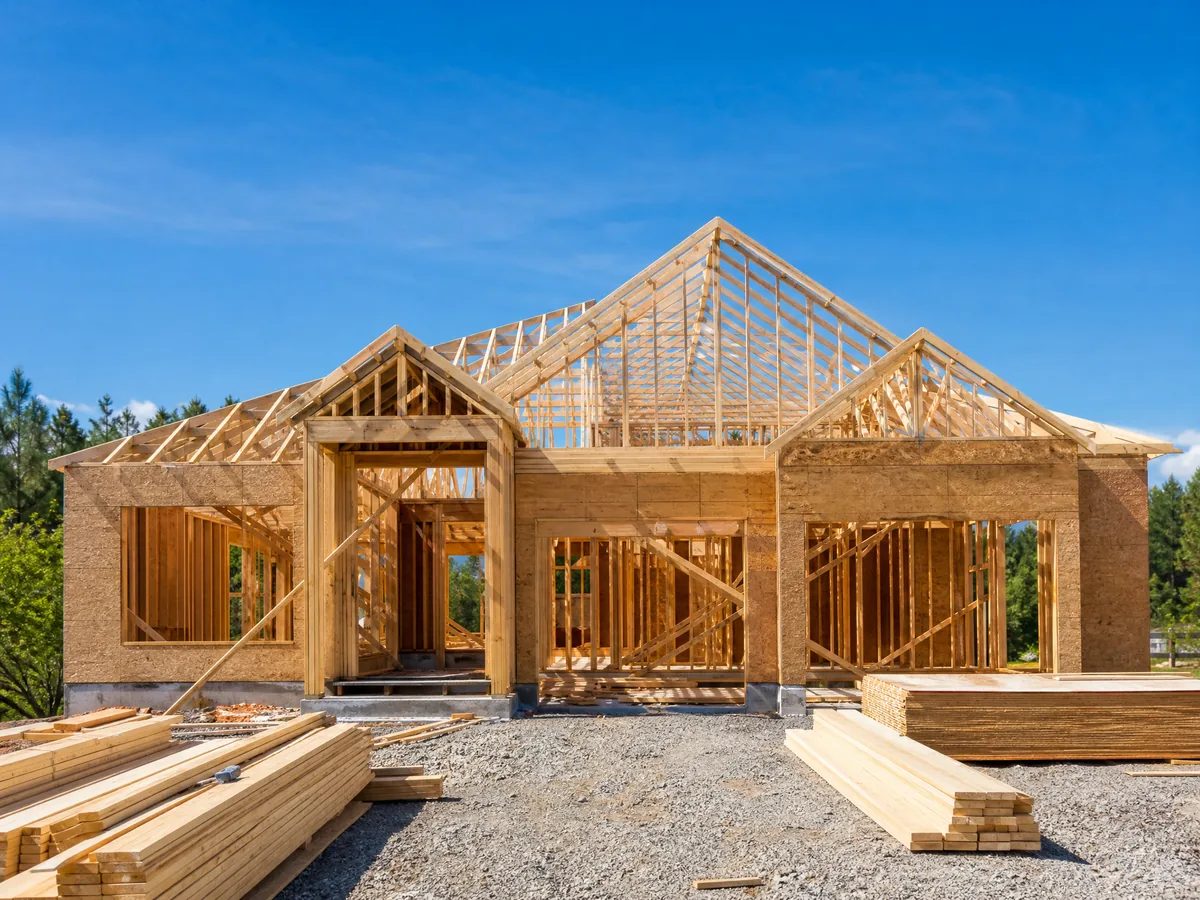
Ground up construction loans for Washington builders, dirt to finish.
Built for spec home builders and developers. We fund the land and the vertical build up to 70% LTV and 85% of cost, with draws that keep pace with the job, on a 12 to 24 month term. New construction is the one asset class Washington's rent cap leaves alone for its first 12 years, which is worth understanding before you decide whether to sell or hold. Business-purpose only, and every structure is set in underwriting.
Typical figures, subject to underwriting and market conditions. Not a commitment to lend.
How it works
We finance both the land and the vertical construction, with a draw schedule built around your timeline. Experienced builders can access higher leverage on cost.
Does new construction escape Washington's rent cap?
For 12 years, and the clock is measured more precisely than people assume. RCW 59.18.710(1)(a) exempts a tenancy in a unit whose first certificate of occupancy issued 12 or fewer years before the date of the rent-increase notice. It runs from the first CO to the date of the notice, not to the date the increase takes effect, and it follows the building rather than the owner, so the exemption transfers with a sale and expires on the twelfth anniversary regardless of who holds title. Two things a builder should not assume: we have found no Commerce or Attorney General guidance saying a rehab or an office-to-apartment conversion earns a new first certificate of occupancy and restarts the window, and the exemption still has to be claimed on the statutory notice form with supporting facts under RCW 59.18.700(2). If your plan is build and hold, that window is a real asset. Talk it through with your Washington attorney before you underwrite to it.
What does the excise tax do to a spec sale in Washington?
It scales with your price, which matters most to builders at the top of the market. Washington REET is graduated: 1.10% up to $525,000, 1.28% to $1,525,000, 2.75% to $3,025,000, and 3.00% above, plus a $5 state technology fee per transfer, with a possible 0.25% local levy and another 0.25% where the jurisdiction plans under the Growth Management Act. Worked on an $800,000 spec sale in a full 0.50% city: $5,775 on the first $525,000 plus $3,520 on the next $275,000 equals $9,295 of state REET, plus $4,000 local, about $13,295, roughly 1.66% of price. Push the same house to $1.6 million and part of the price crosses into the 2.75% band. One live caution for anyone planning a 2027 delivery: the thresholds are adjusted every fourth year and 2026 is an adjustment year, with new numbers published by September 1, so re-check DOR rather than carrying these forward. Undeveloped agricultural land and timberland sit at a flat 1.28% regardless of price.
Does Washington charge business tax on the sale of a finished spec home?
Not on the real estate proceeds themselves. RCW 82.04.390 says the business and occupation tax chapter does not apply to gross proceeds derived from the sale of real estate, and WAC 458-20-118 repeats it for sale and rental alike. What the chapter does reach is commissions, interest, and fees, plus service income, and the B&O service rates published by the Department of Revenue are 1.5% under $1 million of prior-year income, 1.75% from $1 million to $4,999,999, and 2.1% at $5 million and above, with retailing at 0.471% and wholesaling at 0.484%. A small business B&O credit exists. Where a builder's own structure lands, and whether construction activity itself is classified as retailing on someone else's land, is a question for your Washington CPA, not for a lender.
How does the land loan and the trustee's sale calendar affect a Washington build?
It gives you a long lead on distressed dirt and a long tail if a project goes sideways. Washington forecloses non-judicially under chapter 61.24 RCW, with the notice of trustee's sale recorded and mailed at least 90 days out and a statutory floor of 190 days from the date of default before any sale. That is a long visible runway on land coming to auction, and a cure right that runs to 11 days before the sale, so budget for attrition on anything you are chasing. Because a business-purpose construction loan is a commercial loan under RCW 61.24.005(6), it sits outside the 61.24.031 meet-and-confer track and outside Foreclosure Fairness Act mediation. After a trustee's sale there is no right of redemption. For what land actually costs and how fast product absorbs, go to the market page, for example Bellingham ground up construction or Olympia.
What insurance issues come up on a Washington build?
Earthquake and earth movement, both of which sit outside a standard policy. The Washington Office of the Insurance Commissioner states plainly that earthquake insurance is coverage you add or buy separately, and that deductibles usually run 10% to 25% of the maximum the policy would pay on the building. Earth movement, including landslide, settling and sinking, is also excluded, which is the line that matters on a sloped or filled lot. And carriers normally impose a waiting period after an earthquake before new coverage can be bound, so it is not a coverage you add reactively. We have not sourced Washington premium levels and will not quote them. Get real quotes on the parcel, with the builder's risk form your lender will require, before you finalise the budget.
What credit score do I need for a Washington construction loan?
There is no minimum score on this program. Ground up construction is asset-based, so credit carries far less weight than it would at a bank. The file turns on the land, the budget, the build schedule and the exit. Weaker credit is usually answered with lower leverage rather than a decline, and there is no hard credit pull to start. Subject to underwriting.
How much do I have to put into a Washington ground up deal?
Enough to clear both tests, and the tighter of the two governs. We lend up to 70% LTV and up to 85% of cost. On a $2,000,000 total project cost, 85% LTC is $1,700,000 from us and $300,000 from you (2,000,000 x 85% = 1,700,000), provided that number also sits inside 70% of value. Experienced builders can access higher leverage. Funds go out in draws against the build schedule rather than up front. Subject to underwriting.
What is the largest Washington construction loan you write, and over what term?
Up to $5,000,000, on a 12 to 24 month term. Draws are released against the build schedule as work is completed and inspected. Size the term against permitting, the build itself, and a sale window, then look at the excise tax on the exit, because it is graduated and rises with your price. If the plan is to hold rather than sell, look at the 12-year rent-cap exemption a new certificate of occupancy carries. Subject to underwriting.
More Ground-Up Construction questions, answered on the program page
Local rules move. Every tax rate, fee, ordinance and market figure here comes from a primary source and carries the date we read it, and we correct them as the rules change. Where a number is mid-change or we could not verify it, we say so rather than guess. Before you commit a budget, confirm anything that drives it with the city or county, and talk to your attorney or CPA on questions of law or tax.
Published by USA Mortgage Funding, LLC, NMLS #152588. Researched from primary sources by our team, drafted with AI assistance, and every figure checked against its source before publishing. Where an answer rests on a public record, that record is linked under it. Figures read on 2026-08-12.
Funding Washington deals fast.
Get real terms, usually same day. No obligation, no hard credit pull to start.