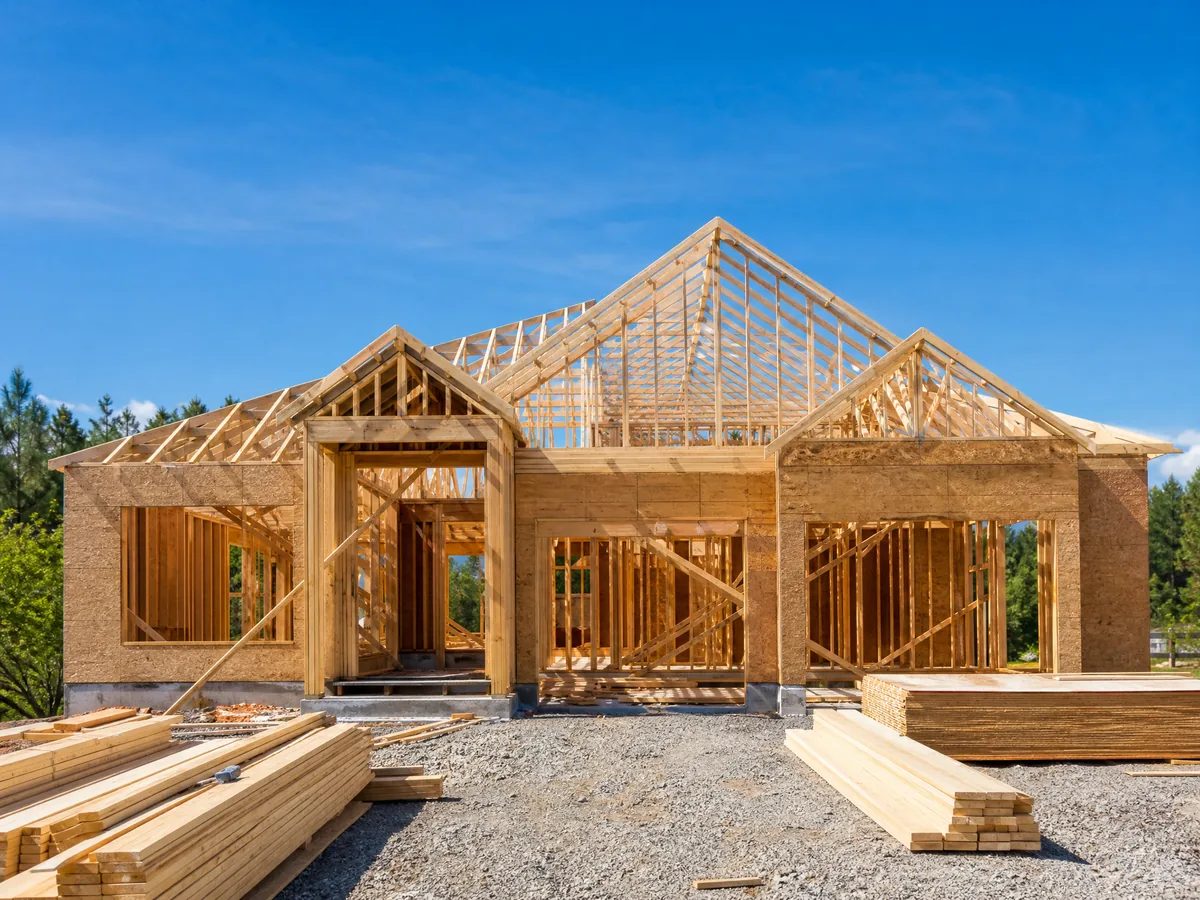
Ground-up construction financing for Colorado builders.
Land and vertical construction financing up to $5,000,000, drawn against your build schedule on a 12 to 24 month term. Colorado is cheap to convey and record, taxes vacant land as non-residential until it is improved, and prices insurance around hail. Business-purpose only, and every structure is set in underwriting.
Typical figures, subject to underwriting and market conditions. Not a commitment to lend.
How it works
We finance both the land and the vertical construction, with a draw schedule built around your timeline. Experienced builders can access higher leverage on cost.
How is my Colorado lot taxed while I am building on it?
As non-residential property, which is the expensive side of the Colorado table. Vacant land sits with commercial and business personal property at a 27% assessment rate for tax year 2025, with most non-residential categories dropping to 25% to 26% for 2026. Finished residential property is assessed far lower, on two rates since tax year 2025: 7.05% against school district mills and 6.25% against local government mills for 2025, moving to 7.05% and 6.8% for 2026. So the carry on a held lot is not the same math as the carry on a finished house, and a build that stretches across a January 1 assessment date carries the higher classification for that year. Confirm the classification with the county assessor for your parcel rather than assuming.
What do recording and conveyance actually cost on a Colorado build?
Almost nothing, and that is genuinely unusual for a loan with this many documents. Recording went flat on July 1, 2025 under HB24-1269: $43 per recorded document regardless of page count, being a $40 fee plus a $3 technology surcharge. A 40-page construction deed of trust records for the same $43 as a one-page release, which in a per-page state would have been a real number. On the land purchase, CRS 39-13-102 charges a documentary fee of one cent per $100 of consideration, so a $300,000 lot costs $30 (300,000 divided by 100 = 3,000, times $0.01 = $30). Colorado has no state real estate transfer tax beyond that fee, and TABOR bars new ones, with a few pre-1992 grandfathered exceptions in home-rule mountain towns and none in the Denver or Colorado Springs metros. Confirm the current schedule with the county clerk and recorder.
Does wildfire risk change what you can lend on in Colorado?
It changes the insurance conversation more than the lending one, and the exposure is concentrated rather than statewide. More than 321,000 Colorado homes carry moderate or higher wildfire risk, with about $141 billion of reconstruction value behind them. Along the Front Range, a Division of Insurance analysis published in February 2026 attributes only 0.9% to 24.6% of premium to wildfire, about 1% in Denver, while hail accounts for 26% to 54% depending on county. The Marshall Fire is the warning for builders: per Colorado State University research, 74% of affected homeowners were underinsured and 36% severely so, meaning under 75% of replacement cost. The state FAIR Plan created by HB23-1288 opened residential applications on April 10, 2025, but it writes actual cash value only, caps residential coverage at $750,000, and requires three private-market declinations. We require replacement-cost coverage, so insure the completed value, not the budget.
Does a Colorado build pencil the same way in every metro?
No. The state layer is constant, being the $43 flat recording charge, the documentary fee, the non-residential assessment on your lot, and the June 8 protest deadline. Lot cost, absorption, and what a finished house sells for are not. Denver carries the highest land basis and the deepest buyer pool, Colorado Springs runs cheaper dirt with different demand drivers, and Fort Collins is supply-constrained in a way that shows up in lot pricing. For those numbers go to Denver ground-up construction or Fort Collins ground-up construction, and run the project through the calculators before you close on land.
What happens if a Colorado construction loan goes into default?
It runs through the county public trustee, on a clock that is fast by national standards. Once the notice of election and demand records, CRS 38-38-108(1)(a) sets the sale 110 to 125 calendar days later for non-agricultural property, and 215 to 230 days if the property is agricultural, which matters on rural acreage. A court order authorizing sale under Rule 120 is mandatory but limited in scope. There is no owner redemption after the sale, only junior lienor redemption on the timeline in CRS 38-38-302. Deficiency is permitted, with CRS 38-38-106(6) requiring the holder to bid at least its good faith estimate of fair market value less senior liens, unpaid taxes, and holding costs, though never more than the total owed. We say this plainly because it is the honest backdrop to leverage, not because we expect to use it.
What credit score do I need for a Colorado construction loan?
There is no minimum score on this program. Construction is asset-based, so the file turns on the land, the budget, the plans, and the completed value. We run credit, but it carries far less weight than it would at a bank, and weaker credit is usually answered with lower leverage rather than a decline. There is no hard credit pull to start. Subject to underwriting.
How much equity do I need in a Colorado build?
Enough to clear both tests, because we size to the lower of them. We go up to 70% LTV and up to 85% LTC. On a $2,000,000 total cost that caps us at $1,700,000 on the cost test (2,000,000 x 85% = 1,700,000), and if completed value is $2,300,000 the value test allows $1,610,000 (2,300,000 x 70% = 1,610,000), so the value test governs and you bring the rest. Loans run up to $5,000,000 on a 12 to 24 month term with draws against the build schedule. Subject to underwriting.
Can a first-time builder get a Colorado construction loan?
It is the hardest program to start on, but experience is a leverage question here, not a gate. Experienced builders can access higher leverage, up to the 70% LTV and 85% LTC caps. A first build is underwritten on the plans, the budget, the general contractor, and the completed value, and it usually prices at lower leverage rather than a decline. Bring a real contractor bid and a replacement-cost insurance quote. Subject to underwriting.
More Ground-Up Construction questions, answered on the program page
Local rules move. Every tax rate, fee, ordinance and market figure here comes from a primary source and carries the date we read it, and we correct them as the rules change. Where a number is mid-change or we could not verify it, we say so rather than guess. Before you commit a budget, confirm anything that drives it with the city or county, and talk to your attorney or CPA on questions of law or tax.
Published by USA Mortgage Funding, LLC, NMLS #152588. Researched from primary sources by our team, drafted with AI assistance, and every figure checked against its source before publishing. Where an answer rests on a public record, that record is linked under it. Figures read on 2026-08-12.
Funding Colorado deals fast.
Get real terms, usually same day. No obligation, no hard credit pull to start.