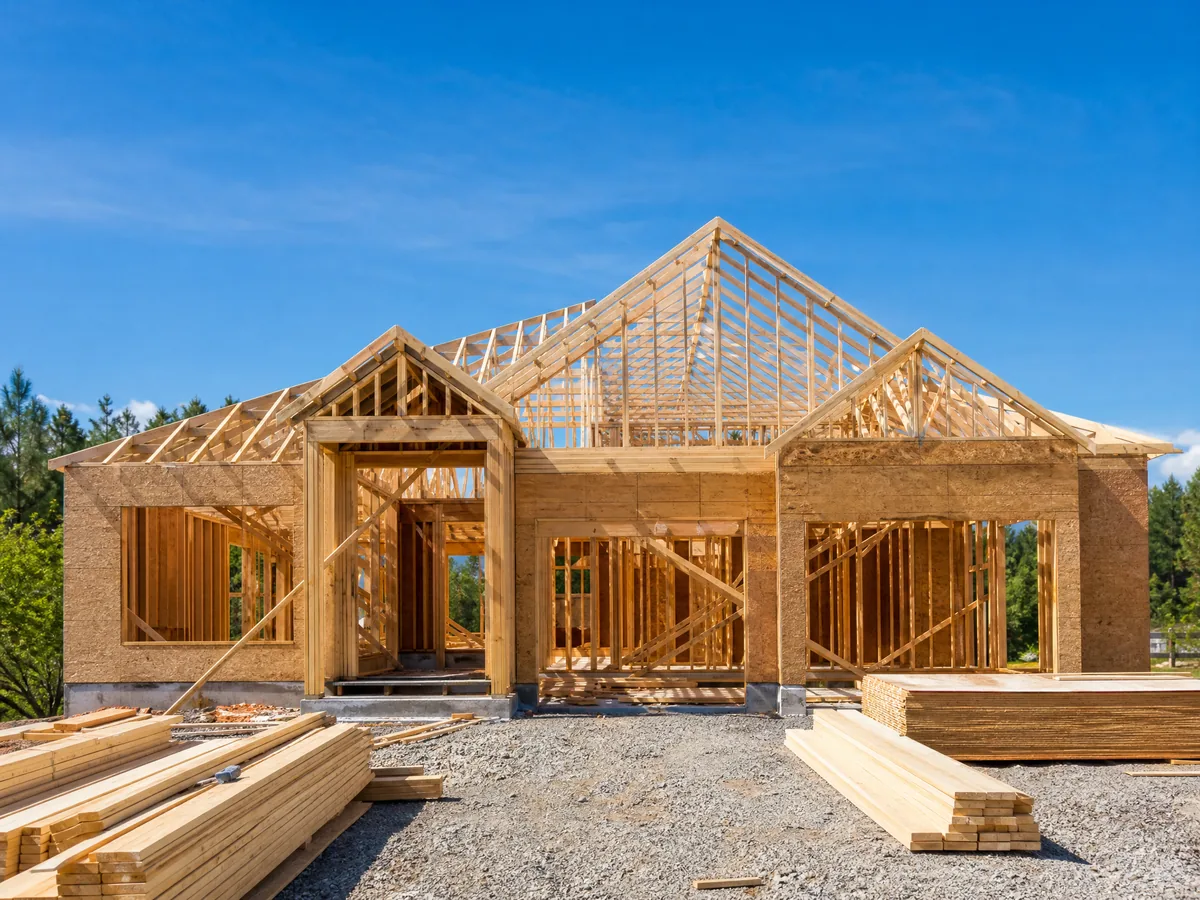
We fund Houston new builds with ground up construction loans.
Built for spec home builders and developers. We fund the land and the vertical build up to 70% LTV and 85% of cost, with draws that keep pace with the job. Houston has no zoning, so recorded deed restrictions and Chapter 19 floodplain elevation decide what the lot yields. Business-purpose only, and every structure is set in underwriting.
Typical figures, subject to underwriting and market conditions. Not a commitment to lend.
How it works
We finance both the land and the vertical construction, with a draw schedule built around your timeline. Experienced builders can access higher leverage on cost.
With no zoning, what actually controls what I can build in Houston?
Two things: the recorded deed restrictions on your block, and Chapter 42 of the city code. Houston is the largest U.S. city without conventional zoning, and voters turned zoning down in 1948, 1962 and 1993. In its place, land use runs on private deed restrictions, which the city will help enforce, and on Chapter 42, which sets platting, minimum lot size, building lines, parking and density. Neighbors can also tighten a specific block through a Special Minimum Lot Size or Special Minimum Building Line designation under Chapter 42, and those local designations prevail over the citywide minimums. So the document that decides your exit is the title commitment plus the recorded restrictions, not a zoning map. This is the most common Houston diligence miss we see, and we want to see both before we size the loan. Interpreting a restriction is a question for your real estate attorney.
How small can a Houston lot be for a townhouse-style build?
As low as 1,400 square feet inside the urban core, and 3,500 square feet across most of the broader urban area. The citywide minimum used to be 5,000 square feet; the townhouse reforms cut it, and that is the reason so much of the inner Loop redeveloped as three-story attached product rather than single houses. The catch is that the citywide minimum is a floor, not a guarantee. If the block carries a Special Minimum Lot Size designation or a deed restriction that sets a larger lot, that controls, and a subdivide-into-four plan collapses into one house. Pull the restrictions and check for an SMLS before you tie up the dirt. We underwrite the unit count you can actually plat, not the one on the pro forma.
What does the floodplain do to a Houston ground-up budget?
It can add elevation and compensating storage, and both are real money. Houston's Chapter 19, adopted April 4, 2018 and effective September 1, 2018, requires new construction in the 500-year floodplain to sit 2 feet above the 500-year base flood elevation, with critical facilities at 3 feet. The same ordinance extended the zero-net-fill requirement to the 500-year floodplain, so any fill you place on the site has to be offset with compensating storage somewhere on it. That detention line item is the one out-of-state builders leave out of the budget most often. Chapter 19 also catches heavy rehab: a substantial improvement, which includes expanding an existing footprint by 33% or more, gets treated like new construction. Get the floodplain determination before you close on the lot, and put the elevation and fill costs in the budget we lend against.
Do the new Harris County flood maps change a build I am starting now?
They change who has to buy flood insurance, more than they change what a policy costs. MAAPnext, the new FEMA mapping for Harris County, would more than double the properties in the 100-year floodplain, from roughly 158,500 to roughly 330,000, and the maps still face a months-long review before final approval. Under Risk Rating 2.0, FEMA prices each property on more than 30 property-specific factors such as flood exposure, replacement cost, distance to water and elevation, rather than mostly on the mapped zone, so a map change by itself does not reprice most existing policies. What it does trigger is the mandatory purchase requirement on federally backed mortgages, which could reach more than 100,000 properties likely facing $1,000 or more a year. Properties in the 500-year floodplain carry no mandatory purchase requirement. If you are building to hold or building to rent, carry a flood premium in the expense stack even when the current owner shows none.
How should I plan the permit and insurance runway on a Houston build?
No zoning review, but floodplain review and windstorm certification can both gate you. Houston requires no zoning review, which removes a step other Texas cities have, and sites in affected areas add floodplain review time. The city publishes live plan-review metrics on its permitting dashboard, and that is the number we use rather than a rule of thumb, because correction cycles, not the first submittal, are what stretch a schedule. On the east side there is a second gate: TWIA, the residual windstorm market, covers the 14 first-tier coastal counties plus the part of Harris County east of Highway 146 inside listed city limits, which reaches parts of Pasadena, La Porte, Seabrook and Kemah. Property there needs a WPI-8 certificate of code compliance to get a TWIA policy, and no policy can mean no closing. Build the inspection sequence for that certificate into the schedule from the start. Construction terms run 12 to 24 months, subject to underwriting, and we would rather set the term to your real permit path than watch you buy an extension.
Where is the spec and build-to-rent demand, and what does the carry look like?
The master-planned corridors are still the volume, and the tax rate out there is higher than inside the Loop. Greater Houston placed 10 communities in RCLCO's top 50 best-selling master-planned communities of 2025, including Bridgeland on US-290 near the Grand Parkway in Cypress, which ranked 11th nationally with 812 sales, down 13% from 938 sales and a 7th-place ranking the year before. So demand is real and slower than it was. Resale competition is real too: the metro carried about 37,000 active single-family listings and 5.1 months of inventory in May 2026. On carry, most newer Houston-area subdivisions in Katy, Cypress, Fort Bend and Montgomery sit inside a Municipal Utility District that levies its own tax on top of county, ISD and city rates, which is how a suburban total rate lands near 3% against roughly 2.1% inside Houston city limits on 2025 rates. MUD rates fall over time as the original bonds amortize. Pull the actual rate for the district before you set the carry budget, and take the tax questions to your CPA.
How much cash do I need with Chapter 19 elevation inside the cost stack?
Roughly 15% of total cost. We fund up to 85% of cost and up to 70% of value, whichever binds first. On a $1,000,000 Houston project that is up to $850,000 from us and $150,000 from you (1,000,000 x 85% = 850,000), with the vertical drawn against the build schedule. If the lot sits in the 500-year floodplain, two Houston line items belong inside that cost number before you size it: Chapter 19 elevation and the compensating storage that comes with zero net fill. Subject to underwriting.
Does builder experience change my leverage in Houston?
Yes. Experienced builders can access higher leverage. The ceiling is 70% LTV and 85% LTC, and a builder with finished Houston projects behind them is the one most likely to reach it. A first project usually sizes more conservatively, which is a smaller loan rather than a no. Bring the last few jobs, the budget and the schedule, and we will tell you where the file lands. Subject to underwriting.
How big a construction loan will you write in Houston?
Up to $5M. Term runs 12 to 24 months, with draws released against the build schedule, and it covers spec or build-to-rent product. On a Houston file we set the term against your real permit path rather than a rule of thumb, because correction cycles, not the first submittal, are what stretch a schedule here. Subject to underwriting.
Do you set a minimum credit score on a Houston construction loan?
No. We run credit, but construction is an asset-based loan and there is no minimum score on it. Weaker credit is normally offset with lower leverage rather than a decline, and there is no hard credit pull to start. What we underwrite is the lot, the budget and the builder. Subject to underwriting.
More Ground-Up Construction questions, answered on the program page
Local rules move. Every tax rate, fee, ordinance and market figure here comes from a primary source and carries the date we read it, and we correct them as the rules change. Where a number is mid-change or we could not verify it, we say so rather than guess. Before you commit a budget, confirm anything that drives it with the city or county, and talk to your attorney or CPA on questions of law or tax.
Published by USA Mortgage Funding, LLC, NMLS #152588. Researched from primary sources by our team, drafted with AI assistance, and every figure checked against its source before publishing. Where an answer rests on a public record, that record is linked under it. Figures read on 2026-08-12.
Funding Houston deals fast.
Get real terms, usually same day. No obligation, no hard credit pull to start.