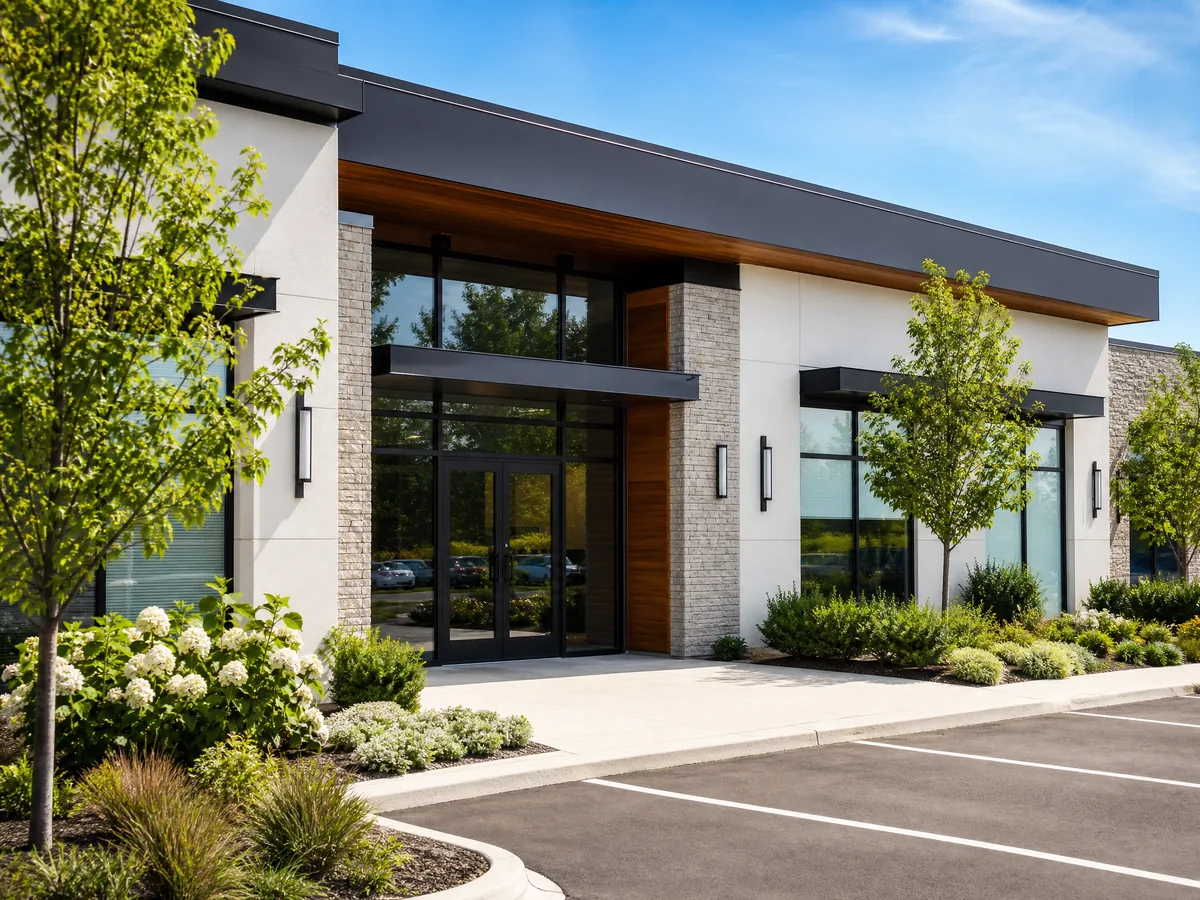
Buying your Houston building, financed with SBA loans.
When a deal calls for long-term, government-backed financing, we place SBA 7(a) and 504 loans through relationships with more than 20 SBA lenders. We match your scenario to the right program and the best terms. Houston's basis depends on which market you are in: retail, industrial, or office. Business-purpose only, and every structure is set in underwriting.
Typical figures, subject to underwriting and market conditions. Not a commitment to lend.
How it works
SBA loans offer low down payments and long amortizations for owner-occupied property and business acquisition. USA Mortgage arranges and places SBA financing through our network of partner lenders; we are not ourselves an SBA lender. We shop your file across that network so you get the strongest approval.
Who actually funds an SBA loan on a Houston property?
A partner lender does, not us. USA Mortgage arranges and places SBA 7(a) and 504 financing through a network of more than 20 SBA lenders; we are not ourselves an SBA lender. On the agency side, the SBA Houston District Office covers 32 counties in southeastern Texas, and the local 504 certified development company for the region is the Houston-Galveston Area Local Development Corporation. Our job is to shop the file and keep it moving. Start an application and we'll tell you which program fits before you fill out anything long.
Three different ones, and the basis you buy at depends on which. In the second quarter of 2026, Houston retail vacancy sat at 5.8%, industrial at 6.7%, and office at 24.7%. A retail or industrial owner-user is buying into a tight market where leasing is high-cost and space is scarce, which is part of the argument for owning. An office buyer is shopping a soft one, where the discount is real but so is the reason for it, since a tenant in that market has room to negotiate a lease instead. Run the buy-versus-lease math on the specific building with your broker, not on the metro average.
Houston has no zoning. What decides whether my business can operate at the site?
The recorded deed restrictions on that specific block, plus Chapter 42 of the city code. Houston is the largest U.S. city with no conventional zoning, and voters turned it down in 1948, 1962 and 1993. Land use is controlled instead by private deed restrictions, which the City will help enforce, and by Chapter 42, which governs platting, minimum lot size, building lines, parking and density. Neighbors can also lock a block down further with a Special Minimum Lot Size or Special Minimum Building Line designation, and those prevail over the citywide minimums. For an owner-user purchase, that makes the title commitment and the recorded restrictions the documents that decide whether your use, your signage and your parking count actually work. Read them before you go hard, and have your attorney read them too.
I'm buying a building and renovating it. What can blow up the budget in Houston?
The floodplain rules, more often than the permit office. Houston's Chapter 19, effective September 1, 2018, requires new construction and substantial improvements in the 500-year floodplain to sit two feet above the 500-year base flood elevation, and a project counts as a substantial improvement if it expands the existing footprint by 33% or more. Critical facilities go three feet up, and the zero-net-fill requirement now reaches the 500-year floodplain too, so any fill you place has to be offset with compensating storage. A cosmetic build-out that crosses the 33% line turns into an elevation and fill project, with the budget and schedule to match. On the plus side, Houston requires no zoning review, which removes a step other Texas cities have; floodplain review adds time where it applies. Get the floodplain determination before you set the construction budget an SBA lender will underwrite.
Will I be forced to carry flood insurance on a Houston building?
If the building sits in the 100-year floodplain and the loan is federally backed, yes. Properties in the 500-year floodplain carry no mandatory purchase requirement. What makes this live right now is MAAPnext, the new FEMA maps for Harris County, which would more than double the properties in the 100-year floodplain, from roughly 158,500 to roughly 330,000. Those maps still face months of review before final approval. Two separate questions are at work: the map change drives the mandatory-purchase trigger, while FEMA's Risk Rating 2.0 prices each property on 30-plus property-specific factors rather than on its mapped zone, so a new map line does not by itself reprice an existing policy. For context, Harris County has about 262,391 active NFIP policies averaging $931 a year, and only about 1 in 7 households carries flood coverage at all. A seller telling you they've never bought flood insurance is not evidence the building doesn't flood. Put a premium in the expense stack anyway.
What changes if the building is near the Ship Channel, in Pasadena or La Porte?
Windstorm coverage moves to TWIA, and TWIA has a paperwork gate. The Texas Windstorm Insurance Association covers the 14 first-tier coastal counties plus the part of Harris County east of Highway 146 that falls inside listed city limits, which reaches parts of Pasadena, La Porte, Seabrook and Kemah. Most of the metro, including Katy, Cypress, Spring, Sugar Land, The Woodlands and the bulk of Houston, sits outside that territory and buys wind coverage in the standard market. Inside it, a TWIA-eligible property needs a WPI-8 or WPI-8-E certificate of code compliance, or a TWIA WPI-8-C. On new construction or a substantial rehab that means no certificate, no policy, and potentially no closing, because your SBA lender will require the coverage. TWIA also implemented a 0% rate change for 2026 policies. Line up the windstorm inspection early rather than in the last week.
How much should I budget for property taxes on an owner-occupied building?
Start near 2.1% of taxable value inside Houston city limits, and higher in the newer suburbs. On 2025 rates, the combined bill inside the city runs roughly 2.1%, with the school district about 43% of it, the City of Houston about 26% and Harris County about 19%. In much of Katy, Cypress, Fort Bend and Montgomery County, a Municipal Utility District levies its own ad valorem tax on top of that, which can push a total rate toward the 3% range; MUD rates fall over time as the original bonds amortize. Those MUD figures come from secondary sources, so pull the actual rate from the district itself or the Texas Comptroller special-district data before you underwrite a specific address. Texas has no state income tax, which is exactly why the property tax line dominates carry math here rather than income-tax planning. Run the numbers with your CPA before you commit to a 25-year amortization.
How much do I need to put down on a Houston owner-occupied building?
Often around 10%. SBA financing can reach up to 90% of the project, so on a $2,000,000 Houston building that is up to $1,800,000 financed and $200,000 from you (2,000,000 x 90% = 1,800,000). Amortization runs up to 25 years at market SBA rates, and the property has to be owner-occupied. The partner lender sets the final structure. Subject to underwriting.
What size SBA loan can you place in Houston?
$350,000 to $5M and up. Both 7(a) and 504 are on the table, and which one fits depends on the building and the use of proceeds rather than the size alone. Houston retail and industrial owner-users are shopping tight markets, at 5.8% and 6.7% vacancy in the second quarter of 2026, so the buy-versus-lease math on the specific building is usually what sets the number you need. Subject to underwriting.
Local rules move. Every tax rate, fee, ordinance and market figure here comes from a primary source and carries the date we read it, and we correct them as the rules change. Where a number is mid-change or we could not verify it, we say so rather than guess. Before you commit a budget, confirm anything that drives it with the city or county, and talk to your attorney or CPA on questions of law or tax.
Published by USA Mortgage Funding, LLC, NMLS #152588. Researched from primary sources by our team, drafted with AI assistance, and every figure checked against its source before publishing. Where an answer rests on a public record, that record is linked under it. Figures read on 2026-08-12.
Funding Houston deals fast.
Get real terms, usually same day. No obligation, no hard credit pull to start.