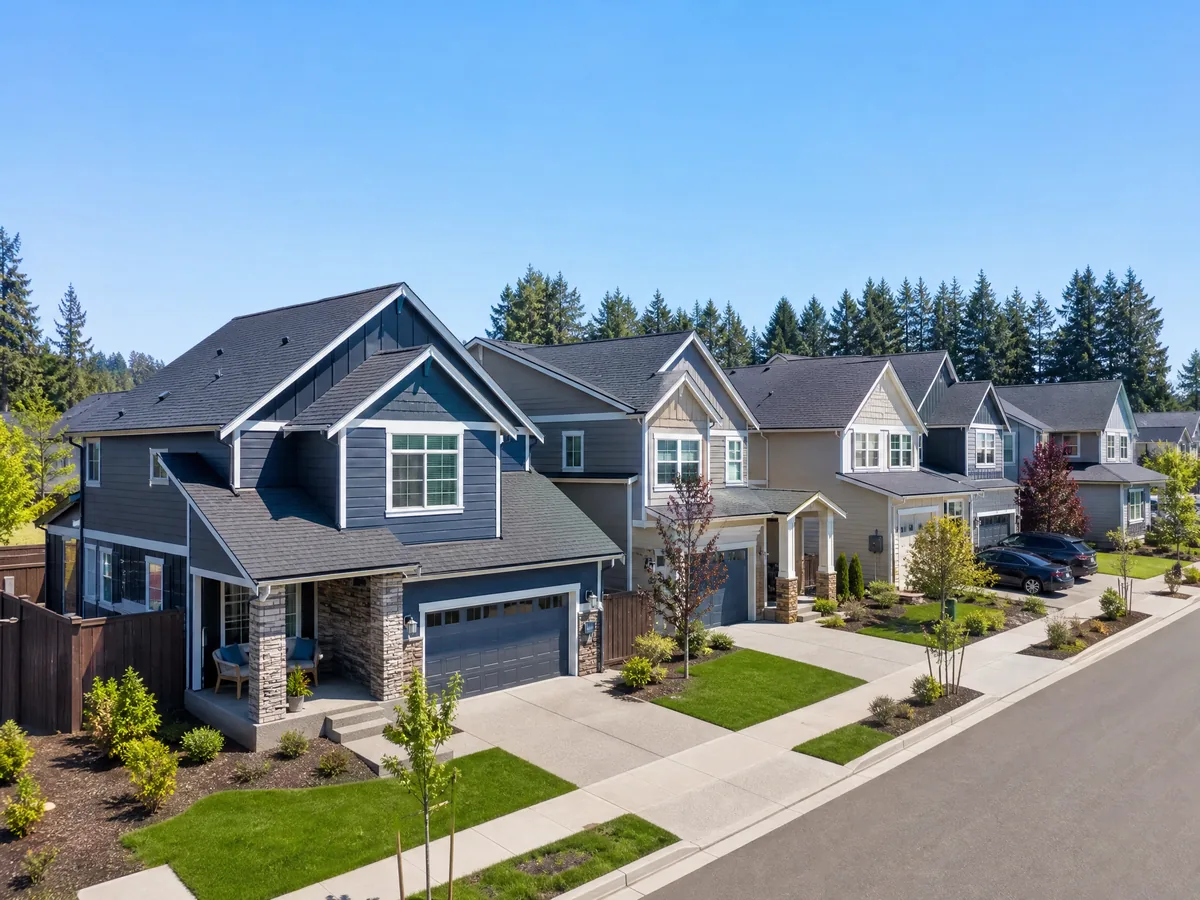
Finance your Houston rentals with one rental portfolio loan.
Built for investors who own multiple properties. Roll five or more rentals into one blanket loan with a single payment, free up capital to keep scaling, and release individual properties as you sell. Katy, Cypress and Pearland doors follow different rules, and east of Highway 146 windstorm coverage changes again. Business-purpose only, and every structure is set in underwriting.
Typical figures, subject to underwriting and market conditions. Not a commitment to lend.
How it works
Instead of a separate mortgage on every door, we structure one blanket loan secured by the portfolio, with the option to release individual properties as you sell them. It is built for investors scaling past a handful of rentals.
What happens to my Houston carry when the 20% appraisal cap expires?
Plan for it to lapse on December 31, 2026, and treat an extension as upside. Texas Tax Code section 23.231 caps the annual increase in appraised value on non-homestead real property at 20%, plus the value of new improvements, for properties at or below a threshold that indexes each year. The threshold was $5 million for tax year 2024. The cap took effect January 1, 2024 and expires December 31, 2026 unless the Legislature extends it. On a single door that is a line item. On a blanket loan it compounds, because every property in the collateral pool loses the same protection in the same tax year, and the 10% homestead cap never applied to investment property in the first place. Texas collects no state income tax, so property tax carry, not income tax planning, is what decides a Houston hold. We underwrite portfolio debt service on the go-forward assessed bill. Your CPA or property tax counsel should confirm how it lands on your specific parcels.
How much does the tax rate change from one Houston suburb to the next?
Enough that two identical houses carry very differently. Combined property tax inside Houston city limits runs roughly 2.1% of taxable value on 2025 rates, with Houston ISD about 43% of a typical bill, the City about 26% and Harris County about 19%. Most newer subdivisions in Katy, Cypress, Fort Bend and Montgomery County sit inside a Municipal Utility District, which levies its own ad valorem tax on top of county, school district and city rates and can push a total rate near 3%. MUD rates generally decline over time as the original bonds amortize, so a district 15 years into its bonds is a different expense than a brand-new one. Don't take a published rate on faith. Pull each district's rate from the Texas Comptroller special-district data or the district's own site, and give us the actual rate per door rather than a metro average. We size the loan on the parcel-level numbers.
My portfolio has short-term rentals in a few different suburbs. Does that work?
It depends on the city, one door at a time. Inside Houston city limits, the short-term rental ordinance took effect January 1, 2026 and covers any dwelling unit rented for periods of less than 30 consecutive days. Registration requires owner and property information, an emergency contact, tax documentation, proof of completed training, a signed authorization form and a fee, renewed annually, and from January 2027 the city intends to direct platforms to delist units without a valid registration number. Pearland stopped allowing short-term rentals in residentially zoned areas in February 2026, grandfathering the 19 listings active at adoption, and the City of Sugar Land's own FAQ says short-term rentals are not permitted there. Texas has no statewide preemption, so outright bans are possible and each city writes its own rules. If nightly income is carrying part of the portfolio's coverage, we'll want the registration or the confirmed local status for every door underwritten that way. Confirm current requirements with the city itself before you count on that income.
Why does insurance get complicated once a portfolio spreads across the metro?
Because Houston has two insurance stories running at once, and a blanket loan can touch both. On wind: the Texas Windstorm Insurance Association covers the 14 first-tier coastal counties plus the part of Harris County east of Highway 146 that lies within listed city limits, which reaches parts of Pasadena, La Porte, Seabrook and Kemah. Most of the metro, including Katy, Cypress, Spring, Sugar Land, The Woodlands and the bulk of Houston, buys wind coverage in the standard market instead. TWIA-eligible properties need a WPI-8 certificate of code compliance, which matters on Pasadena-area new construction and substantial rehabs. On flood: only about 1 in 7 Harris County households carries an NFIP policy, so a seller with no flood insurance tells you nothing about the risk, and the proposed MAAPnext maps would more than double the properties in the Harris County 100-year floodplain, from about 158,500 to about 330,000. Send us the schedule of locations early. The insurance stack is the line that most often moves a portfolio file.
If I plan to sell doors out of the blanket, how long should I assume they take?
Longer than 2021 velocity, so build the release schedule around a real marketing period. As of June 2026 the metro was running about 5.2 months of inventory with 38,839 active listings and 52 days on market, up from 50 a year earlier, and the Q2 2026 median price was $345,200, down 1.2% year over year. That is a balanced-to-buyer-leaning resale market, not a boom. Pending sales were up 5.8% year over year in May 2026 and the region added roughly 126,720 residents between July 2024 and July 2025, so demand is there, but it clears at a normal pace. We'd rather write release terms against a realistic per-property marketing window than a metro average that flatters the plan. Tell us which doors you expect to sell and when, and we'll structure the releases around it.
What does closing look like when several Houston rentals go into one loan?
Through a title company, and the premium is the same wherever you go. Texas closes through title companies rather than attorneys, and title insurance rates are promulgated by the Texas Department of Insurance, so every licensed title company charges the same basic premium. The current rates took effect March 1, 2026. Under that table, above $100,000 the basic premium runs $780 plus 0.00494 per dollar over $100,000, which is roughly $1,274 on a $200,000 policy and $2,262 on a $400,000 policy. Because price is fixed, Houston investors shop title companies on execution, on whether they can run a multi-property file cleanly, and on turn times. One Houston-specific item to pull per door: there is no zoning here, so the recorded deed restrictions and any Chapter 42 Special Minimum Lot Size or Building Line on that block are what control use, and they show up in the title commitment. Tell us about the portfolio and we'll tell you what the file needs.
How many Houston doors do I need for a portfolio loan?
Five or more. Below five, each property is financed on its own, usually with a DSCR loan. At five and up they roll into a single blanket loan with one consolidated payment, and each property keeps an individual release so you can sell a door without unwinding the facility. Doors in Katy, Cypress and Pearland can sit in the same pool. Subject to underwriting.
What is the smallest Houston portfolio loan you will write?
$500,000 and up. That is the whole facility rather than the per-door amount, so five modest Houston rentals can clear it together where none of them would alone. The term is custom rather than off a rate sheet, which is how we fit the release schedule to the doors you actually plan to sell. Send the schedule of locations with the rent and the tax rate per parcel. Subject to underwriting.
More Portfolio Loans questions, answered on the program page
Local rules move. Every tax rate, fee, ordinance and market figure here comes from a primary source and carries the date we read it, and we correct them as the rules change. Where a number is mid-change or we could not verify it, we say so rather than guess. Before you commit a budget, confirm anything that drives it with the city or county, and talk to your attorney or CPA on questions of law or tax.
Published by USA Mortgage Funding, LLC, NMLS #152588. Researched from primary sources by our team, drafted with AI assistance, and every figure checked against its source before publishing. Where an answer rests on a public record, that record is linked under it. Figures read on 2026-08-12.
Funding Houston deals fast.
Get real terms, usually same day. No obligation, no hard credit pull to start.