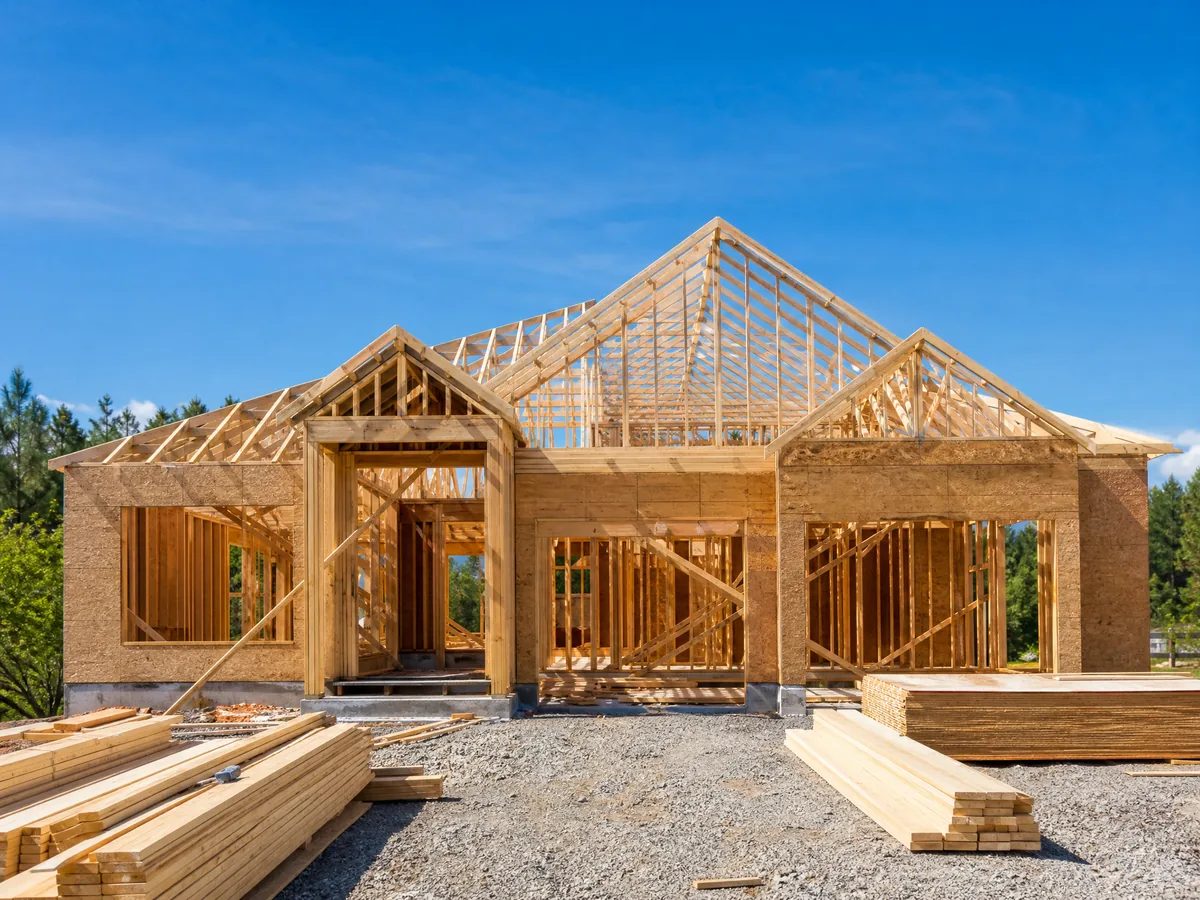
San Francisco ground up construction loans sized to the fee cliffs.
Built for spec home builders and developers. We fund the land and the vertical build up to 70% LTV and 85% of cost, with draws that keep pace with the job. San Francisco's development impact fees step up hard at specific unit counts, and the permit clock is improving but still runs into the hundreds of days. Business-purpose only, and every structure is set in underwriting.
Typical figures, subject to underwriting and market conditions. Not a commitment to lend.
How it works
We finance both the land and the vertical construction, with a draw schedule built around your timeline. Experienced builders can access higher leverage on cost.
Ground-Up Construction in San Francisco, answered.
How long should I budget for San Francisco to actually issue a building permit?
Plan on months, not weeks, even though the trend is improving. A study commissioned by Supervisor Bilal Mahmood and published March 6, 2026 found San Francisco's time to issue a housing building permit had fallen to an average of about 280 days, down from a prior average of 605 days, over a window of January 2024 through August 2025. Applications filed inside that window were issued in 114 days on average, a different and faster-moving population than the 280-day figure, so the two numbers should not be quoted interchangeably. For comparison, the same study cited San Diego at an average of 134 days and Austin at 91 days. The study also flagged a backlog of more than 1,300 pending applications averaging 1,489 days pending as of late October. We size the construction term to the permit path you can actually document, not to the posted trend line. If the clock runs long and you need to carry the acquisition meanwhile, see San Francisco CRE bridge loans.
Why does unit count matter more than square footage to my San Francisco impact fee bill?
Because the fees are structured as cliffs, not a smooth rate. A residential project of nine units or fewer falls below the Inclusionary Affordable Housing threshold entirely; at ten units the project owes an in-lieu fee of $249.66 per square foot of residential gross floor area against 20% of the project. The Transportation Sustainability Fee kicks in above twenty units, at $11.86 per gross square foot on projects of 21 to 99 units. The Child Care Impact Fee applies from the first net new unit, but the rate doubles from $1.41 to $2.80 per square foot once a project reaches ten units. A tenth unit does not cost a tenth more, it crosses two separate fee lines at once, and that structure is the reason small infill is the practical private-capital lane in this city. Rates cited are effective January 1, 2026; confirm against the adopted register before you finalize a budget.
If I'm building or adding five or more units, what changes about my ADU options?
The unit count and the retrofit path both expand what you can add. In an existing San Francisco building with four or fewer legal units, you can add one ADU plus one detached ADU. At five or more units, or in any building undergoing a seismic upgrade, the ceiling opens to unlimited ADUs plus one detached ADU, and ADUs are allowed to exceed the density otherwise permitted by the zoning district. Routing the project through the State ADU Program keeps the new units on a ministerial 60-day review clock and, per the city's planning page, state law prevents subjecting some ADUs to rent stabilization, unlike the Local Program's waivers, which do carry rent control. This is a structural question with real consequences for your unit mix, so confirm the specific eligibility with land-use counsel before you finalize a plan set. Once the ADU is built and rented, see San Francisco DSCR terms for financing it as a hold.
Does the transfer tax hit a land or assemblage purchase before I even start building?
Yes, and it's tiered on the entire price, not the amount above each threshold. San Francisco's real property transfer tax applies to any recorded conveyance, which includes a raw land purchase or a multi-parcel assemblage, and the rate jumps hard at specific dollar levels: 0.75% from $1,000,000 to $4,999,999, then 2.25% from $5,000,000 to $9,999,999, then 5.50% from $10,000,000 to $24,999,999. Cross from $9,999,999 to $10,000,000 and the tax owed jumps from $225,000 to $550,000, a $325,000 cost for crossing one dollar. A builder assembling adjacent lots to hit a unit-count threshold should price the assemblage's total consideration against these cliffs before structuring the purchase, since the tax applies to the whole price on each recorded transfer, not to a blended average.
How much of my own money goes into a San Francisco ground-up build?
Plan on at least 15% of total project cost, plus closing costs. We fund up to 85% of cost and up to 70% of value, whichever is lower. On a $2,000,000 all-in project that is up to $1,700,000 from us and $300,000 from you (2,000,000 x 85% = 1,700,000), with the vertical build funded in draws against the build schedule rather than paid out at closing. Put the impact fee line in the cost budget before you run that math, since a tenth unit crosses two separate fee lines at once in this city. Subject to underwriting.
Is there a loan ceiling on a San Francisco ground-up construction loan?
Yes. We go up to $5,000,000 on this program. That is a real fit with how this city actually pencils for private capital: a residential project of nine units or fewer falls below the Inclusionary Affordable Housing threshold entirely, and the Transportation Sustainability Fee does not start until above twenty units. Small infill is the practical lane here, and $5,000,000 covers a lot of it. Bigger projects need a different capital stack, so tell us the unit count early. Subject to underwriting.
Do I need a build track record to get a construction loan in San Francisco?
No, but it changes your leverage.Experienced builders can access higher leverage against the 70% LTV and 85% LTC ceilings, and a first build usually prices at a lower advance rather than getting turned down. We do run credit, and on an asset-based loan like this one it carries far less weight than at a bank, with no minimum score and no hard credit pull to start. What we read is the budget, the plan set, and the permit path, which in this city is the part that most often runs long. Subject to underwriting.
Local rules move. Every tax rate, fee, ordinance and market figure here comes from a primary source and carries the date we read it, and we correct them as the rules change. Where a number is mid-change or we could not verify it, we say so rather than guess. Before you commit a budget, confirm anything that drives it with the city or county, and talk to your attorney or CPA on questions of law or tax.
Published by USA Mortgage Funding, LLC, NMLS #152588. Researched from primary sources by our team, drafted with AI assistance, and every figure checked against its source before publishing. Where an answer rests on a public record, that record is linked under it. Figures read on 2026-08-21.
Funding San Francisco deals fast.
Get real terms, usually same day. No obligation, no hard credit pull to start.