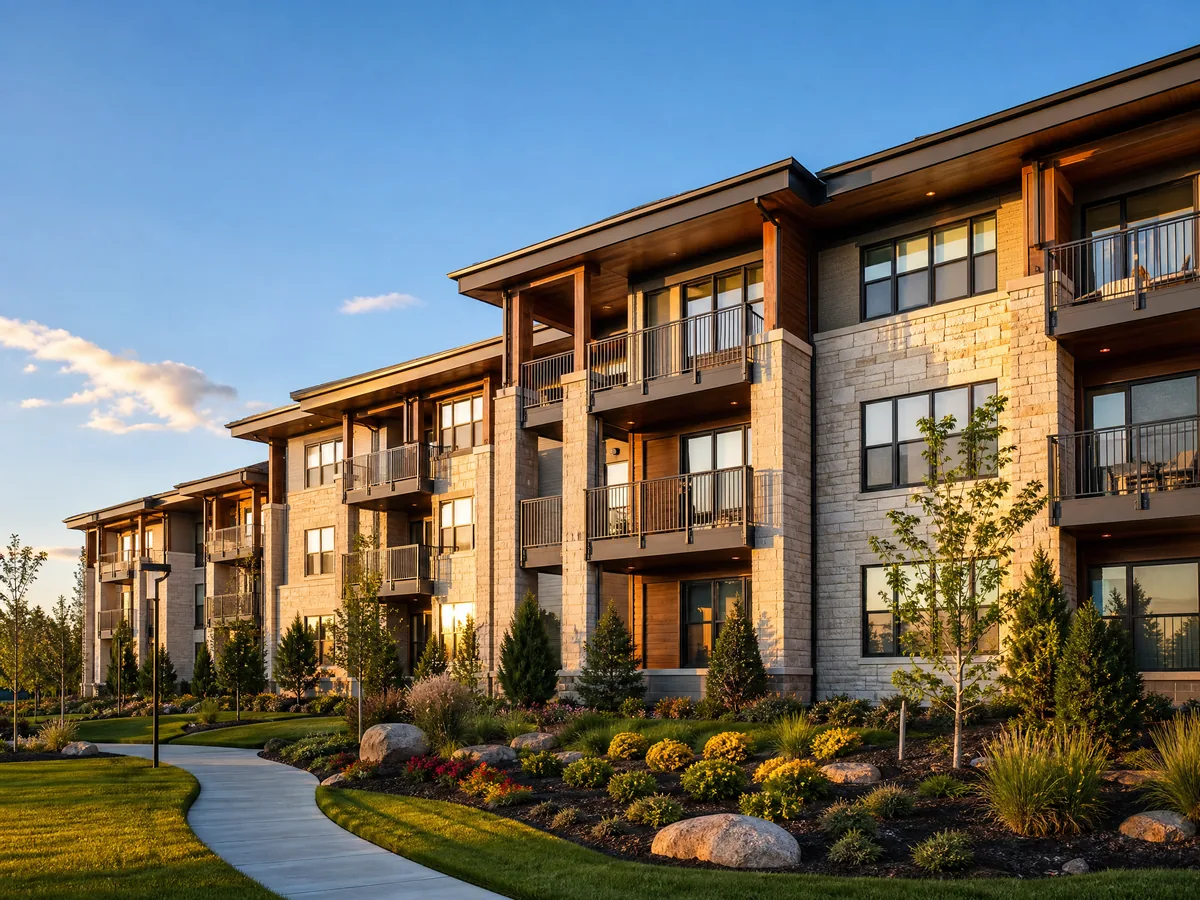
Permanent commercial mortgage debt on stabilized North Carolina property.
Long-term, permanent financing for stabilized commercial real estate. We place it in house through agency multifamily channels (Fannie Mae and Freddie Mac), insurance funds, and other wholesale sources. North Carolina is a cheap state to place debt in and a procedural one to enforce in, and a long-term lender prices both. Business-purpose only, and every structure is set in underwriting.
Typical figures, subject to underwriting and market conditions. Not a commitment to lend.
How it works
For a stabilized asset ready for permanent debt, we shop your file across agency multifamily programs, insurance companies, and wholesale lenders, then place the structure that fits your hold. When a deal needs to stabilize first, we can bridge it and refinance into permanent debt later.
What does North Carolina tax when I place permanent debt on an asset?
Almost nothing on the debt itself, and 0.2% on the conveyance. There is no mortgage tax and no intangibles tax on the note in North Carolina, so a deed of trust records for a flat fee under NCGS 161-10: $64 for the first 35 pages plus $4 for each additional page. A refinance therefore carries no percentage-based state tax at all, which is a real difference from a doc-stamp state on a large placement. On an acquisition, the state excise tax under NCGS 105-228.30 is $1 per $500 of consideration, and the statute puts it on the transferor: a $10,000,000 purchase carries $20,000 (10,000,000 divided by 500 = 20,000, times $1). Seven far-northeastern coastal counties add a 1% local land transfer tax; the Piedmont markets like Charlotte pay only the state rate.
How does county revaluation move the NOI a permanent lender underwrites?
In steps, and on a long-term loan you will live through at least one of them. NCGS 105-286 requires counties to reappraise all real property at least every eight years on a staggered statewide schedule, with assessed values frozen in between. Effective burden drifts down late in a cycle and then resets. Counties above 75,000 population must advance a reappraisal if their sales-assessment ratio falls below 0.85 or rises above 1.15, and any county may shorten its cycle by resolution, which Wake did: revalued effective January 1, 2024, next 2027, then two-year cycles from 2029. Mecklenburg revalued effective January 1, 2023 on a four-year cycle, next 2027. There is no homestead cap or investor split. Underwrite the tax line at post-reval value rather than the seller's frozen bill, and keep the county appeal calendar in your asset management plan. Market and rate detail belongs to the metro page: Raleigh.
What does North Carolina cost the ownership entity over a long hold?
Less every year through 2030, on a published schedule. The corporate income tax is phasing out: 2.0% for 2026 and 2027, 1.0% in 2028, 0.5% in 2029, and zero from 2030, already the lowest corporate rate among the states that levy one. Franchise tax is $1.50 per $1,000 of net worth with a $200 minimum, C-corps capped at $500 on the first $1,000,000 of base and S-corps paying $200 on the first $1,000,000 with $1.50 per $1,000 above it, but an LLC taxed as a partnership or a disregarded entity does not pay North Carolina franchise tax unless it elects corporate treatment. The individual rate is flat at 3.99% for 2026, with further trigger-based cuts unverified. Pass-through entity tax election details are outside what we researched. Confirm the structure with your North Carolina CPA.
How does a lender enforce a North Carolina deed of trust?
Non-judicially, but through the clerk of superior court, and the sale stays open afterwards. NCGS 45-21.16 requires a hearing before the clerk on at least 10 days' notice, where the clerk must find valid debt held by the party foreclosing, default, a right to foreclose under the instrument, and notice to those entitled to it. NCGS 45-21.17 requires the sale notice posted 20 days ahead, published weekly for two successive weeks, and mailed 20 days ahead. NCGS 45-21.27 then allows upset bids for 10 days after the report of sale, each new bid restarting the clock. On deficiency, North Carolina has no general anti-deficiency statute for third-party lender loans: the purchase-money bar at NCGS 45-21.38 reaches only seller financing, and NCGS 45-21.36 gives a debtor a fair-value offset where the creditor bought at its own sale. For a permanent lender this is a slower, more procedural recovery than a first-Tuesday state, and it is priced accordingly.
Who closes a permanent commercial loan in North Carolina?
That is a question for your counsel, and we will not guess at it. The State Bar's Authorized Practice Advisory Opinion 2002-1 addresses residential closings, holding that a non-attorney may not handle one: no title opinions, no explaining the legal status of title, no advice on how to take title, no drafting documents, though a non-lawyer may present documents, direct signatures, and receive and disburse funds. Whether that framing leaves commercial closings open to non-attorneys is not settled in anything we could source, and it would be irresponsible for a lender to extrapolate. We also do not publish North Carolina title insurance premium data, because we did not find a reliable source on how those rates are regulated here. Bring in North Carolina counsel early on a permanent placement, and tell us who is closing.
Does insurance volatility affect a North Carolina permanent underwrite?
Less than in most states, because the rate path is negotiated statewide. North Carolina is a rate-bureau state: the North Carolina Rate Bureau files homeowners rates for all carriers and the Commissioner of Insurance approves, negotiates, or litigates them. The settled 2025 round took a requested 42.2% average statewide increase, with up to 99.4% in some territories, down to 7.5% on June 1, 2025 and 7.5% on June 1, 2026, capped at 35% in any territory, with no new filing before June 1, 2027. That is homeowners rather than commercial lines, so treat it as context rather than as your quote. Location still matters: the coastal wind pool writes only in eligible coastal counties, and inland assets sit in the standard market with no pool assessment story. Get a bound quote on the asset before you size the loan.
More CRE Permanent questions, answered on the program page
Local rules move. Every tax rate, fee, ordinance and market figure here comes from a primary source and carries the date we read it, and we correct them as the rules change. Where a number is mid-change or we could not verify it, we say so rather than guess. Before you commit a budget, confirm anything that drives it with the city or county, and talk to your attorney or CPA on questions of law or tax.
Published by USA Mortgage Funding, LLC, NMLS #152588. Researched from primary sources by our team, drafted with AI assistance, and every figure checked against its source before publishing. Where an answer rests on a public record, that record is linked under it. Figures read on 2026-08-12.
Funding North Carolina deals fast.
Get real terms, usually same day. No obligation, no hard credit pull to start.