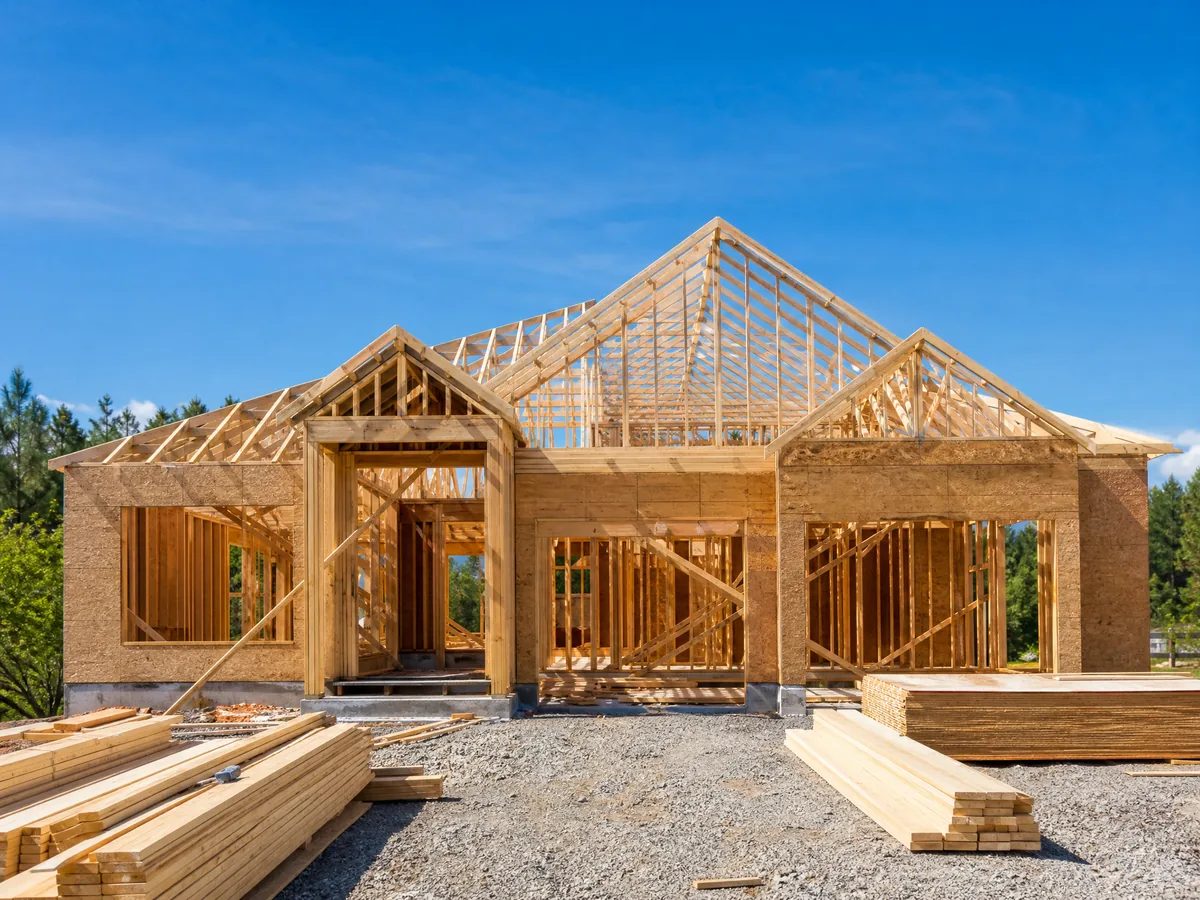
Ground up construction loans for North Carolina builders.
Built for spec home builders and developers. We fund the land and the vertical build up to 70% LTV and 85% of cost, on a 12 to 24 month term, with draws that keep pace with the job. North Carolina adds an attorney closing, a stepped property tax calendar, and an insurance market that moves by negotiated statewide filing. Business-purpose only, and every structure is set in underwriting.
Typical figures, subject to underwriting and market conditions. Not a commitment to lend.
How it works
We finance both the land and the vertical construction, with a draw schedule built around your timeline. Experienced builders can access higher leverage on cost.
Ground-Up Construction in North Carolina, answered.
Is a construction loan to my building entity regulated as a mortgage in North Carolina?
No, and the reason is the definition rather than an exemption. The NC SAFE Act at NCGS 53-244.030(30) defines a residential mortgage loan as one made to one or more individuals primarily for personal, family, or household use, secured by a dwelling or by residential real estate on which a dwelling is or will be constructed. A construction loan to an LLC building spec inventory fails both halves: the borrower is not an individual and the purpose is not household. The licensing trigger at NCGS 53-244.040 hangs off that same definition, and the exemption list contains no business-purpose carve-out because none is needed. Note the flip side: if you are building your own house to live in, that is a consumer transaction and not something we lend on. Purpose is a facts-and-circumstances test, so we paper it.
What does it cost to record a North Carolina construction deed of trust?
A flat fee, not a percentage, which is worth knowing if you have built in a doc-stamp state. NCGS 161-10 sets recording at $64 for the first 35 pages of a deed of trust plus $4 for each additional page, and $26 for the first 15 pages of a deed plus $4 a page after. Construction instruments run long, so count your pages, but the number stays small. On the land purchase itself, the state excise tax under NCGS 105-228.30 is $1 per $500 of consideration, 0.2%, and the statute puts it on the transferor, so on a $300,000 lot the seller pays $600 (300,000 divided by 500 = 600, times $1). There is no mortgage tax and no intangibles tax on the note in North Carolina, so a larger construction facility does not carry a larger closing tax. Seven far-northeastern coastal counties add a local land transfer tax of $1 per $100; none of them is in the Piedmont.
How will the county tax my lot while I am building on it?
At whatever the last revaluation set, until the county comes back around. NCGS 105-286 requires a reappraisal of all real property at least every eight years on a staggered schedule, and values are frozen between revaluations. Counties over 75,000 population must advance a reappraisal if their sales-assessment ratio drifts below 0.85 or above 1.15, and any county can adopt a shorter cycle by board resolution. Mecklenburg revalued effective January 1, 2023, four-year cycle, next 2027. Wake revalued effective January 1, 2024, next 2027, then a two-year cycle starting 2029. For a builder the practical question is where your county sits in its own cycle when your build finishes, since a reval landing mid-project resets the base you carry. NCDOR publishes an annual county and municipal tax rate table; the local rate and the market are the metro page's job. See Raleigh ground up construction.
What should I expect on builder's risk insurance in North Carolina?
A statewide rate environment that moves in steps, and a fallback market for hard-to-place risk. North Carolina is a rate-bureau state: the Rate Bureau files homeowners rates for all carriers and the Commissioner approves, negotiates, or litigates them. The settled 2025 round took a requested 42.2% average statewide increase down to 7.5% on June 1, 2025 and 7.5% on June 1, 2026, capped at 35% in any territory, with no new Bureau filing before June 1, 2027. For a property that carriers will not write, the NCJUA FAIR Plan provides fire and basic property coverage statewide, which is the relevant fallback for a structure under renovation or standing empty. What we could not source is North Carolina builder's risk or vacant-dwelling pricing, so we are not going to publish a number. Get a bound quote on the actual address before you finalize the budget.
What happens if a North Carolina construction deal goes sideways?
Power of sale through the clerk, and it is more procedural than most states. NCGS 45-21.16 requires a hearing before the clerk of superior court on at least 10 days' notice, where the clerk finds valid debt, default, a right to foreclose, and proper notice. Sale notice under NCGS 45-21.17 is posted 20 days ahead and published weekly for two successive weeks. Then NCGS 45-21.27 keeps the sale open for 10 days of upset bids, each new bid restarting the clock. One provision matters specifically at construction sizes: under 45-21.16(f), for loans originally exceeding $100,000 the parties may waive notice and hearing by written, acknowledged instrument. Whether North Carolina counsel routinely papers that waiver is not something we could verify, so treat it as a question for your attorney rather than an assumption about your documents.
What credit score do I need for a North Carolina construction loan?
There is no minimum score on this program. Construction is asset-based, so the file turns on the land basis, the budget, the build schedule, and the finished value. We run credit, but it carries far less weight than it would at a bank, and weaker credit is typically answered with lower leverage rather than a decline. There is no hard credit pull to start. Subject to underwriting.
How much do I have to bring to a North Carolina spec build?
Enough to cover the gap at 70% of value and 85% of cost, whichever binds first. We fund up to 70% LTV and up to 85% of cost, so on a $1,000,000 total project cost that is up to $850,000 from us and $150,000 from you (1,000,000 x 85% = 850,000), provided the finished value supports the 70% test. Loans run up to $5,000,000 on a 12 to 24 month term, with funds drawn against the build schedule rather than advanced up front. Subject to underwriting.
Do I need a track record to build in North Carolina?
Not to get a loan, but it shows up in the leverage.Experienced builders can access higher leverage on this program. A first build is underwritten harder on the budget, the general contractor, and the exit, and a thinner record usually means a lower advance rather than a decline. Draws follow the build schedule, so the inspection cadence matters as much as the approval. Subject to underwriting.
More Ground-Up Construction questions, answered on the program page
Local rules move. Every tax rate, fee, ordinance and market figure here comes from a primary source and carries the date we read it, and we correct them as the rules change. Where a number is mid-change or we could not verify it, we say so rather than guess. Before you commit a budget, confirm anything that drives it with the city or county, and talk to your attorney or CPA on questions of law or tax.
Published by USA Mortgage Funding, LLC, NMLS #152588. Researched from primary sources by our team, drafted with AI assistance, and every figure checked against its source before publishing. Where an answer rests on a public record, that record is linked under it. Figures read on 2026-08-12.
Funding North Carolina deals fast.
Get real terms, usually same day. No obligation, no hard credit pull to start.