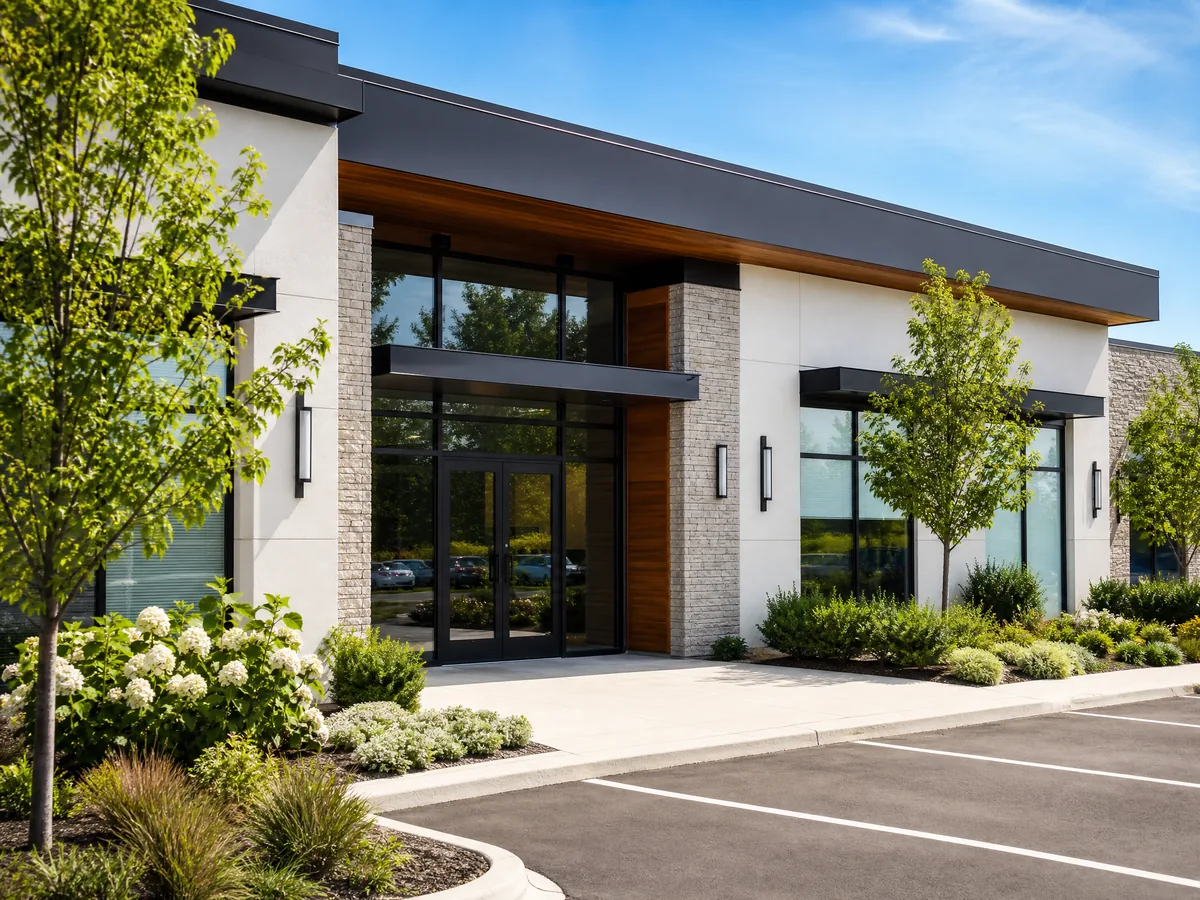
SBA loans for owner-occupied real estate across Washington DC.
When a deal calls for long-term, government-backed financing, we place SBA 7(a) and 504 loans through relationships with more than 20 SBA lenders, matching your scenario to the right program and the best terms. Across Washington DC, Maryland and Virginia, that means underwriting SBA's national occupancy and down payment rules against three separate deed recordation and transfer tax stacks, not one. Federal contracting and professional services firms cluster along Northern Virginia's Route 267 and I-395 corridors, and a business buying its own office or industrial space there closes on the lowest-cost stack of the three jurisdictions. Business-purpose only, and every structure is set in underwriting.
Typical figures, subject to underwriting and market conditions. Not a commitment to lend.
How it works
SBA loans offer low down payments and long amortizations for owner-occupied property and business acquisition. USA Mortgage arranges and places SBA financing through our network of partner lenders; we are not ourselves an SBA lender. We shop your file across that network so you get the strongest approval.
Does the 51% occupancy rule work the same way in the District as it does in Maryland or Virginia?
Yes, the federal rule does not change at any state or district line. Under 13 CFR 120.131, an existing building needs your business occupying at least 51% of the rentable space, with the rest free to lease out; new construction is stricter, at a 60% owner-occupancy floor, only 20% permanently leasable to a third party, and an absorption plan for the remainder. That test applies the same way to a District rowhouse office, a Bethesda medical suite, or an Arlington industrial building. What changes across the three jurisdictions is the carry cost once you own it, not the occupancy test to get the loan.
How much do closing costs differ between a District, Maryland and Virginia SBA purchase?
Virginia is by far the lowest-cost of the three to close in, and the District carries the highest deed tax stack. On a commercial or mixed-use deed, the District's combined recordation and transfer tax runs 2.9% of the price, 1.45% plus 1.45%, under DC Code 42-1103 and 47-903. Montgomery County, Maryland charges a tiered recordation tax that runs roughly 0.9% to 2.3% of the price depending on the purchase amount, on top of the state's 0.5% transfer tax and the county's own 1% transfer tax. Prince George's County, Maryland charges a 1.4% transfer tax that can also reach a non-purchase-money deed of trust, on top of a recordation tax near 0.55%. Virginia's state recordation tax is 0.25% of the price, with a local recordation tax of one-third of that and a 0.10% grantor tax, before any regional transportation fee that applies in some Northern Virginia jurisdictions. Run the arithmetic on your own purchase price and location before you budget the closing.
Does the District's commercial property tax class affect an SBA-financed building purchase there?
Your carry cost jumps as soon as the assessor moves the parcel into Class 2. The District taxes Class 2 commercial and industrial property at $1.65 per $100 of assessed value up to $5 million, $1.77 from $5 million to $10 million, and $1.89 above $10 million, all higher than the $0.85 Class 1A residential rate. An SBA 7(a) or 504 loan on an owner-occupied District building should be underwritten against the commercial rate on the property's full assessed value, not a lower residential rate a prior owner may have paid. Confirm the current tax year on OTR's own rate page before you close. Montgomery and Prince George's Counties in Maryland, and Arlington, Alexandria and Fairfax in Virginia, each set their own separate rate and none of them uses the District's class system.
Does an SBA loan on a District property get taxed again on top of the deed tax?
Not if it closes the way most SBA acquisitions do. DC Code 42-1102 exempts a purchase money deed of trust recorded at the same time as the deed conveying the property from the separate 1.1% security-instrument recordation tax that would otherwise apply to the loan amount. An SBA 7(a) or 504 acquisition loan recorded simultaneously with the deed gets that exemption in the District; a later-recorded cash-out refinance does not.
Does a building's size trigger an energy compliance obligation I need to budget for?
Yes, in the District and in Montgomery County, once the building crosses the size threshold. Under the District's Building Energy Performance Standards, privately owned buildings 10,000 square feet or larger must benchmark energy use annually and meet phased performance targets, with the first compliance cycles for the 10,000 to 25,000 and 25,000 to 50,000 square foot bands beginning in 2026. Montgomery County, Maryland runs its own program under Bill 16-21, covering privately owned commercial and multifamily residential buildings over 25,000 square feet, with deadlines set per building or through a filed improvement plan. No comparable local program was located for Prince George's County or for Arlington, Alexandria or Fairfax in Virginia. Either obligation travels with the building, not the seller, so it belongs in your sources and uses on a 504 or 7(a) purchase near the threshold.
If I hold my building through an LLC, does that change what I owe across the three jurisdictions?
It can, and the exposure is different in each one. In the District, the Unincorporated Business Franchise Tax runs 8.25% on DC gross receipts over $12,000, with a minimum tax of $250 on gross receipts of $1 million or less; an LLC holding an SBA-financed District building can owe that minimum even in a loss year. In Maryland, a nonresident entity, one not formed in Maryland or not registered with SDAT to do business there, has 8.25% withheld from its proceeds at the closing table on a future sale; registering the LLC with SDAT before you acquire the building is what avoids that withholding at exit. No comparable entity-level tax or withholding was located for Virginia in this pass. Talk to a CPA licensed in the jurisdiction where you are buying before you pick a structure. If a straight long-term purchase fits better than an SBA file, permanent CRE financing is worth comparing.
What is the smallest SBA loan you will place in the Washington DC metro?
$350K, and we place up to $5M and beyond. We work 7(a) and 504 through relationships with more than 20 SBA lenders and match the scenario to the program, on terms running up to 25 years at market SBA rates. The building has to be owner-occupied, which is the federal 51% test on an existing building and 60% on new construction, and that test does not change at the District, Maryland or Virginia line. Subject to underwriting.
How much do I put down on a Washington DC SBA purchase, and does that cover closing costs?
Financing runs up to 90%, so plan on roughly 10% down, and no, that is separate from closing costs. On a $2,000,000 building that is up to $1,800,000 financed and $200,000 from you (2,000,000 x 90% = 1,800,000). The closing stack on top is where the jurisdiction shows up: a commercial or mixed-use deed in the District carries 2.9% combined recordation and transfer tax, while Virginia's state recordation tax is 0.25% of the price with a smaller local share and a 0.10% grantor tax. Run it on your own price and location. Subject to underwriting.
More SBA Financing questions, answered on the program page
Local rules move. Every tax rate, fee, ordinance and market figure here comes from a primary source and carries the date we read it, and we correct them as the rules change. Where a number is mid-change or we could not verify it, we say so rather than guess. Before you commit a budget, confirm anything that drives it with the city or county, and talk to your attorney or CPA on questions of law or tax.
Published by USA Mortgage Funding, LLC, NMLS #152588. Researched from primary sources by our team, drafted with AI assistance, and every figure checked against its source before publishing. Where an answer rests on a public record, that record is linked under it. Figures read on 2026-08-15.
Funding Washington DC deals fast.
Get real terms, usually same day. No obligation, no hard credit pull to start.