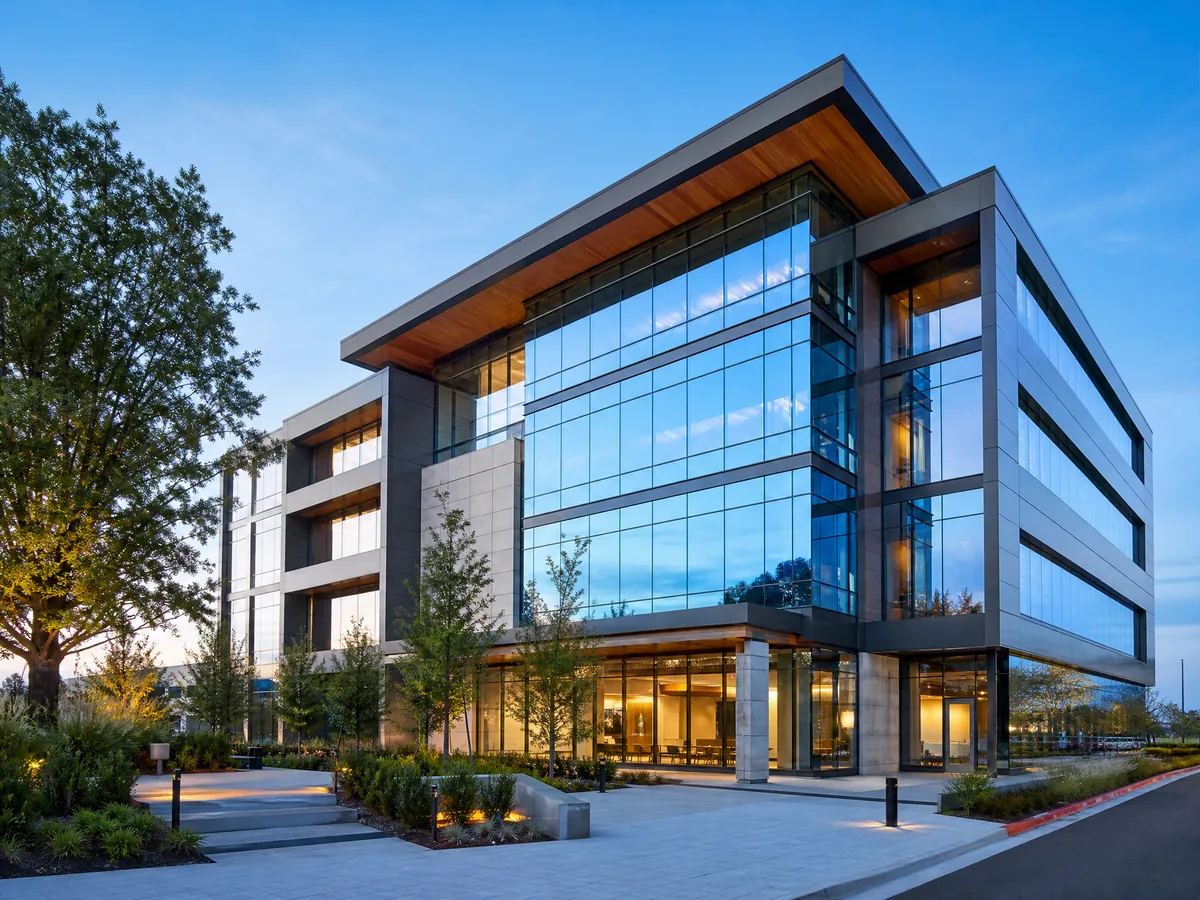
Commercial bridge loans across the Washington DC metro's office story.
Access equity or finance a project before permanent financing. Flexible commercial bridge across property types, with terms up to 24-36 months and loan sizes up to $10M. Across the Washington DC metro, that means underwriting a District office conversion against its own tax abatement, a Northern Virginia reposition against an assessor already re-coding office as apartments, and a Maryland asset against a building-performance deadline that travels with the property. Business-purpose only, and every structure is set in underwriting.
Typical figures, subject to underwriting and market conditions. Not a commitment to lend.
How it works
Use bridge capital to reposition an asset, buy out a partner, or stabilize before a refinance. We move quickly on commercial deals that banks find too time-sensitive. When the asset is stabilized, we refinance you out of the bridge and into long-term permanent debt, which we also place in house, so you have a clear exit from day one.
Is there real data behind converting Northern Virginia office into apartments, or is that a broker pitch?
Yes, and it comes from the assessor's own numbers, not a broker deck. Arlington County's adopted budget shows assessed office value falling 18.0% year over year for calendar year 2026, even as apartment value rose 6.0%, and part of that decline is Arlington re-coding office buildings approved for adaptive reuse as apartments before they're even converted. That is a government document pricing the office-to-apartment trade in Arlington County specifically, not a market narrative, and it is the strongest CRE signal in this metro. A bridge loan on an Arlington reposition should be underwritten against that documented shift, not against speculative office leasing.
Does the District actually subsidize an office-to-residential conversion, or is that just a headline?
Yes, through a real 20-year property tax abatement, not just a zoning allowance. The District's Housing in Downtown (HID) program authorizes a 20-year real property tax abatement for a change of use that produces at least 10 housing units, where at least 15% of those units are affordable, met as either 10% of units at 60% of median family income or 18% at 80%. The abatement authority is capped year by year: up to $2.5 million annually through fiscal year 2026, $6.8 million in fiscal year 2027, and $41 million in fiscal year 2028. Geography covers downtown plus parts of Dupont Circle, the West End, the East End and Foggy Bottom. Structure a District bridge loan on an eligible conversion with the abatement built into the sources and uses, and confirm current-year cap availability before you underwrite to it.
Which jurisdictions in this metro attach a building-performance deadline to the asset itself?
The District and Montgomery County, Maryland do; Northern Virginia currently does not. Under the District's Building Energy Performance Standards, privately owned buildings of 10,000 square feet or more must benchmark energy use, with compliance cycles for the largest buildings already running and evaluation and penalties beginning in 2027. Montgomery County's own Building Energy Performance Standards cover privately owned commercial and multifamily buildings over 25,000 square feet, with performance deadlines set per building or a filed improvement plan. No comparable Northern Virginia ordinance has been located, and Virginia's Dillon Rule structure makes one unlikely without state authority. A bridge borrower acquiring an older District or Montgomery County office or multifamily asset over these thresholds inherits a dated compliance obligation that belongs in the sources and uses, not the next owner's problem.
Is the pullback in federal employment actually driving this metro's office story, or is that overstated?
It's real, it's dated, and it isn't a forecast. Metro-area federal government employment stood at 313,300 jobs as of June 2026, down roughly a sixth since January 2025 to its lowest level in about three decades, and federal losses account for more than half of the metro's total job decline over the same year. Metro-area unemployment, meanwhile, moved only from 3.9% to 4.1% over that period, so this looks like a structural shift concentrated in one employment category rather than a broad collapse. Use it as backdrop for why office conversion has momentum across the District, Arlington and the Maryland suburbs right now, not as a prediction of further federal cuts or a claim about any specific building or submarket.
If a bridge deal doesn't perform, does the foreclosure process look the same in DC, Maryland and Virginia?
No, and the differences are large enough to affect how you underwrite the downside. The District of Columbia's foreclosure runs non-judicially under a power of sale, with a 30-day clock that starts when the Mayor receives the required notice, not when it is mailed; a mediation track exists but is keyed to loans secured by four or fewer single-family dwellings made to a natural-person borrower, so it does not reach an entity-held commercial bridge loan. Maryland's process is court-supervised and the slowest of the three: an action cannot even be filed until the later of 90 days after default or 45 days after the notice of intent to foreclose, and on non-owner-occupied property the pre-sale wait is at least 45 days after service, with the sale requiring circuit court ratification. Virginia is non-judicial and the fastest: a deed of trust on non-owner-occupied property, which covers a typical business-purpose bridge loan, sits on a 14-day notice track under Virginia law, against 60 days for owner-occupied residential property. Talk to jurisdiction-specific counsel before you rely on any of this for a specific deal.
What does the District's transfer and recordation tax stack cost on a bridge-to-permanent commercial deal?
2.9% combined on a commercial or mixed-use deed, but the District gives back real money if you structure the construction loan correctly. The District's deed recordation tax and deed transfer tax are each 1.45% on commercial and mixed-use property, 1.1% base plus a 0.35% additional rate, for 2.9% combined; the earlier 5% commercial rate expired October 1, 2023 and has not been reinstated. A security instrument, meaning a deed of trust, is separately taxed at 1.1% of the debt amount, but where the construction loan's deed of trust tax was properly paid at closing, the District taxes the permanent loan only on the amount by which the permanent debt exceeds the construction debt. That construction-to-permanent relief is real and belongs in your refinance math when a District bridge loan is designed to roll into permanent debt. Confirm the current rate and the relief mechanics with your closing attorney before you close.
Does my credit score decide a Washington DC commercial bridge loan, or does the property?
The property carries the file, and there is no minimum score on this program. We do run credit, but on an asset-based bridge loan it carries far less weight than at a bank, and weaker credit is usually handled with lower leverage rather than a decline. There is no hard credit pull to start. What we underwrite instead is the asset, the equity and the exit, including any compliance obligation that travels with the building rather than with the seller. Subject to underwriting.
How much equity do I need on a Washington DC commercial bridge loan?
About 25% of value. Max leverage is up to 75% LTV, interest-only, on a term of up to 24 to 36 months. On a $4,000,000 basis that is up to $3,000,000 from us and $1,000,000 from you (4,000,000 x 75% = 3,000,000). On an older District or Montgomery County building over the local energy-performance thresholds, put the compliance work into the sources and uses too, because that obligation comes with the asset. Subject to underwriting.
How large a bridge loan can you write in the Washington DC metro?
Up to $10M. That covers most of the reposition and conversion work moving here right now, including the Arlington office-to-apartment trade that the county's own assessed values already reflect. The structure can be a straight bridge or a cash-out, interest-only, running up to 24 to 36 months. Subject to underwriting.
More CRE Bridge questions, answered on the program page
Local rules move. Every tax rate, fee, ordinance and market figure here comes from a primary source and carries the date we read it, and we correct them as the rules change. Where a number is mid-change or we could not verify it, we say so rather than guess. Before you commit a budget, confirm anything that drives it with the city or county, and talk to your attorney or CPA on questions of law or tax.
Published by USA Mortgage Funding, LLC, NMLS #152588. Researched from primary sources by our team, drafted with AI assistance, and every figure checked against its source before publishing. Where an answer rests on a public record, that record is linked under it. Figures read on 2026-08-15.
Funding Washington DC deals fast.
Get real terms, usually same day. No obligation, no hard credit pull to start.