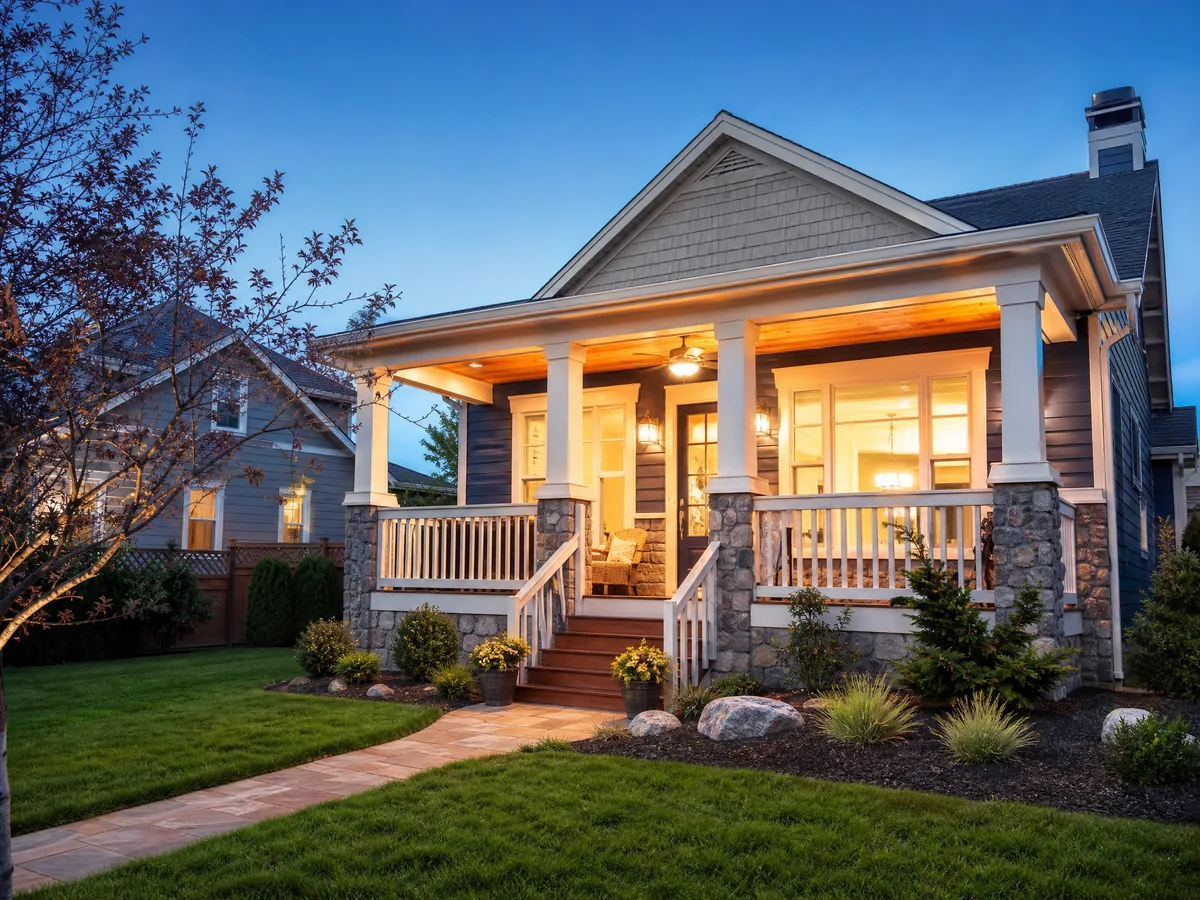
DSCR loans for California rentals, qualified on the property.
Hold your rentals with financing that underwrites the asset, not just you. DSCR from 0.75, credit from 640, and 30-year fixed or 5, 7 and 10 year ARM options. In California the tax line resets the day you buy and then climbs slowly. Business-purpose only, and every structure is set in underwriting.
Typical figures, subject to underwriting and market conditions. Not a commitment to lend.
How it works
No tax returns or personal income docs in most cases. We qualify on the property's cash flow, so you can scale your portfolio without the paperwork drag of conventional lending.
How does Prop 13 change the way I model a California rental?
Your tax line is set by what you pay, then capped at 2% growth. Article XIII A holds the ad valorem tax to 1% of full cash value, and full cash value is reappraised when the property is purchased, newly constructed or changes ownership. So the seller's assessed value does not carry over. Underwrite the tax at your purchase price, not the seller's bill, because that mistake is the single most common way a California DSCR pro forma comes in short. The upside is on the back end: once you own it the base rises by an inflationary rate not to exceed 2% a year, no matter what the market does, so a long hold gets a tax line that falls in real terms while rent moves. Effective bills add voter-approved debt levies that vary by county and district, and we do not publish county rate stacks we have not verified. Pull the actual bill for the parcel and hand it to underwriting.
Can I add an ADU to a California rental I already own?
Yes, and unlike the SB 9 lot split there is no owner-occupancy string attached. California ADU law was recodified in 2024 by SB 477 out of Government Code section 65852.2 into sections 66310 through 66342, so cite the new numbering. Applications are ministerial, with completeness review inside 15 business days and appeal decisions inside 60 days under 2025 legislation, and section 66315 prohibits local owner-occupancy requirements for ADUs. AB 1033, effective January 1, 2024, also lets a city opt in by ordinance to allow an ADU to be sold separately as a condominium under section 66342. For a DSCR borrower that is a straightforward density and value-add play on a parcel you are already holding: more units, more rent, a better coverage ratio on the refinance. Local objective standards and fees still apply, so confirm what your city has adopted before you budget the build. Financing the build itself is a construction loan conversation.
What happens to a California rental that gets inherited?
It is reassessed to market, which is why so many long-held rentals come to market at all. Proposition 19 took effect February 16, 2021 and narrowed the parent-child exclusion from reassessment so that it survives only for a principal residence, where the transferee also occupies it, and for family farms, subject to a value cap of current taxable value plus $1,000,000, adjusted biennially and reported at $1,044,586 as of February 2025. Prop 19 eliminated the exclusion for other real property. So an heir who inherits a rental that has been assessed on a 1980s base inherits the full market-value tax bill instead. That is a genuine driver of inherited-property sales, and if you are buying one, remember the reassessment lands on you at your price either way. Separately, owners 55 and over, severely disabled owners and disaster victims may port a base year value to a replacement home anywhere in the state, up to three times. Talk to your California CPA about your own situation.
I live out of state. Does my LLC owe California anything?
Yes. Owning a California rental means doing business here. Revenue and Taxation Code section 17941 keys the $800 annual LLC tax to doing business in California, and section 23153(d) is where the $800 figure lives. Section 17942 adds a gross receipts fee on total California income on top: $900 from $250,000 to under $500,000, $2,500 from $500,000 to under $1,000,000, $6,000 from $1,000,000 to under $5,000,000, and $11,790 at $5,000,000 or more. Total income is gross income plus cost of goods sold, so it is a revenue test, not a profit test. On a single rental the $800 is usually the whole story, and it is still $800 a year against the cash flow. We did not verify whether any first-year waiver currently applies, so do not assume one. That is a question for your California CPA, and it is worth asking before you form the entity rather than after.
Does California insurance pricing affect whether my DSCR deal pencils?
It can, and in wildfire ZIP codes it often does. DSCR sizes off net operating income, and insurance is part of that number, so a premium that reprices upward moves your coverage ratio directly. The FAIR Plan has grown to roughly 573,739 policies as of March 2025, with residential exposure around $696B by September 2025, and it writes basic named-peril dwelling fire coverage only, so a property placed there needs a companion policy for liability and other perils. Both premiums are underwritten into your NOI. The Sustainable Insurance Strategy trades catastrophe modeling in rate filings for a commitment to write at least 85% of statewide market share in wildfire-distressed ZIP codes, so availability is improving while price is not. Bring the actual binder or quote early. Regional exposure varies a lot, which is part of why Fresno DSCR and a coastal file look different.
What credit score do I need for a California DSCR loan?
640. That is the floor on this program, and it is a real underwriting line rather than a guideline, because the loan is qualified on the property rather than on your tax returns. Above the floor, score affects leverage and structure more than it affects the yes or no. There is no hard credit pull to start a file. If you are under 640 today, an asset-based fix and flip or bridge loan has no minimum score and can carry a project while you rebuild. Subject to underwriting.
How much do I put down on a California DSCR loan?
20% at maximum leverage. We go up to 80% LTV, so on a $500,000 Inland Empire purchase that is $400,000 from us and $100,000 from you (500,000 x 80% = 400,000). Coverage has to work too: DSCR from 0.75 means we will look at properties that do not fully cover debt service, but the ratio and the leverage move together. Reassessment at your purchase price under Prop 13 hits the expense side of that ratio, so model it before you set your offer. Metro rent and price detail sits on the metro pages, for example Riverside. Subject to underwriting.
What is the smallest California rental you can finance this way?
$100,000 is the floor and $3,000,000 is the ceiling. Below the floor a closing costs too much for both of us to make sense. Terms run 30-year fixed or 5, 7 and 10 year ARM, with flexible prepay structures so the exit you actually plan is the one you price. In much of coastal California the ceiling is the live constraint rather than the floor, and a single asset above $3,000,000 usually moves to a different program. Subject to underwriting.
More Rental / DSCR questions, answered on the program page
Local rules move. Every tax rate, fee, ordinance and market figure here comes from a primary source and carries the date we read it, and we correct them as the rules change. Where a number is mid-change or we could not verify it, we say so rather than guess. Before you commit a budget, confirm anything that drives it with the city or county, and talk to your attorney or CPA on questions of law or tax.
Published by USA Mortgage Funding, LLC, NMLS #152588. Researched from primary sources by our team, drafted with AI assistance, and every figure checked against its source before publishing. Where an answer rests on a public record, that record is linked under it. Figures read on 2026-08-12.
Funding California deals fast.
Get real terms, usually same day. No obligation, no hard credit pull to start.