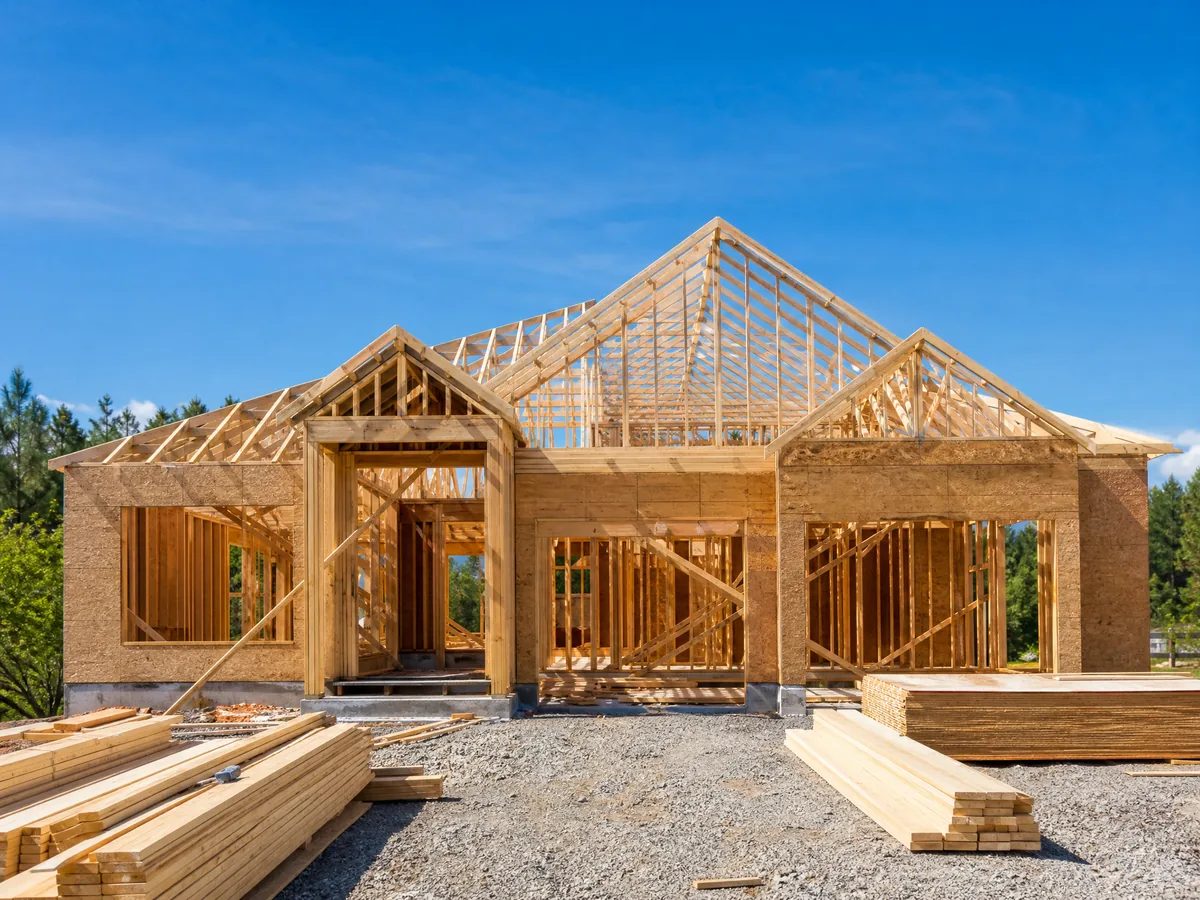
Ground up construction loans for California builders.
Built for spec builders and infill developers. We fund the land and the vertical build up to 70% LTV and 85% of cost, with draws that keep pace with the job. California has written ministerial approval into state law for small infill, which changes what a lot is worth. Business-purpose only, and every structure is set in underwriting.
Typical figures, subject to underwriting and market conditions. Not a commitment to lend.
How it works
We finance both the land and the vertical construction, with a draw schedule built around your timeline. Experienced builders can access higher leverage on cost.
Does SB 9 let me build two units on a single-family lot?
Yes, ministerially, and this is the half of SB 9 an investor can actually use. Government Code section 65852.21 requires local agencies to ministerially approve up to two units on a single-family parcel in an urbanized area, subject only to objective standards, and those standards may not force a unit below 800 square feet. The decision is due within 60 days. The limits are real: you cannot demolish rent-controlled, deed-restricted or tenant-occupied housing, cannot use it on a parcel withdrawn from rent control within a 15-year lookback, and cannot touch historic property. Rentals of SB 9 units must be for terms longer than 30 days, so there is no short-term rental play. Note what is not in this statute: the two-unit path carries no owner-occupancy affidavit. That requirement lives in the lot split statute, and the two are constantly conflated. Confirm your city's objective standards before you buy the lot.
Can I do an SB 9 urban lot split as a pure investor?
No, and this is the trap. Government Code section 66411.7 is the lot split half of SB 9. It gives you a ministerial parcel map splitting one lot into two of roughly equal area, with neither parcel below 40% of the original or under 1,200 square feet, and a 60-day decision. But the applicant must sign an affidavit that they intend to occupy one of the housing units as their principal residence for a minimum of three years from the date the lot split is approved. The only exemptions are community land trusts and qualified nonprofits. An investor who will not live there cannot sign it. Blogs and forum posts routinely attach that affidavit to the two-unit statute instead, and they are wrong. If your plan needs the split, the plan needs an owner-occupant. If it only needs the units, section 65852.21 has no such affidavit and is the path to look at. Run it past your land use counsel before you write the offer.
How does new construction get taxed under Prop 13?
The improvement is reassessed when it is built, not when you sell it. Article XIII A sets full cash value as the 1975-76 base or the appraised value when a property is purchased, newly constructed, or changes ownership, and caps the ad valorem tax at 1% of that value, with the base rising by an inflationary rate not to exceed 2% a year. On a ground up job that means two events, not one: your land purchase resets the land basis, and completion of the build adds the new improvement value on top. Effective bills add voter-approved debt levies that vary by county and district, so pull the actual rate stack for the parcel rather than assuming a flat 1%. On a 12 to 24 month build the carry is the number that matters, and it steps up partway through. Model it that way, and have your California CPA price the finished-value line before you set your budget. Metro absorption detail sits on the metro pages, for example Sacramento.
Will I be able to insure a California build in a wildfire area?
Get the answer before you close on the dirt. The FAIR Plan has grown to roughly 573,739 policies in force as of March 2025, up 74% from September 2023, and it writes basic named-peril dwelling fire coverage only, meaning a property placed there still needs a companion policy for liability and other perils. After the January 2025 Palisades and Eaton fires the FAIR Plan drew a $1B assessment from member insurers, and the Department of Insurance imposed the Insurance Code section 675.1 mandatory one-year moratorium on wildfire-risk cancellations and non-renewals of residential policies in affected ZIP codes from January 7, 2025. That tool is residential-specific and time-limited, and after the year non-renewal for wildfire risk resumes. Meanwhile the Sustainable Insurance Strategy is trading catastrophe modeling in rate filings for carrier commitments to write in distressed ZIP codes. Bring a real course-of-construction quote to underwriting, not a placeholder.
Who closes a California land purchase, and what does the transfer tax run?
An escrow company, and the transfer tax depends entirely on the city. California is an escrow state and no attorney is required at closing. Independent escrow companies are licensed by the DFPI under the Escrow Law, and in Northern California the title company typically runs escrow while in Southern California a separate escrow company usually sits alongside the title insurer. On tax, Revenue and Taxation Code section 11911 sets the county documentary transfer tax at 55 cents per $500, which is $1.10 per $1,000, so a $400,000 lot carries $440 at the base (400 x 1.10 = 440). Charter cities stack on top, and the City of Los Angeles alone runs $5.60 per $1,000 combined before Measure ULA. We do not publish a per-city table we have not verified, so confirm the rate for the city the lot sits in. See San Jose for that market's own detail.
What credit score do I need for a California construction loan?
There is no minimum score on this program. Construction is asset-based, so the file turns on the lot, the plans, the budget and the completed value. We do run credit, but it carries far less weight than it would at a bank, and weaker credit is usually answered with lower leverage rather than a decline. There is no hard credit pull to start. What moves the needle here is your builder, your schedule and whether your entitlements are actually in hand. Subject to underwriting.
How much do I need to put into a California ground up deal?
Plan on 15% of cost, and understand the value test sits alongside it. We fund up to 70% LTV and up to 85% of cost, whichever binds first. On a $2,000,000 total project cost, 85% is $1,700,000 from us and $300,000 from you (2,000,000 x 85% = 1,700,000), provided that number also clears 70% of value. Funds release as draws against the build schedule, so your equity generally goes in early, at the land. Budget the escrow, title and city transfer tax lines on the land close on top of that. Subject to underwriting.
How large a California build can you fund, and for how long?
Up to $5,000,000, on a 12 to 24 month term. That covers most infill, small subdivisions and the two-unit and ADU work state law has made ministerial. Experienced builders can access higher leverage within the program, and a first build is underwritten more conservatively rather than turned away. Match the term to a real schedule including plan check and inspections, not to the optimistic one. Subject to underwriting.
More Ground-Up Construction questions, answered on the program page
Local rules move. Every tax rate, fee, ordinance and market figure here comes from a primary source and carries the date we read it, and we correct them as the rules change. Where a number is mid-change or we could not verify it, we say so rather than guess. Before you commit a budget, confirm anything that drives it with the city or county, and talk to your attorney or CPA on questions of law or tax.
Published by USA Mortgage Funding, LLC, NMLS #152588. Researched from primary sources by our team, drafted with AI assistance, and every figure checked against its source before publishing. Where an answer rests on a public record, that record is linked under it. Figures read on 2026-08-12.
Funding California deals fast.
Get real terms, usually same day. No obligation, no hard credit pull to start.